
 Write a Review
Our Product / Services
Our offered Product range includes Flange Nuts, Castle Nuts, Castle Nut, Flange Slotted Nuts and Slotted Nuts.
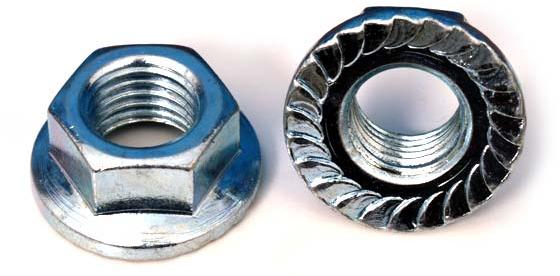
A Flange nut is a nut that has a wide flange at one end that acts as an integrated, non-spinning washer. This serves to distribute the pressure of the nut over the part being secured, reducing the chance of damage to the part and making it less likely to loosen as a result of an uneven fastening surface. These nuts are mostly hexagonal in shape and are made up of hardened steel and often coated with zinc.
Usability
The flange may be serrated to provide a locking action. The serrations are angled such that they keep the nut from rotating in the direction that would loosen the nut. Because of the serrations they cannot be used with a washer or on surfaces that must not be scratched. The serrations help in preventing the vibration of the nut from moving the fastener, thus maintaining the holding power of nut.
Specification
| Diameter | Thread | Standard | Class |
|---|---|---|---|
| M14 | Metric | IS, DIN, ISO | 10 |
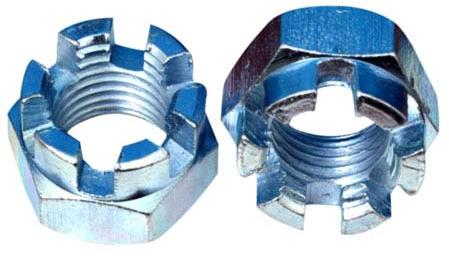
A castellated nut, also called a castle nut or slotted nut, is a nut with slots (notches) cut into one end.[1] The name comes from the nut’s resemblance to the crenellated parapet of a medieval castle.
The bolt or axle has one or two holes drilled through its threaded end. The nut is torqued properly and then, if the slot is not aligned with the hole in the fastener, the nut is rotated forward to the nearest slot. The nut is then secured with a split pin, R-clip or safety wire. It is apositive locking device. Castellated nuts are used in low-torque applications, such as holding a wheel bearing in place.
Specification
| Diameter | Thread | Standard | Class |
|---|---|---|---|
| M12 to M18 | Metric | IS, DIN, ISO | 8 |
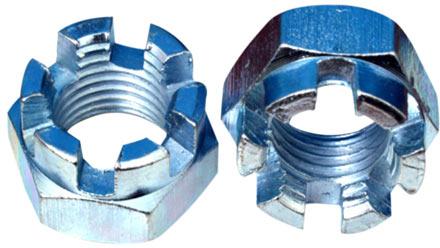
A castellated nut, also called a castle nut or slotted nut, is a nut with slots (notches) cut into one end.[1] The name comes from the nuts resemblance to the crenellated parapet of a medieval castle.
The bolt or axle has one or two holes drilled through its threaded end. The nut is torqued properly and then, if the slot is not aligned with the hole in the fastener, the nut is rotated forward to the nearest slot. The nut is then secured with a split pin, R-clip or safety wire. It is apositive locking device. Castellated nuts are used in low-torque applications, such as holding a wheel bearing in place.
| Diameter | Thread | Standard | Class |
|---|---|---|---|
| M12 to M18 | Metric | IS, DIN, ISO | 8 |
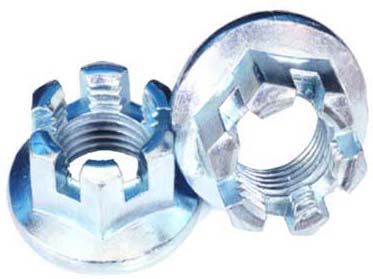
A Flange nut is a nut that has a wide flange at one end that acts as an integrated, non-spinning washer. This serves to distribute the pressure of the nut over the part being secured, reducing the chance of damage to the part and making it less likely to loosen as a result of an uneven fastening surface. These nuts are mostly hexagonal in shape and are made up of hardened steel and often coated with zinc.
Usability
The flange may be serrated to provide a locking action. The serrations are angled such that they keep the nut from rotating in the direction that would loosen the nut. Because of the serrations they cannot be used with a washer or on surfaces that must not be scratched. The serrations help in preventing the vibration of the nut from moving the fastener, thus maintaining the holding power of nut.
Specification
| Diameter | Thread | Standard | Class |
|---|---|---|---|
| M14 | Metric | IS, DIN, ISO | 8 |
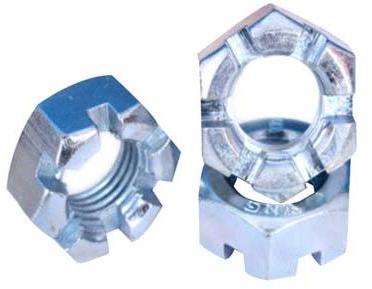
A Slotted Nut (sometimes called a castle nut because it resembles the top of a castle) is a nut that is designed to be held in place with a cotter pin.
Specification
| Diameter | Thread | Standard | Class |
|---|---|---|---|
| M10 to M18 | Metric | IS, DIN, ISO | 8 |
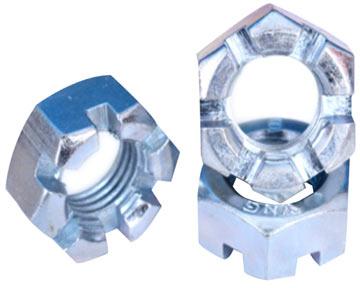
A slotted nut (sometimes called a castle nut because it resembles the top of a castle) is a nut that is designed to be held in place with a cotter pin.
 Mr. Tanuj Gupta (YNG Steels Limited)
 8/33, 3rd Floor, WEA,
Sat Bhrawan School Marg
Karol Bagh. New Delhi-110005, India
8/33, 3rd Floor, WEA,
Sat Bhrawan School Marg
Karol Bagh. New Delhi-110005, India Share us via