Our Products
We are leaders in the market for providing best range of Flakiness Gauge and Elongation Gauge
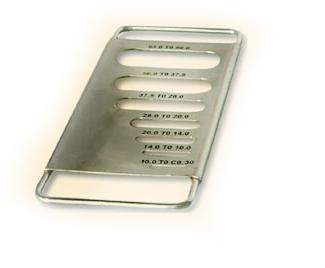
For determination of flakiness index of coarse aggregate, where the size of the coarse aggregate are larger than 6.3mm .
REFERENCE STANDARDS
IS : 2386 (Part I) 1963 Method of test for aggregates for concrete (Part I) Particle size and shape.
EQUIPMENT & APPARATUS
Thickness gauge
Sieves [63, 50, 40, 31.5, 25, 20, 16, 12.5, 10 & 6.3mm]
Balance [0-10 kg]
Thickness Gauge
PREPARATION SAMPLE
Surface dry samples is used for the test. A minimum number of 200 pieces of any specified fraction is required to do the test.
PROCEDURE
1. The sample is sieved through IS sieve specified in Table shown below.
2. A minimum of 200 pieces of each fraction is taken and weighed.
3. In order to separate flaky materials, each fraction is then gauged individually for thickness on a thickness gauge.
4. The total amount of flaky material retained by the thickness gauge is weighed to an accuracy of 0.1% of the weight of sample.
CALCULATION
In order to calculate the flakiness index of the entire sample of aggregates, first the weight of each fraction of aggregate passing and retained on the specified set of sieves is noted (Y1, Y2, Y3, Y4.etc). Each piece of these are tried to be passed through the slot of the specified thickness of the thickness gauge are found and weighed (y1, y2, y3, y4etc). Then the flakiness index is the total weight of the material retained on the various thickness gauges, expressed as a percentage of the total weight of the sample gauged.
REPORT
Flakiness index is reported in percentage to the nearest whole number

Elongation index of an aggregate is the percentage by weight of particles whose greatest dimension (length) is greater than one and four-fifth times their mean dimension. It is measured on particles passing through mesh size of 63mm and retained on mesh size of 6.3mm. Determination of elongation index of coarse aggregate is explained below.
Apparatus required:
Apparatus required for elongation index determination tests are balance, elongation gauge (length gauge) and IS sieves of the following mesh sizes 63mm, 50mm, 40mm, 31.5mm, 25mm, 20mm, 16mm, 10mm and 6.3mm.
Procedure of the test:
1. Take enough quantity of dry blended sample so that at least 200 pieces of any fraction is present. This is not applicable for the biggest and smallest size.
2. Sieve the blended sample through all the sieves mentioned above starting from the largest sieve i.e. 63mm.
3. Separate all the individual fractions 63mm to 50mm, 50mm to 40mm, 40mm to 25mm, 25mm to 20mm, 20mm to 16mm. 16mm to 12.5mm. 12.5mm to 10mm and 10mm to 6.3mm.
4. Take all the fraction separately, gauge them one by one through the corresponding slot provided in the gauge. Keep the particles retained by the length separately. The aim should be to retain as much as possible to avoid testing bias.
5. Weigh the particles retained on length gauge.
6. Elongation index is the total weight of the material retained on the various length gauges, expressed as a percentage of the total weight of the sample gauged.
Calculations:
Elongation index of aggregate in % is calculated as follows:
Where, W1 = weight of particles retained in length gauge (grams). W2 = weight of total sample taken for test (grams).
Reporting of Test Results:
Report the elongation index in percentage rounded off to the nearest whole number. For determination of Elongation index of coarse aggregate as per BS code, look for BS812: Section 105.2
 Ace Engineering & Scientific Equipment (Ace Engineering & Scientific Equipment)
 Mahalaxmi Co-op Hsg soc, Shop no: 1, 433, New Mangalwar Peth (Final plot no: 38, somwar peth) next to Ladkat petrol pump, -, Pune, Maharashtra - 411011
 Share us via







 Write a Review