Our Products
Our offered Product range includes LE Chatelier Flask, Aggregate Crushing Value, Brass Sieves, Reliable Automatic Compensator and Marshall Stability.
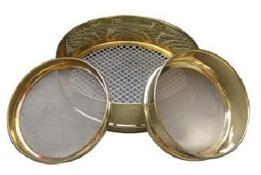
Standard Test Sieves help in ascertaining possible frost action, determining graded, filters, selection of groating materials, designing of Cement and Asphaltic, Concrete mixes etc. Coarse Test Sieves: Diameter 300mm or 450mm. made of G.I sheet frame with joint, fitted With steel perforated square openings.
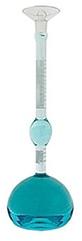
To determine the specific gravity is normally defined as the ratio between the weight of a given volume of material and weight of an equal volume of water. To determine the specific gravity of cement, kerosene which Does not recent with cement is used.
APPARATUES
Le Chaterliers flask, weighing balance, kerosene (free from water).Le Chaterliers flask, is made of thin glass having a bulb at the bottom. The capacity of the bulb is nearly 250 ml. The bulb is 7.8 cm in mean diameter. The stem is graduated in millimeters. The zero graduation is at a distance of 8.8 cm from the top of the bulb. At 2 cm from the zero, there is another bulb is of length 3.5cm and capacity 17 ml. At 1 cm from bulb, the stem is marked with 18 ml and is grated up to 24 ml. The portion above 24ml mark is in the form of a funnel of diameter 5cm.
PROCEDURE
(I) Dry the flask carefully and fill with kerosene or naphtha to a point on the stem between zero and 1 ml.
(II) Record the level of the liquid in the flask as initial reading.
(III) Put a weighted quantity of cement (about 60 gm) into the flask so that level of kerosene rise to about 22 ml mark, care being taken to avoid splashing and to see that cement does not adhere to the sides of the above the liquid.
(IV) After putting all the cement to the flask, roll the flask gently in an inclined position to expel air until no further air bubble rise3s to the surface of the liquid.
(V) Note down the new liquid level as final reading.
OBSERVATION AND CALCULATIONS
(I) Weight of cement used =W gm
(ii)Initial reading of flask =V1 ml
(iii)Final reading of flask =V2 ml
(iv)Volume of cement particle= V2-V1 ml
(v)weight of equal of water= ( V2-V1) x specific weight of water.
(vi)Specific gravity of cement = (Weight of cement/ Weight of equal volume of water) = W/(V2-V1)
NOTE
(I) Duplicate determination of specific gravity should agree within 0.01.
(II) To get more accurate result, the flask should be held in a constant temperature before each reading is taken.
RESULT
Specific gravity of a sample of cement
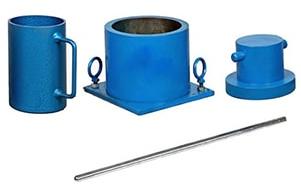
This test helps to determine the aggregate crushing value of coarse aggregates as per IS: 2386 (Part IV) 1963. The apparatus used is Cylindrical measure and plunger, Compression testing machine, IS Sieves of sizes 12.5mm, 10mm and 2.36mm
Procedure to determine Aggregate Crushing Value
i) The aggregates passing through 12.5mm and retained on 10mm IS Sieve are oven-dried at a temperature of 100 to 110oC for 3 to 4hrs.
ii) The cylinder of the apparatus is filled in 3 layers, each layer tamped with 25 strokes of a tamping rod.
iii) The weight of aggregates is measured (Weight A).
iv) The surface of the aggregates is then leveled and the plunger inserted. The apparatus is then placed in the compression testing machine and loaded at a uniform rate so as to achieve 40t load in 10 minutes. After this, the load is released.
v) The sample is then sieved through a 2.36mm IS Sieve and the fraction passing through the sieve is weighed (Weight B).
vi) Two tests should be conducted.
Aggregate crushing value = (B/A) x 100%.
 Ace Engineering & Scientific Equipment (Ace Engineering & Scientific Equipment)
 Mahalaxmi Co-op Hsg soc, Shop no: 1, 433, New Mangalwar Peth (Final plot no: 38, somwar peth) next to Ladkat petrol pump, -, Pune, Maharashtra - 411011
 Share us via







 Write a Review


