 Write a Review
Our Products
We offer a complete product range of Tinned Copper Bus Bar and Copper Bus Bar
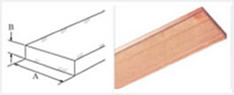
We manufacture and export Tinned Copper Bus bar. In electrical power distribution, a bus bar is a strip of copper or aluminium that conducts electricity within a switchboard, distribution board, substation or other electrical apparatus.The size of the bus bar determines the maximum amount of current that can be safely carried. Bus bars can have a cross-sectional area of as little as 10 mm2 but electrical substations may use metal tubes of 50 mm in diameter (1, 963 mm2) or more as bus bars.
Silver, tin (Tinned Copper Bus bar) or nickel plating for copper bus bars is necessary in high temperature applications. At DC to 60Hz there is some controversy as to which plating is the best because while silver has the highest conductivity, it is also more noble than copper so it will actually accelerate corrosion wherever the plating gets scratched. Thus, you don't want to just use toothed lock washers, for example, in between a nut and the bus bar (i.e. - use a flat washer, too).
Tin plating Tinned Copper Bus bar is an excellent solution practically speaking, because it protects the copper, has reasonably low resistance (higher than silver or copper but lower than nickel) and can be easily applied yourself using "electro less" plating kits such as "TINNIT".
Tin (non-lead bearing) solder can work, but it may sweat at a higher temperature. Having someone with a hobby plating set-up will make it work better. Alternatively, buying a hobby plating transformer and some acid and cyanide will provide you the ability to do it at will. Nickel is the metal of choice. It is used to 'flash' the copper bar material, prior to plating with silver, and thus prevent corrosion by 'sealing the surface of the copper. Then fine silver is used to do the final plate, but the copper is a naturally oxidizing metal, that is why it is noted for its 'green patina' and why the planet Venus is considered the Goddess of Copper. If it is just straight plated with silver, it would be useless as the corrosion will start and the bar will blister with copper oxide and shed the silver. Nickel and silver don't melt like tin will at a temperature under 1000 degrees. (Nickel = @1100 deg f, Silver = 1470 deg f)
If you have access to a good metal cutting blade and jig-saw or a scroll-saw with a metal cutting blade, buy a sheet in the desired thickness. It's cheaper and you can customize your needed 'bar'. You can then also use a propane torch to 'anneal the copper to work or bend it. A hand drill with some good sharp bits will always provide good puncturing capabilities for necessary holes.
If using it for battery terminals, make sure the batteries are well secured and the battery boxes are solid so that the batteries do not shift around or flex relative to each other during driving. Favour a bus bar that is fairly thin but wide (to get enough conductivity) and design them with "kinks" in the middle so that they can allow slight movement between the batteries.
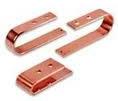
We also make different shapes of Bus Bars in Tin Plating
| Conductor Size mm | Product Code |
| 12 x 3 | E12-CBB - 123 |
| 20 x 3 | E12-CBB - 203 |
| 20 x 5 | E12-CBB - 205 |
| 25 x 3 | E12-CBB - 253 |
| 25 x 4 | E12-CBB - 254 |
| 25 x 5 | E12-CBB - 255 |
| 25 x 6 | E12-CBB - 256 |
| 30 x 5 | E12-CBB - 305 |
| 31 x 25 | E12-CBB - 3125 |
| 38 x 3 | E12-CBB - 383 |
| 38 x 4 | E12-CBB - 384 |
| 38 x 6 | E12-CBB - 386 |
| 40 x 3 | E12-CBB - 403 |
| 40 x 5 | E12-CBB - 405 |
| 40 x 6 | E12-CBB - 406 |
| 40 x 10 | E12-CBB - 401 |
| 50 x 5 | E12-CBB - 505 |
 Ujjwal Shah (Amiable Impex)
 1, Kiranbulding, Kiran Neela Rashmi CHSL, Opp. Swami Narayan Mandir, Premnagar, Borivali - West Mumbai - 400092, Borivali West, Maharashtra
 Share us via