 Write a Review
Our Products
Our offered Product range includes K Type Thermocouple and E Type Thermocouple.
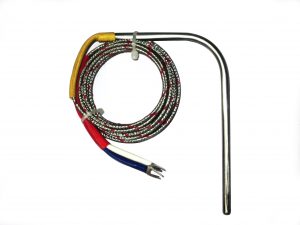
K Type Thermocoupleis the most common type of thermocouple. It is reliable, inexpensive, and accurate and its temperature range is wide. It is mostly used in nuclear applications due to the relative radiation hardness. The maximum temperature (continuous) is nearly 1, 100C.
These types of thermocouples are used widely in the industry. They have very good resistance to oxidation and high thermopower. They provide us withcorrect temperature monitoring in the range between -200C and 1370C (-328F to 2498F). They consist of nickel-5% aluminum and silicon (-) wire vs. nickel-10% chromium (+) wire. One should use this kind of thermocouple in oxidizing or inert atmospheres.The heating elementlikeelectric heatersis the best source to heat it up.
They are mostly used at temperatures over 540C (1004F) because of the higheroxidation resistance as compared to J, T or E types of thermocouples.
The range of K Type Thermocouple :
Extension wire Between 32 F and 392 F (0C to 200C)
Thermocouple grade wire Between 454 F and 2, 300 F (270C to 1260C)
Accuracy (which will be greater) :Special Limits of Error +/- 1.1C or 0.4%
Standard +/- 2.2C or +/- .75%
Names of Elements :
For describing the positive element of this type of thermocouple (KP), following names can be used: ThermoKanthal-KPs, HAI-KP1, Tophel+, Nickel-chrome, Chromel2, and T-13.
The negative element of this type of thermocouple (KN), is described by these names: ThermoKanthal-KNs, HAI-KN1, T-2s, Nial+, Nickel-silicon, and Alumel2.
Cautions to Take:
Some conditions should be avoided while usingthis type ofK thermocouple. It should not be used in vacuum applications because of the vaporization of chromium in the positive element. Also, it is not supposed to be used in the sulphurous environment as both of the elements will corrode rapidly and eventually the negative element will fail mechanically because of being brittle.
One should also avoid reducing atmospheres. The green-rot phenomenon can be caused due to low oxygen levels. In this phenomenon, chromium in elements will start oxidizing which cause very large negative drifts in calibration.
Take a look here as well, actually, If you are a wholesaler then you can have direct contact to thermocouple manufacturers near your area for bulk order.
Type K Thermocouplesare specified at the time whenmetallurgywas not as advanced as it is nowadays. As a result, the characteristics can vary extensively between samples. Nickel which is the constituent metal of K type thermocouple is magnetic. Thermocouples made with magnetic material have a characteristic that they are subjected to a deviation in output whenever the Curie point is reached by the material. This happens withthermocouple type kat nearly 185C.
Hope you like the content and him information given by us. If still have any query about the product or anything then dont forget to contact us.
FEATURE:-
Product Details:
Minimum Order Quantity:6 Piece
Power(Watts):As per requirement of application
Voltage:As per requirement of application
Size:As per requirement of application
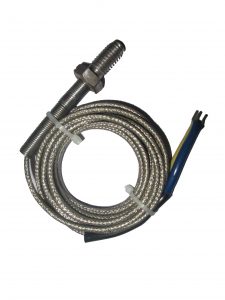
E Type Thermocouple
Thermocouples work as a temperature sensors for control and measurement. They are also used for converting a temperature gradient into electricity. There are two legs made of two different metals wires. These two legs/wires are bonded through welding, and at one end. This joint may be termed as a junction. This junction is the point where temperature finally gets read. Once you have measured something and there is a slight change, you will yourself feel change of voltage.
Different characteristics are possessed by different types of Thermocouples. Here we will discuss the features and limitations ofE Type Thermocouple.Everyone knows that if you are making any thermocouple product thenheating elementis very necessary, as I recommend to useelectric heatersin such cases if want proper heat on the same time.
E Type Thermocouple :
E Type Thermocouplehas potent to catch the signals with better and higher accuracy.
Range of E Type Thermocouple :
Extension wire 32F to 392F which is equal to 0C to 200C
Thermocouple grade wire -454F to 1600F which is equal to -270C to 870C
Accuracy (which will be greater) :
Special limits of error +/-1.0C or 0.4%
Standard +/- 1.7C or +/- 0.5 %
Limitations :
The sensitivity of thermocouple is comparatively small as compared to other types. This is so based on the reading of tens of microvolsts which are measured in Celsius. For better and clearer reading, you would need an offset amplifier, to read usable readings. You will surely need circuits or tables to measure things in better and efficient way. They have lower thermal mass. It may not read temperatures beyond 2300C.
The wires are well insulated and work efficiently. They are not insulated at the junction. If additional contacts are made or other objects are brought in between, it may affect the reading it finally gives.
Benefits and Uses:
Though there are multiple limitations with E-type thermocouple, yet they are worth use. The most commonly used sources, where such thermocouples are installed are:-
If want to give the order in bulk, so direct contact to thethermocouple manufacturers.
Conclusion :
While thinking of investing on thermocouples, for commercial uses, be easy as they are inexpensive and are interchangeable. They come with standard connectors. They are capacitated to measure wide temperature ranges. They are indeed very different than the other devices, used for measuring temperatures. They need not have an external or additional stimulant. Yes, temperatures may not be read accurately and readings are indeed compromised. But this limitation is based on the difference of one degree Celsius only.
In spite of too much of criticism, thermocouple and its variants are still used. Apart from this, If you have any query regarding product, dont feel shy to contact us in such cases.
Product Details:
Minimum Order Quantity: 6 Piece
Power(Watts): As per requirement of application
Voltage: As per requirement of application
Size: As per requirement of application
Features:
 Antique Heating Elements (Antique Heating Elements)
 Plot no - 242 & 243, Rajendra Nagar Industrial Area , Mohan Nagar , Ghaziabad (201001), Uttar Pradesh
 Share us via








