 GST : 24ABACA4824G1Z2
 Write a Review
Our Product / Services
We are leaders in the market for providing best range of 2 Way Stainless Steel Solenoid Valve
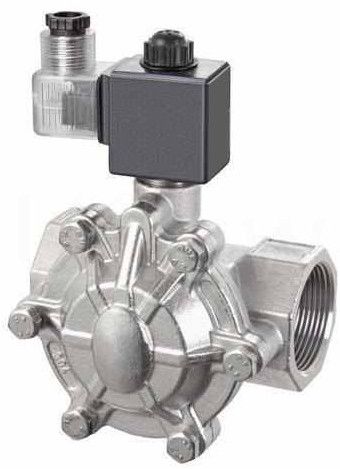
Industrial Valves
Industrial valves are mechanical devices used to control the flow and pressure of liquids, gases, and slurries within a system. These valves are essential components in various industries, including oil and gas, chemical processing, water treatment, power generation, and manufacturing. The selection of the appropriate valve type is critical for ensuring efficient and safe operation of industrial processes.
Types of Industrial Valves
1. Gate Valves:
Used to start or stop the flow of fluid.
Operate by lifting a gate out of the path of the fluid.
Suitable for applications requiring full flow or no flow and minimal pressure drop when fully open.
2. Globe Valves:
Used for regulating flow in a pipeline.
Feature a movable disk-type element and a stationary ring seat in a generally spherical body.
Provide good throttling capabilities and are commonly used in applications where flow control is required.
3. Ball Valves:
Use a spherical ball with a hole through the center to control the flow.
Offer quick shutoff and are ideal for applications requiring tight sealing and minimal leakage.
Suitable for on/off control without pressure drop.
4. Butterfly Valves:
Feature a rotating disk that opens and closes to control flow.
Provide a compact design and are suitable for applications requiring quick operation and minimal space.
Commonly used in water supply, wastewater treatment, and HVAC systems.
5. Check Valves:
Allow fluid to flow in one direction only, preventing backflow.
Operate automatically without any external control.
Used in applications where backflow prevention is critical, such as pumps and compressors.
6. Diaphragm Valves:
Use a flexible diaphragm that moves up and down to control flow.
Provide excellent shutoff and are suitable for handling corrosive fluids, slurries, and applications requiring sanitary conditions.
Common in pharmaceutical, food and beverage, and chemical processing industries.
7. Needle Valves:
Feature a small port and a threaded, needle-shaped plunger for precise flow control.
Suitable for applications requiring fine adjustments of flow rates, such as in instrumentation and sampling systems.
8. Pressure Relief Valves:
Designed to release pressure automatically when it exceeds a predetermined limit.
Ensure safety by preventing overpressure conditions.
Widely used in boilers, pressure vessels, and piping systems.
9. Solenoid Valves:
Electrically operated valves that use a solenoid to control the opening and closing of the valve.
Offer quick and precise control and are commonly used in automation systems and control processes.
10. Plug Valves:
Use a tapered or cylindrical plug to regulate flow.
Provide a simple design with quick operation and tight sealing capabilities.
Suitable for handling liquids with suspended solids.
Applications of Industrial Valves
Oil and Gas Industry: Control the flow of crude oil, natural gas, and refined products in pipelines, refineries, and offshore platforms.
Chemical Processing: Manage the flow of corrosive and hazardous chemicals in reactors, separators, and storage tanks.
Water Treatment: Control water flow in treatment plants, distribution systems, and wastewater facilities.
Power Generation: Regulate steam, water, and fuel flow in power plants, including nuclear, fossil fuel, and renewable energy plants.
Manufacturing: Control the flow of various fluids in production processes, machinery, and equipment.
Selection Criteria for Industrial Valves
1. Type of Fluid:
Consider the properties of the fluid, including corrosiveness, viscosity, temperature, and pressure.
2. Flow Requirements:
Determine whether the application requires on/off control, throttling, or backflow prevention.
3. Pressure and Temperature Ratings:
Ensure the valve can withstand the operating pressure and temperature conditions of the system.
4. Material Compatibility:
Select valve materials that are compatible with the fluid and the operating environment to prevent corrosion and degradation.
5. Size and Configuration:
Choose the appropriate valve size and connection type (flanged, threaded, welded) for the system.
6. Maintenance and Accessibility:
Consider the ease of maintenance and accessibility for inspection and repair.
7. Automation and Control:
Determine if the valve requires manual operation or if it should be integrated into an automated control system.
Maintenance and Safety Practices
Regular Inspections: Conduct routine inspections to check for leaks, wear, and proper operation.
Lubrication: Ensure moving parts are properly lubricated to reduce friction and wear.
Pressure Testing: Perform pressure tests to verify the integrity and performance of valves.
Calibration: Calibrate control and relief valves regularly to ensure accurate operation.
Training: Train personnel on proper valve operation, maintenance procedures, and safety protocols.
Industrial valves are vital components in controlling the flow of fluids within various industrial systems. By selecting the right valve type and maintaining them properly, industries can ensure efficient, safe, and reliable operation of their processes.
 Mr. Purval Patel (Aspal Engineering Private Limited)
 B-38, Dev I Land, Near Zaveri Estate, Singarva, OPP. Karma Estate, Kathwada, Ahmedabad, Gujarat - 382430
 https://www.aspalengineering.co.in
 Share us via