
My ExportersIndia

For Buyer

For Seller

For Help

Our Products

  1. Power Supply System 4 Products available
  2. Electronic Components 4 Products available
  3. Transistors 3 Products available
  4. Transformers 2 Products available
  5. Diodes 2 Products available
  6. Measuring Instruments & Equipment 2 Products available
  7. Laboratory Equipments 2 Products available
  8. Audio Video System 2 Products available
  9. Inverters 2 Products available
  10. Laboratory Apparatus 1 Products available
  11. Inverters, UPS & Converters 1 Products available
  12. Signs 1 Products available
  13. Filters 1 Products available
  14. Safety System & Equipments 1 Products available
  15. Cordless Phone 1 Products available
  16. Mobile Phone & Accessories 1 Products available
  17. Microphones 1 Products available
  18. Gates 1 Products available
  19. Battery Chargers 1 Products available
  20. Lab Instrument 1 Products available
  21. Others Products 68 Products available

Our Products

We offer the best product range of Op-Amp IC 741 Application and Characteristics (Parameter) Trainer SB-913, P,PI,PID Control System- Temperature Control SE-1027, 4:1 Multiplexer & 1:4 Demultiplexer SD-311, Signal Generator Demonstrator SE-806 and QAM Modulation & Demodulation SB-224.
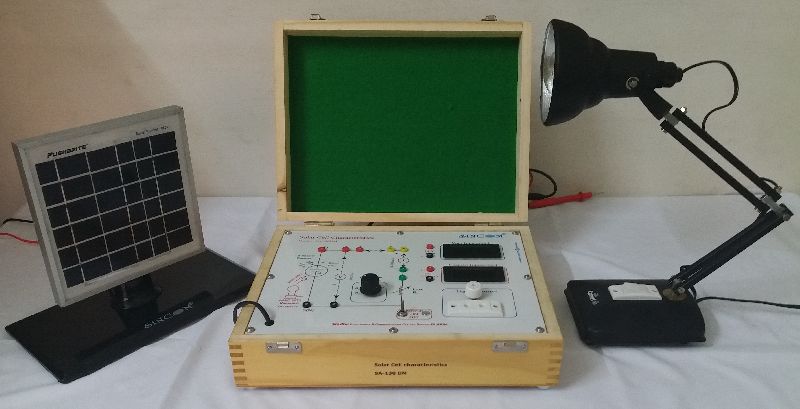
Solar Cell Characteristics SA-130

The Trainer has DC 0-12V/500mA (1 No.) Variable Power supply, Solar Cell of @ 6V mounted on the Panel , Variable light intensity applied to the sell to study its V-I characteristics  and Test Points  for connecting the meters in circuit.

Objectives :

  • To Study the characteristics of Solar Cell.
  • To Observe & Note the Change in Voltage across Solar Cell w.r.t. change in intensity of light


Accessories Included :  

  • Set of Patch Cords, Lamp load, Operating Manual
  • In Built Digital Meters options are also available on demand
View Complete Details

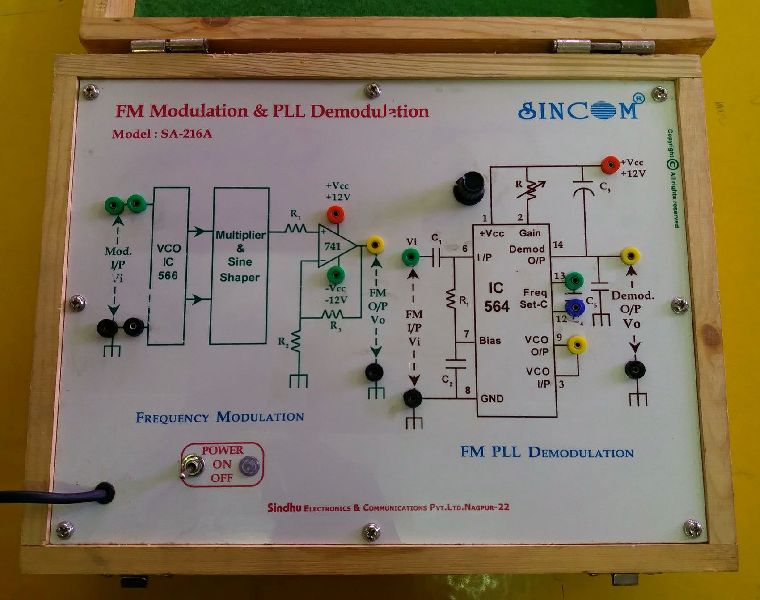
Frequency (FM) Modulation And Demodulation Using PLL IC 565 SA-216

FM Modulation - The monolithic function generator IC and Op-Amp IC 741 as non-inverting amplifier wired with Resistors & Capacitors to generate carrier internally and to provide Frequency modulated (FM) output for applied modulating input. facility to adjust the modulation index. fixed Carrier frequency about 1 MHz generated internally.   FM Demodulation: The PLL IC 565 wired with RC network and higher order filter to form a FM demodulation circuit using PLL IC to provide demodulated output for applied FM input. FM detector bandwidth upto 3KHz, facility to change the VCO free running and locking frequency. Built-in fixed DC ±12V/500mA Power supply and maximum test points for studying the experiments. 
Objectives :

  • To Study Principle & circuit of Frequency modulation (FM) and observe it’s FM waveforms.
  • To observe & note the change in FM O/P w.r.t. change in modulating I/P signal.
  • To determine Modulation index, Bandwidth, sidebands & frequency deviation of FM O/P.
  • To Study PLL IC565 as Frequency Demodulation.
  • To Observe the change in the change in the O/P w.r.t. change in Modulating I/P.
  • To observe and note the change in the O/P w.r.t. change in free running frequency of VCO.


Accessories Included :  

  • Set of Patch Cords, Operating Manual
  • In Built Test Signal generators options are available on demand.
View Complete Details

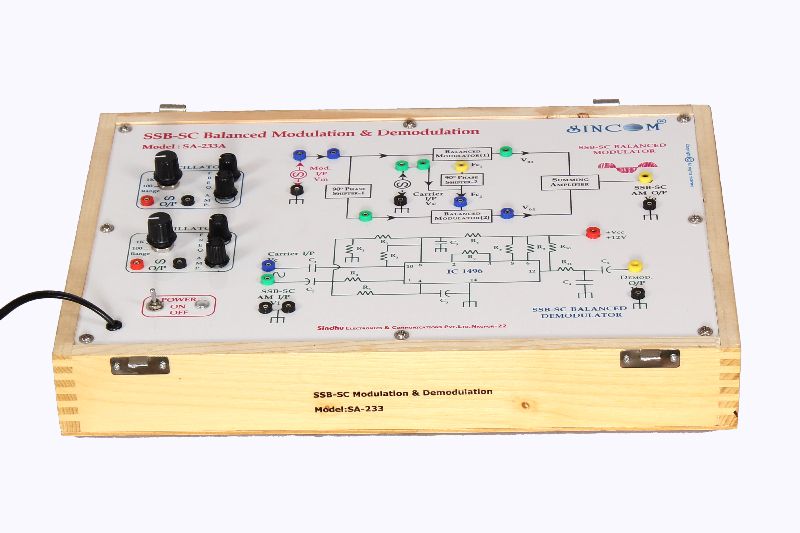
SSB-SC Modulation & Demodulation SA-233

SSB-SC Modulation - The circuit has two Balance modulators wired using IC 1496, two 900 RC Phase shift networks and OP-AMP IC 741 as summing amplifier. The external modulating signal and carrier signal are applied as an inputs directly to one Balance modulator and through 900 RC phase shifter to another Balance modulator to provide Balance modulator output which after summing network provides SSB-SC AM Balance modulator output. Maximum modulating frequency 10KHz, Maximum carrier frequency 100KHz, Built-in fixed DC ±12V/500mA Power supply and maximum test points.
SSB-SC Demodulation - The circuit uses IC 1496 wired with RC components and filter network as a SSB-SC Balance Demodulator to provide the demodulated AF output for the applied SSB-SC input. Maximum modulating frequency 10KHz, Maximum carrier frequency 100KHz, Bandwidth 3KHz, Built-in fixed DC +12V/500mA Power supply and maximum test points. Sine wave signal generators (2Nos) variable upto 100KHz frequency and 10Vpp amplitude.

Objectives :

  • To study the SSB-SC Balanced Modulator circuit. To observe the single side band output with a suppressed carrier signal. To observe and note the change in SSB output w.r.t. change in modulating & carrier signal.
  •  To study the SSB-SC AM Balanced Demodulator circuit. To observe and note the change in Demodulated output w.r.t. change in modulating. To observe the change in the demodulated w.r.t. change in carrier signal.


Accessories Included : Set of Patch Cords, Operating Manual.
View Complete Details

TDM-Pulse Amplitude Modulation (2 Channel) Modulation And Demodulation SA-247

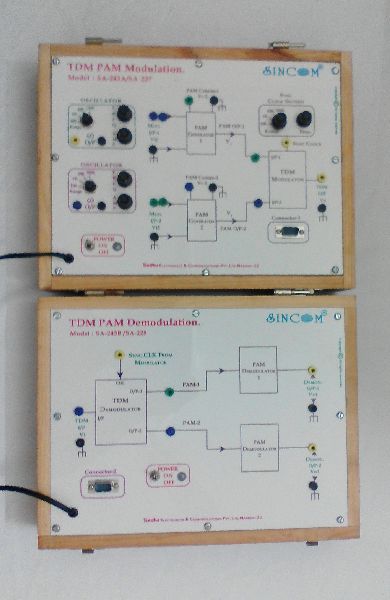
TDM-PAM Modulation - This has two PAM modulators and two channel analog TDM Modulator wired as TDM PAM modulator. Every PAM modulator has IC 555 as sampling pulse generator and IC4016 as CMOS switch wired with RC components to provide PAM outputs 1 & 2 for the applied two analog inputs and sampling pulses. The modulating inputs are processed through two PAM modulators and then as an input to analog TDM modulator circuit to output two channel analog time division multiplexed outputs.  
TDM-PAM Demodulation - This has two channel analog TDM Demodulator and two PAM Demodulators wired as TDM PAM Demodulator. Every PAM demodulator has NPN Transistor as CE amplifier and RC filter wired as Pulse Amplitude Demodulator to provide the demodulated analog output with minimum noise. The applied two channel TDM-PAM input is separated by TDM demodulator and then separated signals are processed through PAM demodulators to recover the multiplexed signals. on board Sine wave (modulating) signal generators (2Nos) with variable  frequency upto 100KHz and amplitude. Sync clock pulse generator variable upto 100 KHz, TDM Channels two analog, facility to control the modulating inputs and sync pulse input, maximum modulating frequency 10KHz, maximum carrier frequency 100KHz, Bandwidth 3KHz, Built-in fixed DC +12V/+5V/1A Power supply and  test points.

Objectives :

  • To study  the operation of two channel TDM-Pulse Amplitude modulation.
  • To study the Pulse Amplitude Modulation. To observe and note the PAM outputs for the applied modulating inputs.
  • To study the two channel TDM- PAM outputs.
  • To observe and note the effect on TDM-PAM output w.r.t. change in modulating inputs.
  • To observe and note the effect on TDM-PAM output w.r.t. change in Sync pulse input.
  •  To study  the operation of two channel TDM-Pulse Amplitude Demodulation.
  • To study the operation of TDM Demodulator.
  • To study the Pulse Amplitude Demodulation.
  • To observe and note the demodulated outputs for the applied TDM-PAM inputs.
  • To observe and note the change in demodulated outputs w.r.t. modulating inputs.


Accessories Included : Set of Patch Cords, Operating Manual
View Complete Details

FDM (Frequency Division) Multiplexing & Demultiplexing SA-250

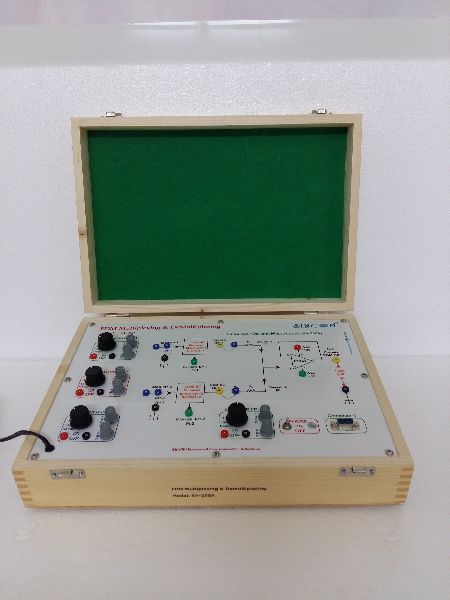
FDM Multiplexing - This has two DSB-SC balanced modulators and two channel OP-AMP based linear multiplexer wired as Frequency Division Multiplexer (FDM). Every DSB-SC Balanced modulator circuit has IC 1496 wired with RC components to provide the DSB-SC Balanced AM output for the applied modulating and carrier input signal. The modulating inputs are processed through two DSB-SC Balanced modulators for the applied respective carrier inputs to provide two DSB-SC outputs which is then applied as an input to linear FDM modulator circuit to output two channel frequency division multiplexed outputs.
FDM Demultiplexing - This has two channel FDM Demodulator and two DSB-SC Balanced Demodulators with low pass filter wired as FDM Demultiplexer. Every DSB-SC demodulator has IC 1496 wired with RC components and filter network to provide the demodulated outputs for both channel inputs. The applied two channel FDM input is separated by FDM demodulator and then these signals are processed through DSB-SC balanced demodulators to recover the multiplexed signals. on board Sine wave (modulating & carrier) signal generators (4Nos) with variable  frequency upto 100KHz and amplitude. FDM Channels two analog, facility to control the modulating inputs and carrier inputs of both the channel, maximum modulating frequency 10KHz, maximum carrier frequency 100KHz, Bandwidth 3KHz, Built-in fixed DC ±12V/1A Power supply and maximum test points.  

Objectives :

  • To study the concept of Frequency Division Multiplexer (FDM).
  • To study  the operation of two channel  FDM.
  • To study the DSB-SC Balanced Modulation. To observe and note the DSB-SC outputs for the applied modulating and carrier inputs.
  • To observe and note change in FDM output w.r.t. change in channel inputs.
  •  To study the concept of Frequency Division Demultiplexing.
  • To study the operation of FDM Demodulator.
  • To study the DSB-SC Balanced Demodulation.
  • To observe and note the demodulated outputs for the applied FDM inputs.
  • To observe and note the change in demodulated outputs w.r.t. channel modulating inputs.


Accessories Included : Set of Patch Cords, Operating Manual.
View Complete Details

Delta Modulation & Demodulation SB-209

Product Category :  Digital Communication Lab Trainer  (Series : 200-B)

Product Name : Delta Modulation &  Demodulation

Model No.: SB-209

Product Details :
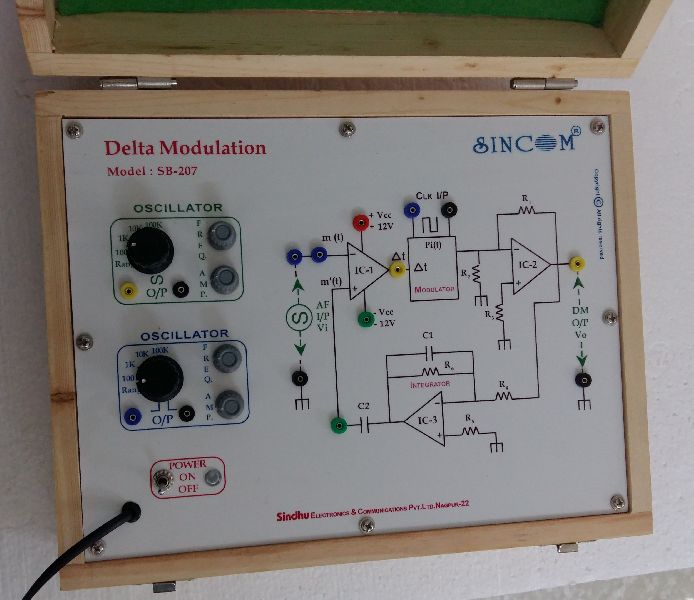
  • DM Modulation : This has OP-AMP IC 741 as differential amplifier, Integrator, RC network and modulator are wired as to form a Delta Modulation circuit to provide the DM output for the applied modulating AF input signal. facility to control the Clock signal, Sine wave signal generators (1No) and Square wave signal generators (1No) with variable frequency upto 100KHz and amplitude. facility to control carrier signal. DM Demodulation : This has OP-AMP IC 741 as an Integrator, RC network and low pass filter wired as to form a Delta Demodulation circuit to provide the demodulated output for the applied DM input signal. maximum modulating frequency 10KHz, maximum carrier frequency 100KHz, Bandwidth 3KHz, Discrete level circuit, Built-in fixed DC ±12V/1A Power supply and maximum test points.  
  • Objectives :
    • To study the principle and circuit of Delta Modulation (DM).
    • To observe and note DM O/P for the applied modulating AF input and carrier input.
    • To observe and note the change in DM O/P w.r.t change in modulating input.
    • To observe the effect on DM O/P w.r.t change in carrier input.
    • To study the limitations and distortions of DM.
    • To study the principle and circuit of Delta Demodulation.
    • To observe and note demodulated O/P for the applied DM input.
    • To observe the change in Demodulated O/P w.r.t change in modulating AF input of DM.
    • To observe the effect on demodulated O/P w.r.t change in carrier input of DM.
  • Accessories Included :  Set of Patch Cords, Operating Manual


View Complete Details

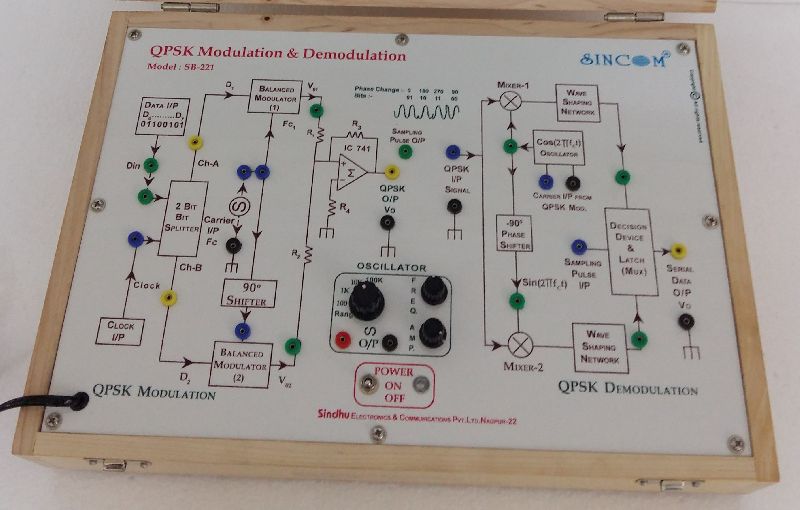
QPSK Modulation & Demodulation SB-221

Product Category :  Digital Communication Lab Trainer  (Series : 200-B)

Product Name : QPSK  Modulation &  Demodulation


Model No. : SB-221


Product Details
  • QPSK Modulation: This circuit has two bit Data Splitter, two Balance modulators wired using IC 1496, 900 RC Phase shift networks and OP-AMP IC 741 as summing amplifier. The 8 bit digital data input with clock input is applied to Data bit splitter  network to split the data into pairs, which is then applied as an inputs to separate balanced modulators with direct and 900carrier input to provide balance modulator outputs which after summing network provides QPSK modulated data output. on board 8 bit digital Data generator, Clock input, Sine wave carrier signal generators (1No) with variable frequency upto 100KHz and 10Vpp amplitude. facility to change the digital data input bits, and carrier input. four phases output 00, 900, 1800, 2700, for data inputs 00, 01, 11, 10 respectively. Maximum carrier frequency 50KHz, sampling pulse output, Discrete level circuit.
  • QPSK Demodulation: This circuit is wired with two mixers, 900 RC Phase shifter, two wave shaping networks, logical decision device circuit and OP-Amps to form QPSK Demodulation circuit to provide the demodulated serial data output with minimum noise for the applied QPSK input signal. Four phase QPSK input, Digital Data input 8 bit, sampling pulse input, maximum carrier input frequency 50KHz, QPSK detector bandwidth upto 2KHz, Discrete level circuit, Built-in fixed DC ±12V/+5V/1A Power supply and maximum test point.
  • Objectives :
    • To Study the Quadrature Phase Shift Keying (QPSK) Modulation.
    • To observe & note the change in QPSK O/P w.r.t. the change in digital Data I/P.
    • To observe & note the change in QPSK O/P w.r.t. the change in Carrier I/P.
    • To Study the Quadrature Phase Shift Keying (QPSK) Demodulation.
    • To observe the note demodulated O/P w.r.t. change in modulating digital Data I/P.
    • To observe and note the change in the O/P w.r.t. change in carrier I/P.
    • To observe and note the distortion/error in O/P w.r.t change in applied digital data I/P.
  • Accessories Included :  Set of Patch Cords, Operating Manual.
View Complete Details

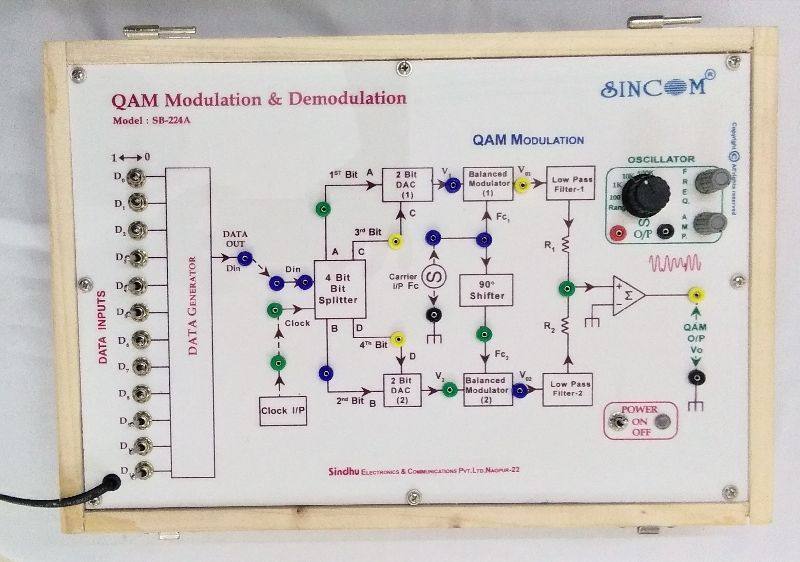
QAM Modulation & Demodulation SB-224

Product Category :  Digital Communication Lab Trainer  (Series : 200-B)


Product Name : QAM Modulation &  Demodulation


Model No. : SB-224


Product Details  
  • QAM Modulation: This circuit has four bit Data Splitter, 2-bit DACs, two Balance modulators wired using IC 1496, 900 RC Phase shifter network, two low pass filters and OP-AMP IC 741 as summing amplifier. The 12 bit digital data input with clock input is applied to four bit Data splitter network to split the data into four bits, which is then applied in pair to respective 2-bit DAC and balanced modulators with direct and 900carrier input to provide balance modulator outputs which is after LPF and summing network provides QAM modulated data output. On board 12 bit digital Data generator, Clock input, Sine wave carrier signal generators (1No) with variable frequency upto 100KHz and 10Vpp amplitude. facility to change the digital data input bits and carrier input. facility to connect external clock  and data input. variation in phase and amplitude of carrier for the given data input pattern. 4-QAM system, maximum carrier frequency 50KHz, Discrete level circuit.  QAM Demodulation: This circuit is wired with two mixers, 900 RC Phase shifter, two low pass filters, logical decision device circuit, multiplexers and OP-Amps to form QAM Demodulation circuit to provide the demodulated serial data output with minimum noise for the applied QAM input signal. QAM input, Digital Data input 12 bit, carrier reference input, maximum carrier input frequency 50KHz, QAM detector bandwidth upto 2KHz, Discrete level circuit, Built-in fixed DC ±12V/+5V/1A Power supply and maximum test point.
  • Objectives :
    • To Study the Quadrature Amplitude Modulation (QAM).
    • To observe & note the change in QAM O/P w.r.t. the change in digital Data I/P.
    • To observe & note the change in QAM O/P w.r.t. the change in Carrier I/P.
    • To Study the Quadrature Amplitude Demodulation.
    • To observe the note demodulated O/P w.r.t. change in modulating digital Data I/P.
    • To observe and note the change in the O/P w.r.t. change in carrier I/P.
    • To observe and note the distortion/error in O/P w.r.t change in applied digital data I/P.
  • Accessories Included :  Set of Patch Cords, Operating Manual.
View Complete Details

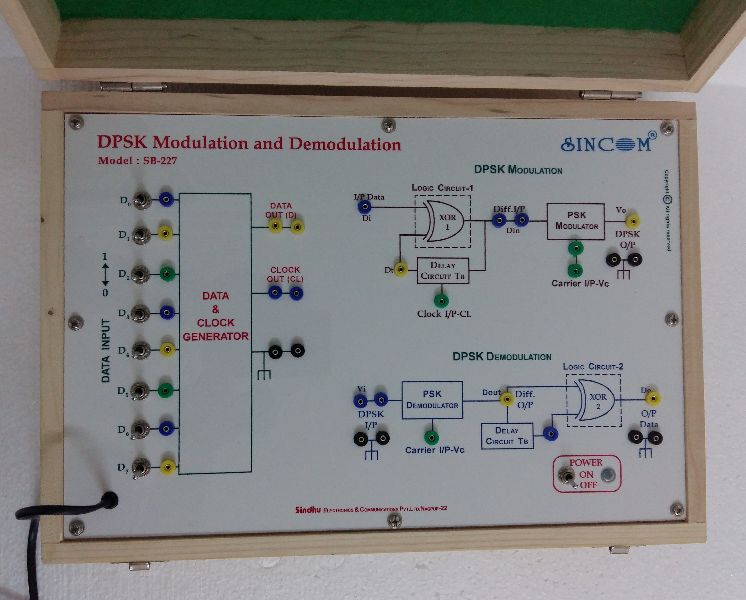
DPSK Modulation & Demodulation SB-227

Product Category :  Digital Communication Lab Trainer  (Series : 200-B)

Product Name : DPSK Modulation &  Demodulation

Model No.: SB-227

Product Details  :
  • DPSK Modulation: The circuit uses logic gates, Delay circuit, PSK modulator using IC 1496 wired with RC components to provide the DPSK output for the applied 8 bit Data input. The 8 bit digital data input and clock input is applied to logical delayed circuit to provide the differential data input signal to PSK modulator with the carrier input signal to output DPSK signal. On board 8 bit digital Data and Clock signal generator. Sine wave carrier signal generators (1No) with variable frequency upto 100KHz and 10Vpp amplitude. facility to change the digital data input bits and carrier input. maximum modulating Data input frequency 5KHz, maximum carrier input frequency 100KHz.
  • DPSK Demodulation: The circuit uses PSK demodulator using IC 1496, logic gates, Delay circuit wired with RC components to provide the demodulated digital data output with minimum noise for the applied DPSK input. Digital Data input 8 bit, carrier reference input, maximum carrier input frequency 100KHz, DPSK Detector bandwidth upto 2KHz, Discrete level circuit, Built-in fixed DC +12V/+5V/1A Power supply and maximum test point.
  • Objectives :
    • To Study the Differential Phase Shift Keying (DPSK) Modulation.
    • To observe & note the change in DPSK O/P w.r.t. the change in digital Data I/P.
    • To observe & note the change in DPSK O/P w.r.t. the change in Carrier I/P.
    • To Study the Differential Phase Shift Keying (DPSK) Demodulation.
    • To observe the note demodulated O/P w.r.t. change in modulating digital Data I/P.
    • To observe and note the change in the O/P w.r.t. change in carrier I/P.
    • To observe and note the distortion/error in O/P w.r.t change in applied digital data I/P.
  • Accessories Included :  Set of Patch Cords, Operating Manual


View Complete Details

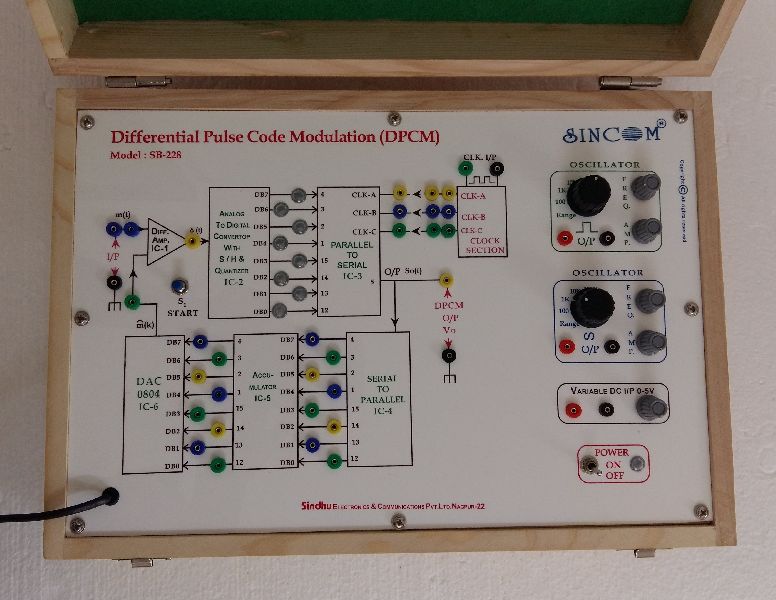
DPCM Modulation & Demodulation SB-238

Product Category :  Digital Communication Lab Trainer  (Series : 200-B)

Product Name : DPCM Modulation & Demodulation

Model No.: SB-238

Product Details :
  • DPCM Modulation: The circuit of OP-AMP IC 741 differential amplifier, 8 bit ADC with S/H Quantizer, Parallel to Serial converter, serial to parallel converter, Accumulator, 8 bit DAC and modulator are wired as Differential Pulse Code Modulation to provide digital DPCM output for applied modulating input. facility of AC/DC  modulating input, Clock section generates three clock signals, facility to control DPCM transmission, Start control, Sine wave signal generators (1Nos) and Square wave signal generators (1Nos) with variable frequency upto 100KHz and amplitude. facility to control carrier signal, DPCM 8 bit, Variable DC Input 0-5V, maximum modulating frequency 5KHz, maximum carrier frequency 100KHz, Built-in fixed DC ±12V/+5V/1A Power supply and maximum test points.  
  • DPCM Demodulation: The circuit of  Serial to Parallel converter, 8 bit DAC, Low pass filter and amplifier are wired as Differential Pulse Code Demodulation to provide demodulated output for the applied DPCM input. synchronized clock from transmitter, DPCM 8 bit, maximum modulating frequency 5KHz, maximum carrier frequency 100KHz, Bandwidth 3KHz and maximum test points.  


  • Objectives :
    • To study the principle of Differential Pulse Code Modulation and Demodulation (DPCM).
    • To study the circuit of DPCM modulator and Demodulator.
    • To study the Clock section of DPCM.
    • To observe the change in DPCM O/P w.r.t change in modulating input.
    • To observe the effect on DPCM O/P w.r.t change in carrier input.
    • To observe the difference between m(t) and m(k) signals.
    • To observe the change in Demodulated O/P w.r.t change in modulating input of DPCM.
    • To observe the effect on demodulated O/P w.r.t change in carrier input of DPCM.
  • Accessories Included :  Set of Patch Cords, Operating Manual


View Complete Details

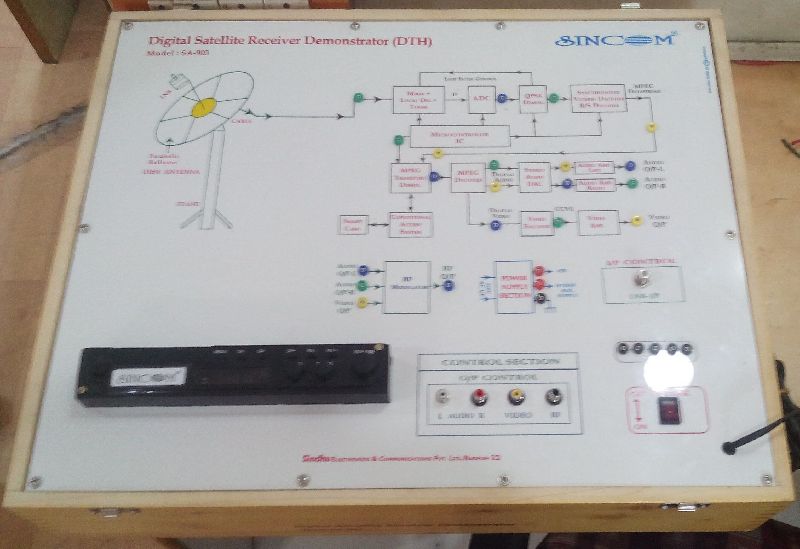
Digital Satellite Receiver DTH Trainer With Dish Antenna KU BAND SA-903

The Trainer is intended to demonstrate the Installation and working of Direct to Home (DTH) Digital Satellite Receiver. The trainer is fully comprehensive, easy to understand and perform experiments on DTH. This has functional Block Diagram printed in multicolor on the front panel of the board with maximum test points and control sections, completely enclosed in elegant poly coated wooden cabinet. This has KU Band Dish Antenna coupled to Digital Satellite Receiver to provide Audio and Video Outputs. On board detail block diagram of RF Section with Dish Antenna Input, Video Decoder, Audio Decoder, System Controller, RF Modulator, Power supply and Display unit.  Control panel has Audio (Left & Right) Out, Video Out, RF Out. On board Dish Antenna LNB Input control. On board Open Circuit board (PCB) to observe the various components of DTH Receiver. On board Remote sensor with LED indications. On board Power ON/OFF control. Facility to control all functions by Remote. Fault created by Switches in UP-Normal & Down-Faulty condition. Facility to study Signal and Voltage analysis of all sections. Facility to create 3 Faults on all sections.

Technical Specifications :

  • Power Supply - 110V - 250V AC 50Hz/60Hz
  • DC Power Supply - +12V, +5V 1A Regulated
  • Dish Antenna  - 3ft Parabolic
  • Dish Input -  F - Connector
  • LNB - 640
  • Receiver Type - Digital
  • RF Output - VHF / UHF  
  • RF Input - 950 MHz - 2150 MHz
  • RF Signal Level - 25dB -65 dB
  • RF Input Impedance - 75 Ohm
  • Channel Decode  - QPSK (SCPC, MCPC)
  • I/P Symbol Rate - 2 - 30 MSPS
  • Audio Out - Stereo Left and Right
  • Audio Frequency Range - 20Hz- 20KHz
  • Audio Decoding - MPEG –II layer I & II
  • Audio Sampling rate - 32/44.1/48KHz
  • Video Out -  CCVS- NTSC/PAL Out
  • Video Decoding - MPEG –II MP@ML
  • Out Terminal - RCA  
  • Video Output level - 1 Vpp ( 75 Ohms)
  • Satellite -  INSAT
  •  Display -  LED Graphical  
  • Distortions -  10 to 15% in live program
  • Controls on Board - Channel Up/Down , Volume Up/Down.
  • Remote Control  -  Control all functions 
  • Total Faults - 3 Faults


Objectives :

  • To study the principle of Digital Satellite Receiver.
  • To study the installation process of Digital Satellite Receiver (DTH).
  • To study the Operation of  DTH.
  • To study the control Panel of  DTH.
  • To study the RF part of Digital Satellite Receiver.
  • To study the MPEG Video Decoder of Digital Satellite Receiver.
  • To study the Audio Decoder of Digital Satellite Receiver.
  • To observe and note the Voltages at various sections.
  • To observe and note the signals/waveforms at various sections.  
  • To study 3 faults on DTH.


Accessories Included : Dish Antenna with LNB, Remote Control, RF Cable, AV Cable, Set of Patch Cords, Operating Manual.
View Complete Details

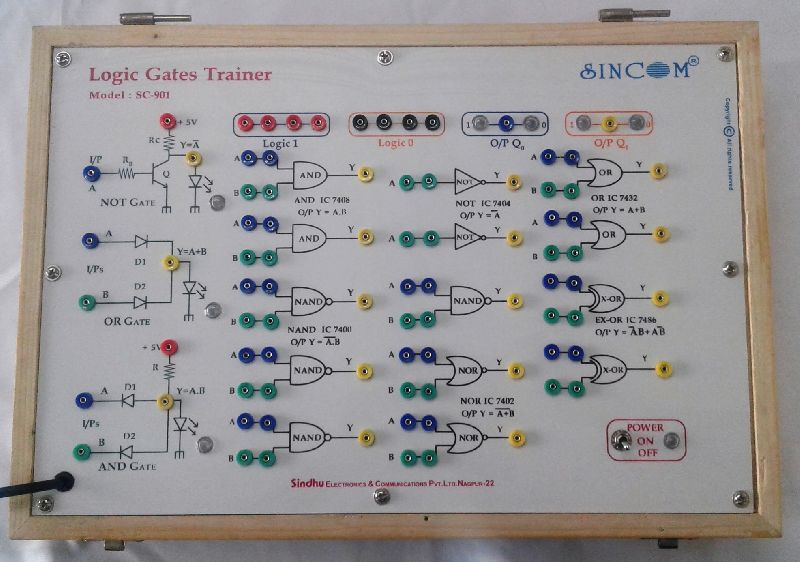
Logic Gate Trainer Using IC SC-901

Product Category :  Digital Electronics Lab Trainer  (Series : 300)

Product Name : Logic Gate trainer using IC

Model No.: SC-901

Product Details :
  • The trainer has on board DC +5V fixed Power supply, Digital TTL Logic Level Generator (4 No), Digital TTL Logic level Indicator (2No). It has two sets of AND, OR, NOT, NAND, NOR, XOR, XNOR logic gates using TTL Digital ICs and also the Basic logic gates AND, OR, NOT using diodes and Transistor. Facility to study logic gates using Discrete components and Integrated Circuits. Equipped with detailed instruction manual and the set of 2mm patch cords for interconnections.  
  • Objectives :
    • To Study the structure of Logic gates trainers for various inputs and outputs.
    • To Study basic logic gates AND, OR, NOT using diode and transistor. Verify its truth table.
    • To Study the truth table of AND, OR, NOT logic gates using TTL Digital ICs.
    • To Study the truth table of NAND, NOR, XOR, XNOR logic gates using TTL Digital ICs.
  • Accessories Included :  Set of Patch Cords, Operating Manual


View Complete Details

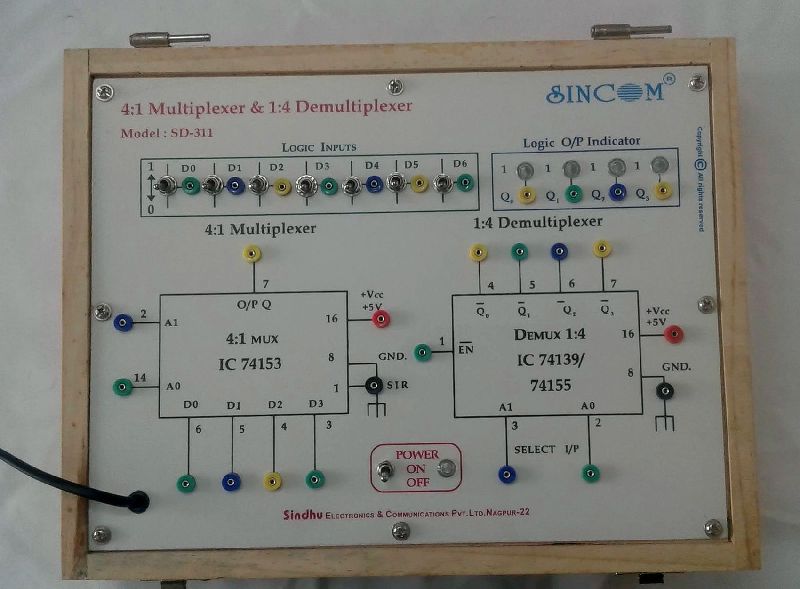
4:1 Multiplexer & 1:4 Demultiplexer SD-311

7,000 - 8,000 / no, Get Latest Price

The trainer is intended to study the Truth Table of Multiplexer and Demultiplexer. The trainer has on board DC +5V fixed Power supply, Digital TTL Logic Level Generator (7 No), Digital TTL Logic level Indicator (5No). 4:1 Multiplexer : On board IC 74153 with open terminals wired as to study the 4:1 Multiplexer using IC and verify its truth table. On board 4 bit data input and 2 bit control input. 1:4 Demultiplexer : On board IC 74155 with open terminals wired as to study the 1:4 Demultiplexer using IC and verify its truth table. On board 1 bit data input and 2 bit control select input. Facility to change the Digital Data Input, Control Inputs and observe the corresponding MUX/DEMUX output.

Objectives :

  • To Study 4:1 Multiplexer using IC 74153 and to verify its Truth Table.
  • To Study 1:4 Demultiplexer using IC 74155 and to verify its Truth Table.


Instruments Required : Digital Multimeter (Optional)

Other Models Available (Model No) :

  • Multiplexer 4:1 using IC 74153 (SD-301)
  • Multiplexer 8:1 using IC 74151 (SD-302)
  • Multiplexer 16:1 using IC 74150 ( SD-303)
  • Demultiplexer 1:4 using IC 74155 (2:4 Decoder) (SD-304)
  • Demultiplexer 1:8 using IC 74138 (3:8 Decoder) (SD-305)
  • Demultiplexer 1:16 using IC 74154 (4:16 Decoder) (SD-306)
  • Multiplexer 4:1 using Gates (SD-307)
  • Multiplexer 8:1 using Gates (SD-308)
  • Demultiplexer 1:4 using Gates (SD-309)
  • Demultiplexer 1:8 using Gates (SD-310)
  • 4:1 Multiplexer & 1:4 Demultiplexer (SD-311)
  • 8:1 Multiplexer & 1:8 Demultiplexer (SD-312)
  • 16:1 Multiplexer & 1:16 Demultiplexer (SD-313)
  • Multiplexer Trainer (4:1, 8:1, 16:1) (SD-314)
  • Demultiplexer Trainer (1:4, 1:8, 1:16) (SD-315)
  • Multiplexer 8:1 and Demultiplexer 1:4 (SD-316)


Product Category : Digital Electronics Lab Trainer (Series : 300)

Product Name : 4:1 Multiplexer and 1:4 Demultiplexer

Model No.: SD-311
View Complete Details

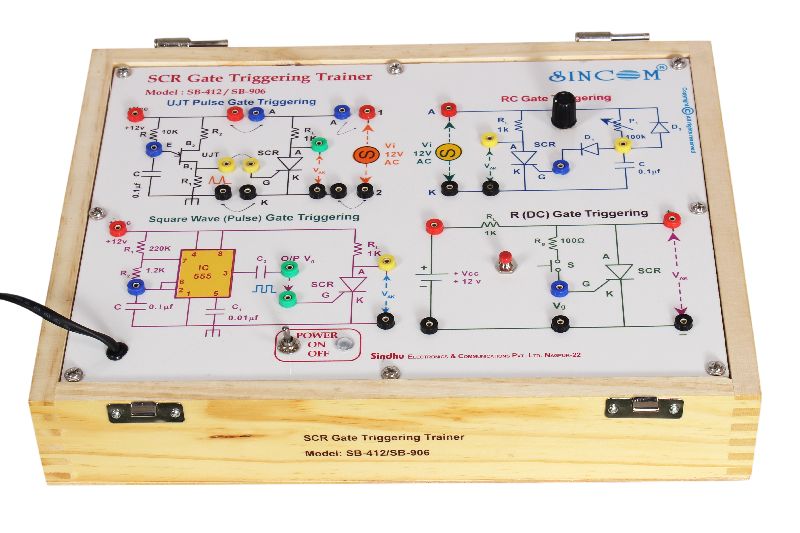
SCR Gate Triggering (Turn-ON Methods) Trainer SB-412

This has Built-In DC +12V/ AC 12V 50Hz/500mA Fixed Power supply, SCR 2P4M / TYN604  with UJT as relaxation oscillator and resistive load is used to study all the SCR gate triggering methods like SCR gate triggering using DC Voltage, using AC Voltage, UJT relaxation oscillator, using Square wave I/P, using RC Network (5 Methods), maximum test points provided to observe the intermediate effects.

Objectives :

  • To Study SCR gate triggering using DC Voltage.  To Observe & Note VAK w.r.t. change in DC gate Voltage.
  • To Study SCR gate pulse triggering using UJT as relaxation oscillator.  To Observe & Note VAK w.r.t. change in gate pulse width.
  • To Study SCR gate triggering using Square wave I/P.  To Observe & Note Voltage VAK w.r.t. change in gate pulse width.
  • To Study SCR gate triggering using RC Network. To Observe & Note Voltage VAK w.r.t. gate I/P. To observe & Note firing & conduction angle of SCR and Note the change w.r.t. change in RC Values.
  • To Study SCR gate triggering using AC Voltage.  To Observe & Note VAK w.r.t. applied AC I/P Voltage.


Accessories Included : Set of Patch Cords, Operating Manual.
View Complete Details

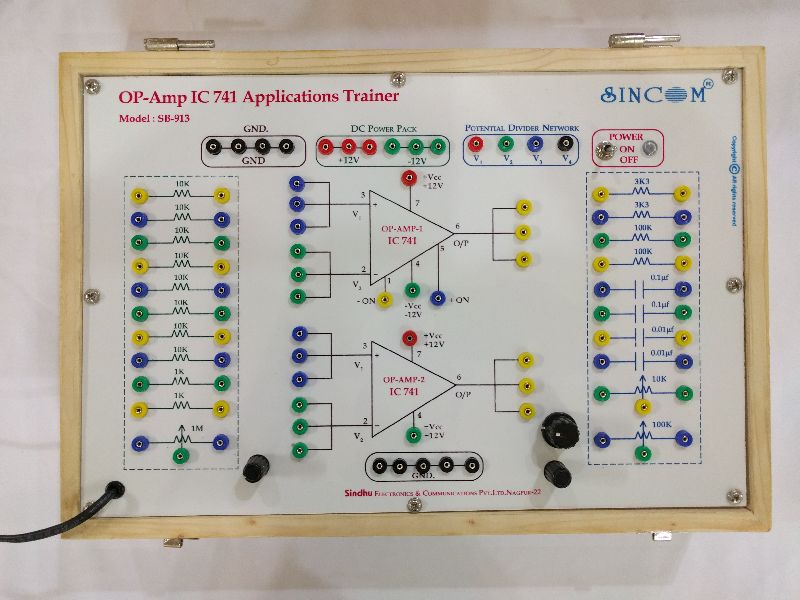
Op-AMP IC 741 Application And Characteristics (Parameter) Trainer SB-913

This has Built-In DC ±12V/1A regulated fixed Power supply, variable ±12V Power supply, Potential divider network to provide V1-V4 DC input levels, Two Op-Amps IC 741 with Open terminals for interconnection with RC components bank provided on the board to study following applications of Op-Amp IC741, fixed and variable Resistor bank (17 Nos), fixed capacitors bank (4Nos), detailed instruction manual with circuit diagram and procedure to determine all 16 parameters of given Op-Amp.  

Objectives :  

  • To Study the following Op-Amp based Applications.
  • To study the Op-Amps applications Trainer
  • IC 741 as Inverting Amplifier.
  • IC 741 as Non-Inverting Amplifier.
  • IC 741 as an Adder Circuit.
  • IC 741 as an Averager Circuit.
  • IC 741 as Subtractor Circuit.
  • IC 741 as Unity Gain Amplifier.
  • IC 741 as AC Amplifier.
  • IC 741 as Differential Amplifier.
  • IC 741 as a first order Low Pass Filter
  • IC 741 as a first order High Pass Filter
  • IC 741 as Differentiating Circuit.
  • IC 741 as Integrating Circuit.
  • IC 741 as Square wave generator Circuit.
  • IC 741 as Schmitt Trigger Circuit.
  • To Study the Op-Amp Parameters/ Characteristics/ Specifications


Accessories Included : Set of Patch Cords, Operating Manual.
View Complete Details

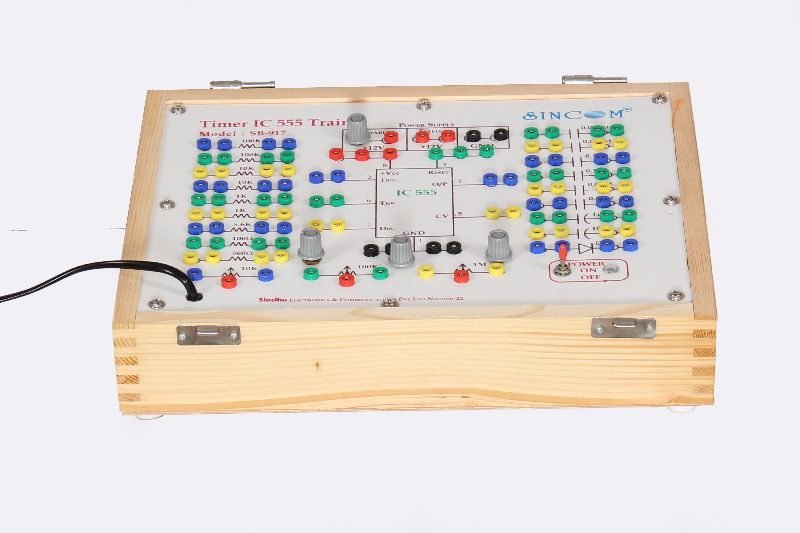
Timer IC 555 Trainer SB-917

This has Built-In DC +12V/1A regulated fixed Power supply, variable +12V Power supply, One Timer IC 555 with Open terminals for interconnection with RC components are provided on the board to study configure the various applications of Timer IC555, fixed Resistor bank (9Nos), variable Resistor/Potentiometers bank of 10K, 100K, 1M (3Nos), fixed capacitors bank (8Nos), Diode 1N4007, LED, relay, NPN Transistor, Speaker, detailed instruction manual with circuit diagram and procedure to study applications.  

Objectives :

  • To Construct & Study IC 555 as Astable Multivibrator. To Observe & Note change in O/P amplitude, Time period, frequency w.r.t. change in RC Components & Compare theoretical & Practical Values.
  • To Construct & Study operation of IC555 as Monostable Multivibrator. To Observe & Note change in O/P width, frequency w.r.t. change in RC Components & applied Trigger Input signal & Compare theoretical & Practical Values.
  • To Construct & Study operation of IC 555 as Bistable Multivibrator. To Observe & Note change in O/P Voltage Vo w.r.t. change in applied DC I/P Voltage or  Square wave.
  • To Construct & Study the circuit of DC timer using IC 555. To Observe & Note the Turn-ON time of DC load & Compare the theoretical & Practical values.
  • To Construct & Study the circuit of AC timer using IC 555. To Observe & Note the Turn-ON time of AC load & Compare the theoretical & Practical values.
  • To Construct & o Study operation of IC 555 as frequency divider circuit. To Observe & Note change in O/P w.r.t. change in applied I/P.
  • To Construct &  Study operation of IC555 as Schmitt Trigger. To Observe & Note Square wave O/P w.r.t. applied sinewave Input. To determine UTP, LTP & Hysterises  Voltage.To Observe & Note change in UTP, LTP w.r.t. change in Components values.
  • To Study operation of IC 555 as Ramp generator circuit. To Observe & Note change in Ramp O/P w.r.t. change components values.
  • To Construct & Study circuit of Voltage Controlled Oscillator (VCO) using IC 555.To Observe & Note the change in frequency of Oscillation w.r.t. applied Input voltage. Compare theoretical & Practical Values.
  • To Construct & Study the operation of Photo relay using IC 555. To Observe &  Note the load ON/OFF condition w.r.t. applied light ON/OFF
  • To Construct & Study the operation of Continuity Tester using IC 555. To Observe & Note change in beep/alarm sound O/P w.r.t. shorting of probes through conductor under test as a Continuity tester.
  • To Construct & Study the operation of Tone Generator using IC 555. To Observe & Note change in tone/sound O/P w.r.t. change in RC components.
  • And many more as per your designed.


Accessories Included : Set of Patch Cords, Operating Manual.
View Complete Details

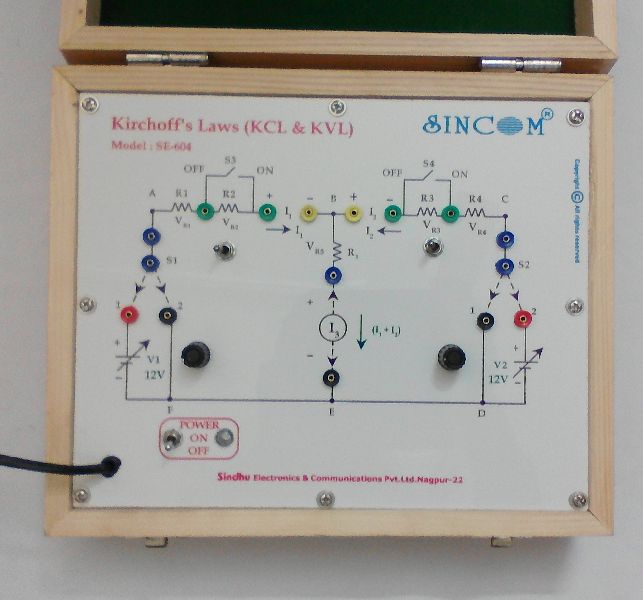
Kirchoffs Laws (KCL & KVL) SE-604

Product Category :  Electrical Network Circuits and Bridges Lab Trainer  (Series : 600)

Product Name : Kirchoff’s Laws (KCL & KVL)

Model No. : SE-604

Product Details :
  • This has Built-In DC +12V/500mA variable Power supply (2Nos), the circuit uses resistive network of different combinations connected with one/two variable DC input voltage source wired as to study the Kirchoff's Current/ Voltage Law (KCL/KVL) in resistive circuit, Two toggle switches to select the various resistive network combinations, maximum test points.
  • Objectives :
    • To Study the Kirchoff's Current Law (KCL) in DC resistive circuit. To Observe & Note the DC voltage and currents in a circuit to verify the KCL law at different nodes.
    • To Study the Kirchoff's Voltage Law (KVL) in DC resistive circuit. To Observe & Note the DC voltage and currents in a circuit to verify the KVL law in different loops.
  • Accessories Included : Set of Patch Cords, Operating Manual In Built Digital Meters options are also available on demand.
View Complete Details

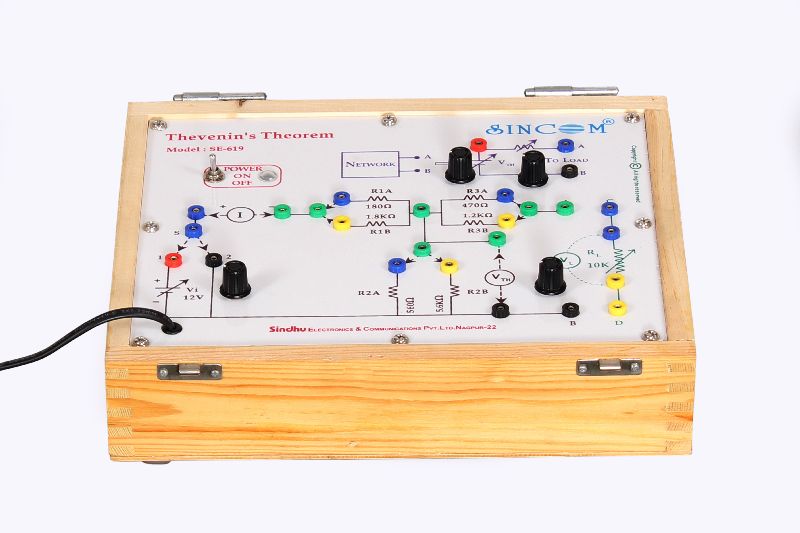
Thevenins Theorem SE-619

Product Category :  Electrical Network Circuits and Bridges Lab Trainer  (Series : 600)

Product Name : Thevenin’s Theorem

Model No. : SE-619

Product Details  
  • This has Built-In DC +12V/500mA variable Power supply, the circuit uses resistive network of six fixed resistors and variable 10K load resistor wired as to verify the Thevenin's theorem for the applied variable DC input voltage source to a resistive circuit, facility to select resistors bank, facility to set an equivalent Thevenins Network using  variable voltage source VTH source & variable RTH for a given selected network and load, maximum test points to connect meters in circuit.  
  • Objectives :
    • To study the Thevenin’s Theorem.
    • To Determine the Value of VTH & RTH for the different Values of Vi.
  • Accessories Included : 
    • Set of Patch Cords, Operating Manual
    • In Built Digital Meters options are also available on demand.
View Complete Details

Superposition Theorem SE-622

Product Category :  Electrical Network Circuits and Bridges Lab Trainer  (Series : 600)

Product Name : Superposition Theorem

Model No. : SE-622

Product Details
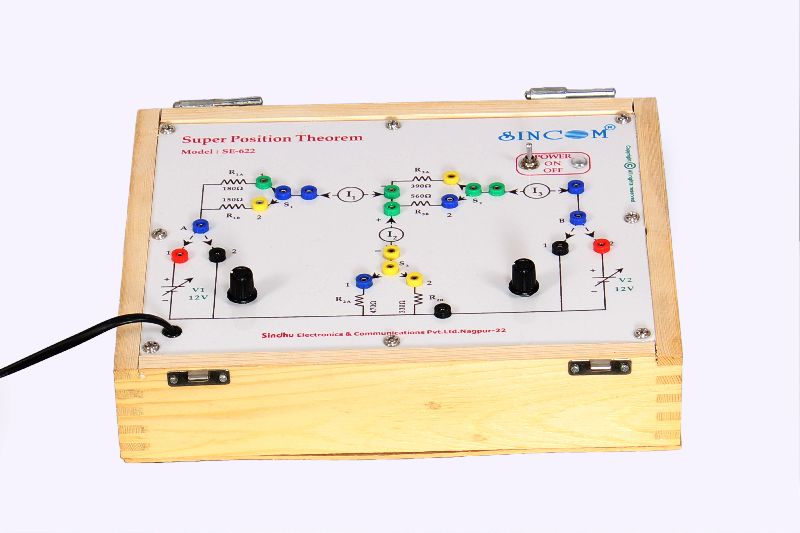
  • This has Built-In DC +12V/500mA variable Power supply(2Nos), the circuit uses resistive network of six fixed resistors connected with two variable DC input sources wired as to verify the Superposition theorem for the applied variable DC input voltage source to a resistive circuit, facility to select resistors bank, facility to change the applied DC inputs, maximum test points to connect the meters in circuit.  
  • Objectives :
    • To study the Superposition Theorem.
    • To Determine the Value of Current & Voltage across R2 for the different values of V1 & V2.
  • Accessories Included : 
    • Set of Patch Cords, Operating Manual
    • In Built Digital Meters options are also available on demand.
View Complete Details

Maxwells Bridge SE-635

Product Category :  Electrical Network Circuits and Bridges Lab Trainer  (Series : 600)

Product Name : Maxwell’s Bridge

Model No.: SE-635

Product Details :
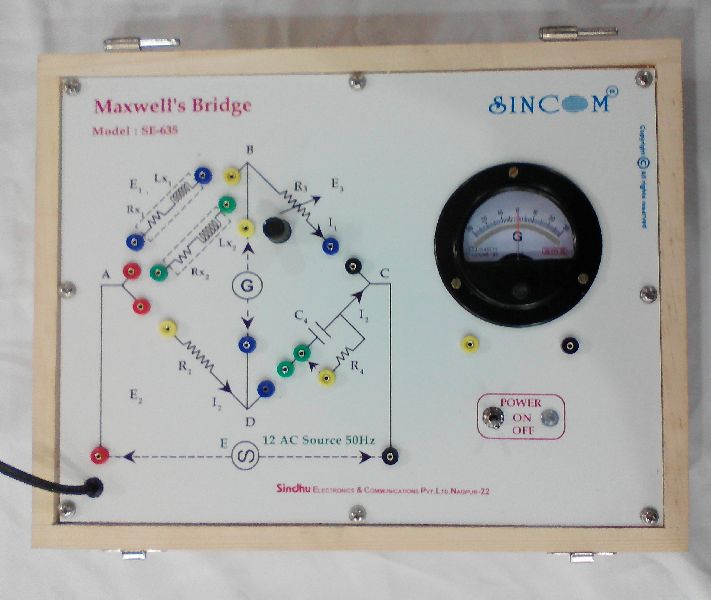
  • This has Built-In AC 12V/50Hz/500mA Power source with current limiting resistor Rs, the arms of LC bridge has two fixed and one variable known resistors, one fixed capacitor wired with Two Unknown Inductors Lx1/Lx2 of mH value to study the Maxwell's Bridge to determine the value of these unknown Inductors, facility to select two unknown inductors, Galvanometer used for null indication, maximum test points to measure all the elements of a bridge.
  • Objectives :
    • To Study the Maxwell's Inductance-Capacitance Bridge.
    • To Study measurement of Unknown Inductance. To Determine Q Factor.
    • To Compare the Theoretical and Practical Values.
  • Accessories Included :  Set of Patch Cords, Operating Manual
View Complete Details

Digital Frequency Counter Demonstrator SE-805

Product Category :  Electronics Measuring Instruments Demonstrator (Series : 800)

Product Name : Digital Frequency Counter Demonstrator  

Model No. : SE-805

Product Details :
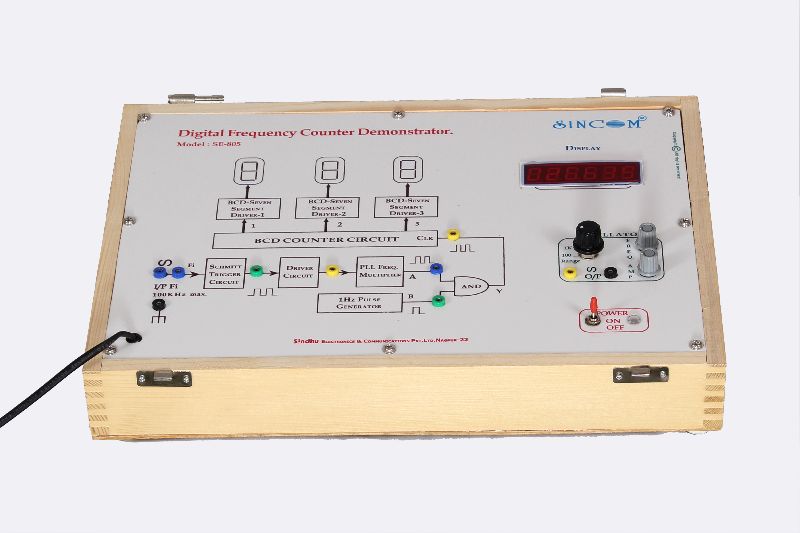
  • This has Built-In DC +5V/±12V/500mA fixed power supply, on board sine wave input signal generator with variable frequency upto 100KHz and variable amplitude upto10 Vp-p, the circuit uses associate circuitry of Schmitt trigger, driver, PLL frequency multiplier with logical & BCD Counter circuit to drive the LED Seven segment displays to indicate the frequency of applied input signal, Indication on three CC LED Seven segment Display, Frequency counter range 100KHz maximum, complete setup with maximum test points.
  • Objectives :
    • To Study the Principle of Digital Frequency Counter.
    • To observe and note the output frequency on LED Seven segment display w.r.t. the applied variable input signal frequency.
    • To compare the Observed (Practical) value with applied theoretical value.
  • Accessories Included :  Set of Patch Cords, Operating Manual


View Complete Details

Signal Generator Demonstrator SE-806

Product Category :  Electronics Measuring Instruments Demonstrator (Series : 800)

Product Name : Signal Generator Demonstrator  

Model No. : SE-806

Product Details :
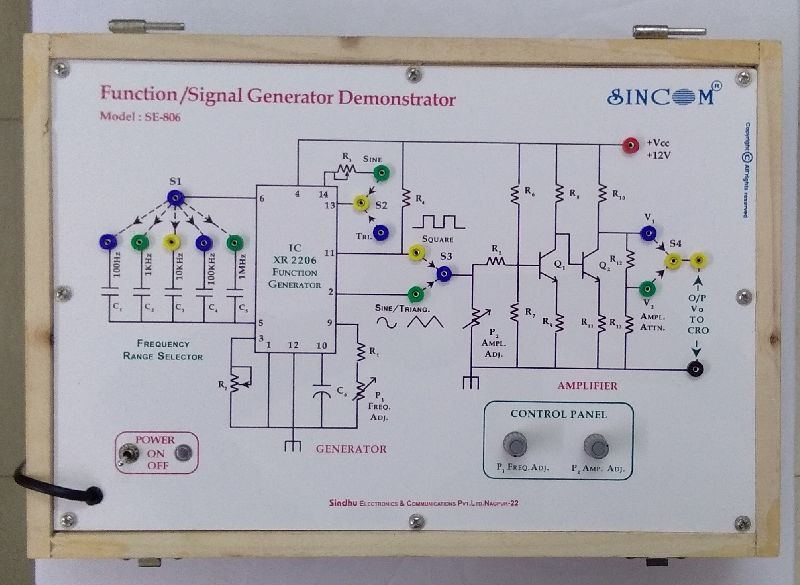
  • This has Built-In DC ±12V/500mA regulated fixed Power supply, IC XR- 2206 with its associate circuitry of variable RC Bank and BJT NPN 548 as direct coupled amplifier wired as to provide Sine, Square, Triangular signal O/Ps with variable amplitude (10Vmax) & frequency (100KHzmax) in steps, on board frequency and amplitude control, frequency range selector in 100Hz/1KHz/ 10KHz/100KHz/1MHz, sine/square/triangular output selector, complete setup with maximum test points.  
  • Objectives :
    • To Study operation of IC XR-2206 as Function generator to generate Sine, Square, Triangular wave O/P.
    • To Observe & Note  time period, amplitude , frequency of Sine, Square, Triangular wave O/P w.r.t. change in RC  Components values.
  • Accessories Included :  Set of Patch Cords, Operating Manual.
View Complete Details

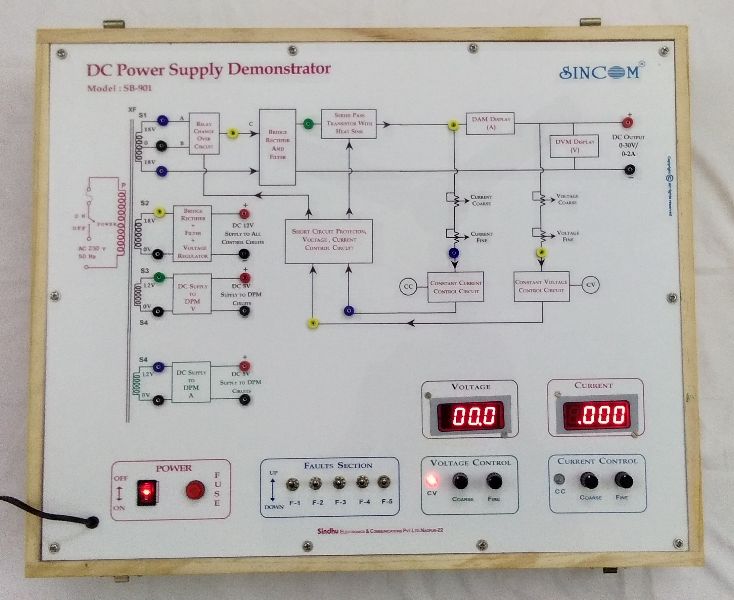
DC Power Supply Demonstrator With Faults Creating Facility (Single 0-30V/2A) SB-901

Product Category :  Electronics Measuring Instruments Demonstrator (Series : 800)

Product Name : DC Power Supply Demonstrator with faults creating facility (Single 0-30V/2A)

Model No.: SB-901

Product Details :
  • This has Built-In DC +12V/±12V/+5V-1A fixed variable Power supply. The trainer has multi-tapped transformer of 18-0-18V/0-18V/0-12V/2A wired with rectifier, capacitive filter, voltage regulator circuit, controller circuit, constant voltage and constant current circuits to provide the DC 0-30V/0-2A power supply. Facility to control the Voltage and current. Maximum test points on the block diagram to study all the corners of the DC variable power supply.  Input voltage AC 230V ± 10% 50Hz, Panel Mounting Glass Cartridge Fuse for AC input protection, Automatic overload and short circuit protection, Output voltage 0-30V, Output current 0-2Amp, Constant voltage and constant current mode of operation, DPM 4 digit- 7 segment LED display for voltage and current indications, Voltage coarse & fine control, Current coarse & fine control.
  • Objectives :
    • To Study the Functional Blocks of DC Single Power supply.
    • To Study the Constant Voltage Regulator Circuit.
    • To Study the Constant Current Regulator Circuit.
    • To Study the display methods of Voltage and Current.
    • To study the voltage and signal analysis on DC power supply.
    • To study the Faults (5) finding on various sections of DC single Power Supply.  
  • Accessories Included :  Set of Patch Cords, Operating Manual
View Complete Details

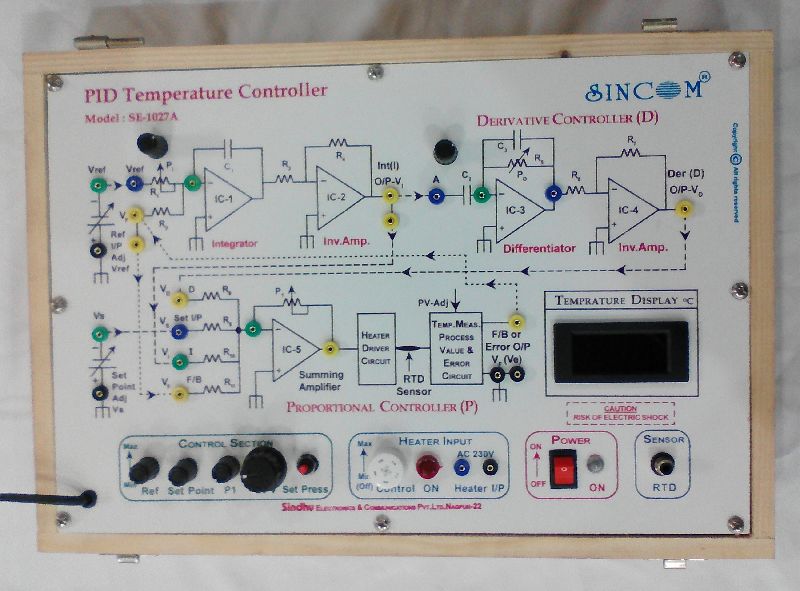
P,PI,PID Control System- Temperature Control SE-1027

Product Category :  Instrumentation and Control System Lab Trainer (Series: 1000)

Product Name : P, PI, PID Control System- Temperature control

Model No.: SE-1027

Product Details
  • This has Built-In DC +5V/±12V/500mA regulated fixed Power supply, Variable Reference input adjust, Variable Set Point input control, temperature process P, PI, PID control system, RTD as Temperature sensor, 31/2 digit LED type Temperature Indicator (0C) display, the Temperature controller circuit has Op-Amp IC 741 based Integrator with amplifier as "Integral Controller (I)" and Op-Amp IC 741 based Differentiator with amplifier as "Derivative Controller (D)" wired with Op-Amp based summing amplifier and error controller as "Proportional Controller (P)" to drive the AC Heater input and maintained the temperature of the heater at desired preset value, facility to select P/PI/PID control process, facility to control AC Heater condition, on board Ref/set point/ feedback gain/temp set/PI-Gain/PD-Gain/P-Gain controllers, Electrical Heating arrangement, complete setup with maximum test points.
  • Objectives :
    • To Study the Principle of P, I, D Controller.
    • To Study the Operation of PID Temperature controller.
    • To Study the Temperature controller in Open Loop.
    • To Study the Temperature controller in Closed Loop-PID mode.
    • To Observe and note the ON/OFF of AC Heater at the set value in closed loop.
  • Accessories Included :  Electrical Heating Arrangement, Set of Patch Cords, Operating Manual.


View Complete Details

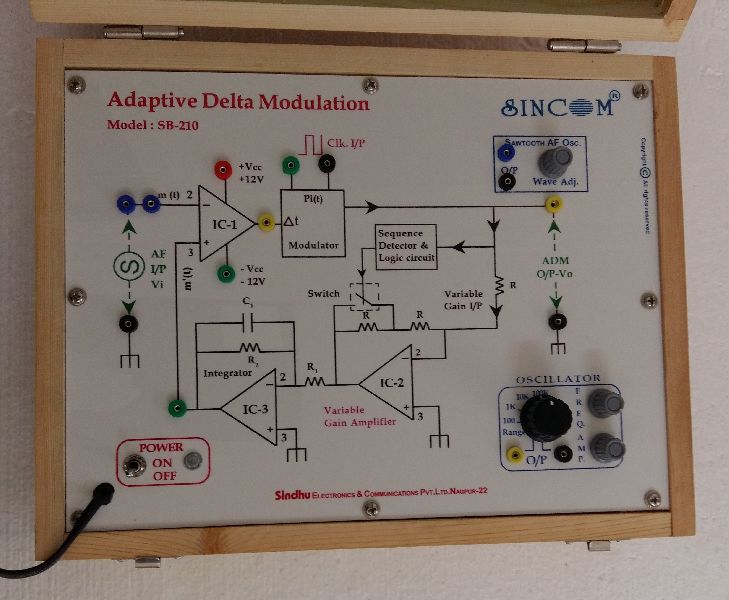
Adaptive Delta Modulation & Demodulation SB-212

Product Category :  Digital Communication Lab Trainer  (Series : 200-B)

Product Name : Adaptive Delta Modulation &  Demodulation

Model No. : SB-212

Product Details  :

  • ADM Modulation :This has OP-AMP IC 741 as differential amplifier, Integrator, RC network, logic sequence detector, variable gain amplifier and modulator are wired as to form a Adaptive Delta Modulation circuit to provide the ADM output for the applied modulating AF input signal. facility to control the Clock signal, AF sawtooth input wave (1No) generator with variable frequency, Square wave carrier signal generators (1No) with variable frequency upto 100KHz and amplitude. facility to control carrier signal.  ADM Demodulation : This has logic sequence detector, variable gain amplifier, OP-AMP IC 741 as amplifier, Integrator, RC network and low pass filter wired as to form a Adaptive Delta Demodulation circuit to provide the demodulated output for the applied ADM input signal. maximum modulating frequency 10KHz, maximum carrier frequency 100KHz, Bandwidth 5KHz, Discrete level circuit, Built-in fixed DC ±12V/+5V/1A Power supply and test point.
  • Objectives :
    • To study the principle and circuit of Adaptive Delta Modulation (ADM).
    • To observe and note ADM O/P for the applied modulating AF input and carrier input.
    • To observe and note the change in ADM O/P w.r.t change in modulating input.
    • To observe the effect on ADM O/P w.r.t change in carrier input.
    • To study the limitations and distortions of ADM.
    • To study the principle and circuit of Adaptive Delta Demodulation.
    • To observe and note demodulated O/P for the applied ADM input.
    • To observe the change in Demodulated O/P w.r.t change in modulating AF input of ADM.
    • To observe the effect on demodulated O/P w.r.t change in carrier input of ADM.
  • Accessories Included :  Set of Patch Cords, Operating Manual
View Complete Details
Tell Us What are you looking for? Will call you back

Contact Us