 Write a Review
Our Products
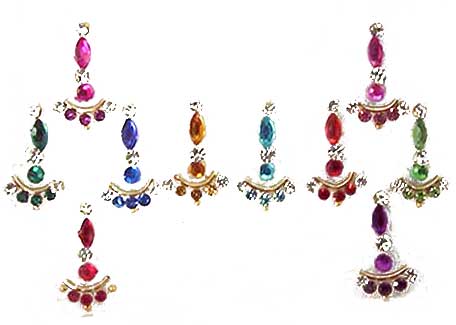
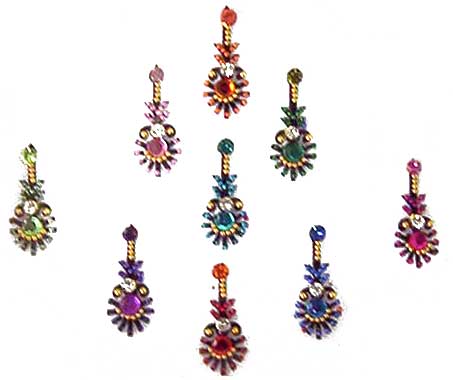
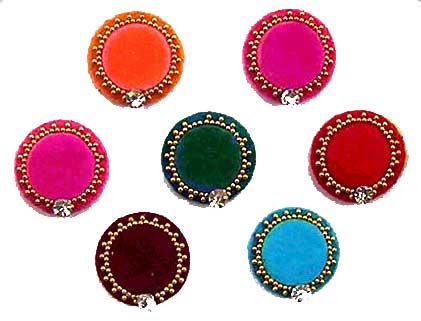
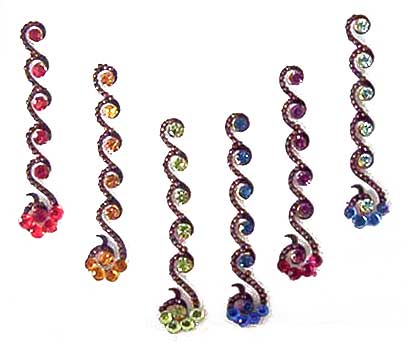
Our Complete range of products are Indian Fashion Women Bindi, Indian Wedding Bindia, Indian Bindis Ib-01, Indian Bindis Ib-03 and Indian Bindis-06.
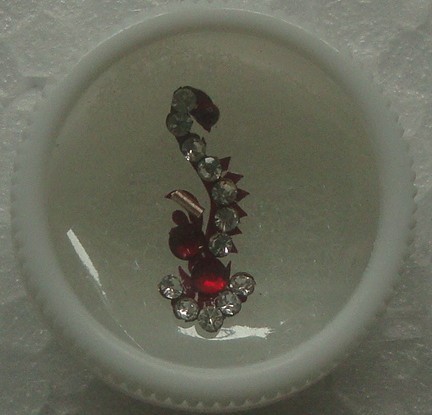
A bindi (from Sanskrit bindu, meaning "a drop, small particle, dot") is a forehead decoration worn in South Asia and Southeast Asia. Traditionally it is a dot of red color applied in the center of the forehead close to the eyebrows, but it can also consist of a sign or piece of jewelry worn at this location. Traditionally, married Hindu women wear a bindi. The traditional bindi is made with red sindoor powder or perhaps a black ointment. The bindi is a form of tilak, religious Hindu signs worn on the forehead. Nowadays, bindis are also worn by women who are not married, children, and by women who are not Hindu.
The area between the eyebrows (where the bindi is placed) is said to be the sixth chakra, ajna, the seat of "concealed wisdom". According to followers of Tantrism, this chakra is the exit point for kundalini energy. The bindi is said to retain energy and strengthen concentration. It is also said to protect against demons or bad luck. In addition to the bindi, in India, a vermilion mark in the parting of the hair just above the forehead is worn by married women as a symbol of their married status. During North Indian marriage ceremonies, the groom applies sindoor on the parting in the bride's hair. Ancient Chinese women wore similar marks (for purely decorative purposes) since the second century, which became popular during the Tang Dynasty.
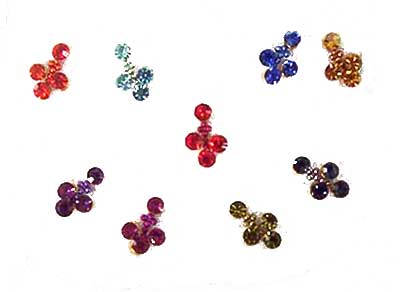
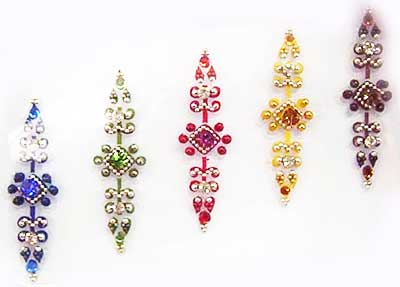
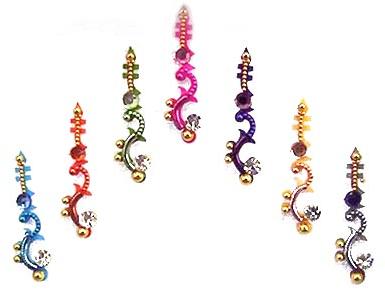
In modern times, the bindi has become a decorative item and is worn by unmarried as well as non-Hindu women, in India, Bangladesh and other countries of South Asia. It is no longer restricted in colour or shape. Self-adhesive bindis (also known as sticker bindis) are available. Sticker bindis come in many colors, designs, materials, and sizes. Fancy sticker bindis may be decorated with sequins, glass beads, or rhinestones for extra dazzle.
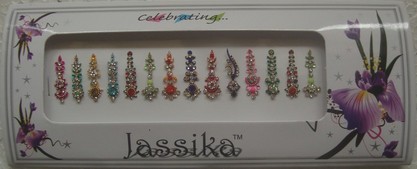
Word bindi originates from Sanskrit bindu, meaning "point, drop, dot or small particle") is a red dot worn on the center of the forehead, commonly by Hindu and Jain women. The word Bindu dates back to the hymn of creation known as Nasadiya Sukta in the Rigveda. Bindu is considered the point at which creation begins and may become unity. It is also considered as "the sacred symbol of the cosmos in its un-manifested state".
Bindi is a bright dot of red color applied in the center of the forehead close to the eyebrow worn in the Indian Subcontinent (particularly amongst Hindus in India, Pakistan, Bangladesh, Nepal, and Sri Lanka)and Southeast Asia among Bali and Javanese Hindus. Bindi in Hinduism, Buddhism, and Jainism is associated with Ajna Chakra and Bindu is known as the third eye chakra. Bindu is the point or dot around which the mandala is created, representing the universe. Bindi has historical and cultural presence in the region of Greater India.
 Saptarshi Mitra (Emfex)
 14/b, Avilasha, Rabindra Nagar, Asansol, West Bengal - 713304
 Share us via