
 Write a Review
Our Products
Leading Manufacturer, Supplier & Retailer of Temporary Mehendi Stickers.
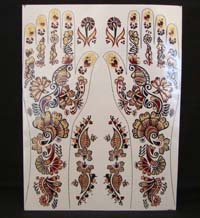
The word tattoo is said to has two major derivations- from the polynesian word 91ta92 which means striking something and the tahitian word 91tatau92 which means 91to mark something92. The history of tattoo began over 5000 years ago and is as
Diverse as the people who wear them. Tattoos are created by inserting colored materials beneath the skins surface. The first tattoos probably were created by accident. Someone had a small wound, and rubbed it with a hand that was dirty with soot and ashes from the fire. Once the wound had healed, they saw that a mark stayed permanently. Despite the social sciences' growing fascination with tattooing, and the immense popularity of tattoos themselves, the practice has not left much of a historical record.
Bronze age :In 1991, a five thousand year old tattooed man 91F6tzi the ice man92 made the headlines of newspapers all over the world when his frozen body was discovered on a mountain between austria and italy. This is the best preserved corpse of that period ever found. The skin bears 57 tattoos: a cross on the inside of the left knee, six straight lines 15 centimeters long above the kidneys and numerous parallel lines on the ankles. The position of the tattoo marks suggests that they were probably applied for therapeutic reasons (treatment of arthritis).
Pazyryk culture :In 1948, 120 miles north of the border between russia and china, russian archeologist sergei rudenko began excavating a group of tombs, or kurgans, in the high altai mountains of western and southern siberia. Mummies were found that date From around 2400 years ago. The tattoos on their bodies represent a variety of animals. The griffins and monsters are thought to have a magical significance but some elements are believed to be purely decorative. Altogether the tattoos are believed to reflect the status of the individual.
Egypt :Written records, physical remains, and works of art relevant to egyptian tattoo have virtually been ignored by earlier egyptologists influenced by prevailing social attitudes toward the medium. Today however, we know that there have been bodies recovered dating to as early xi dynasty exhibiting the art form of tattoo. In 1891, archaeologists discovered the mummified remains of amunet, a priestess of the goddess hathor, at thebes who lived some time between 2160 bc and 1994 bc. This female mummy displayed several lines and dots tattooed about her body - grouping dots and/or dashes were aligned into abstract geometric patterns. This art form was restricted to women only, and usually these women were associated with ritualistic practice. The egyptians spread the practice of tattooing throughout the world. The pyramid-building third and fourth dynasties of egypt developed international nations with crete, greece, persia, and arabia. By 2, 000 bc the art of tattooing had stretched out all the way to southeast asia. The ainu (western asian nomads) then brought it with them as they moved to japan.
 Saptarshi Mitra (Emfex)
 14/b, Avilasha, Rabindra Nagar, Asansol, West Bengal - 713304
 Share us via