 Write a Review
Our Products
Leading Manufacturer, Supplier & Retailer of Precious Stone and Semi Precious Stone.
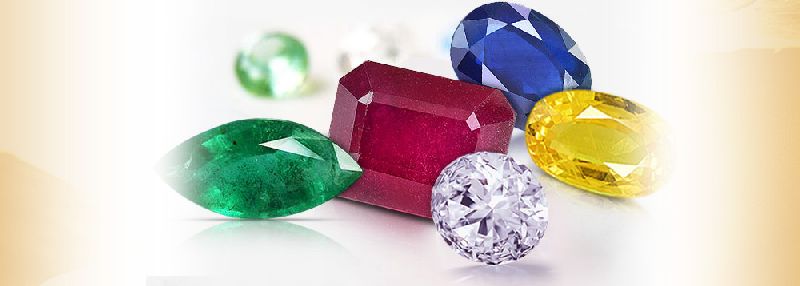
Precious stones are defined as visually appealing gemstones created from rocks or minerals. Often used for jewelry and fashion accents, this term was created in the mid-1800s to refer to four specific stones; diamonds, rubies, emeralds, and sapphires. All precious stones are translucent and are valued by the richness of their color, except for the diamond, which has a higher value based on being colorless.
Their rarity, beauty, and method in which they are produced all add to the allure of a precious stone. Any accessory containing a precious stone would be deemed sophisticated and worn by someone of high class.
List of precious stonesDiamondThe diamond is the most popular of all gemstones. The diamond is the highest valued precious stone, which takes millions of years to form. A diamond is a mineral compound made of pure carbon and is the hardest natural substance on the planet. Diamonds are so strong, they can only be cut or polished by another diamond. The name itself is derived from the Greek word adamus, which means invincible. Diamonds are typically colorless, but yellow, brown, green, gray, black, pink, blue, red, and purple stones can also be found along the diamond color spectrum. Jewelry-grade diamonds are rated based on color from bluish-white to yellow, and on clarity, which ranges from pure to various levels of flawed. Diamonds are measured in caratsthe higher the carat weight and purity level of a stone, the more valuable the gem. The diamond is the birthstone for April.
EmeraldKnown for its brilliant green color, emerald can also have blue or yellow undertones and loses all color when subjected to high heat. Their brittle exterior makes emeralds difficult to shape.The earliest emeralds were mined in Upper Egypt as early as 2, 000 B.C. They were mined throughout the reign of Alexander the Great and were well-loved and collected by Cleopatra. The Aztecs and Incas also coveted emeralds, and the Moguls of India revered them so much they inscribed the gems with sacred text to be used to ward off evil. Historically, emeralds have been mined from Russia, Austria, Australia, and Norway. Today, the majority of emeralds are found in Brazil, Zambia, and Colombia. The emerald is the birthstone for May.
RubyThe ruby is a pink to deep red precious gemstone. The name comes from the Latin word for red, ruber. Rubies are said to attract good luck for the wearer. Ancient Hindus believed rubies were a sign of protection from evil. Today, the ruby has come to symbolize love and passion. Rubies were also highly prized by ancient Chinese warriors who were known to wear rubies on their armor. Most rubies today are mined in Africa and Southeast Asia. The largest mined ruby weighing in at four pounds, the Liberty Bell Ruby, was stolen in a heist in 2011. The ruby is the birthstone for July.
SapphireSapphires come in a variety of colors, but are mostly associated with blue hues. A sapphire of another color, like pink, white or yellow, is generally called a fancy sapphire. The blue sapphire represents peace and serenity. It is seen many times in ancient religious writing to symbolize purity, wisdom, loyalty and faith. Sapphires are mined throughout Africa and Asia, but can be found in Australia and the U.S. The sapphire is the birthstone for September.
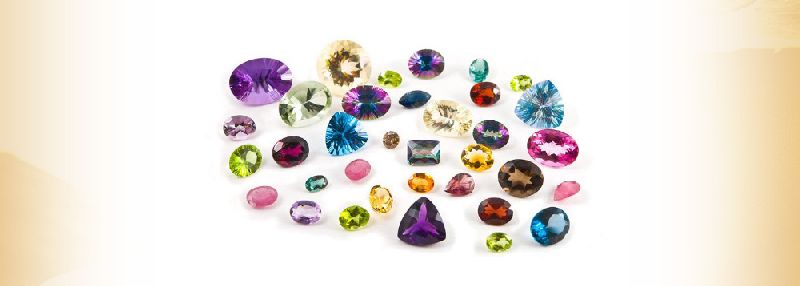
The names "semiprecious stones" and "semi-precious stones" are used for all varieties of gemstones that are not categorized as "precious." Any gemstone suitable for being used in personal adornment would be included. Semiprecious stones include gemstones fashioned from: agate, amber, amethyst, aquamarine, aventurine, chalcedony, chrysocolla, chrysoprase, citrine, garnet, hematite, jade, jasper, jet, kunzite, lapis lazuli, malachite, moonstone, obsidian, onyx, peridot, rhodonite, sunstone, tiger's eye, tanzanite, topaz, turquoise, tourmaline and many other materials.
Some people believe that the word "semiprecious" is derogatory, irreverent, misleading, or confusing, and that its use should be discontinued. Perhaps the people who initiated this classification had the intent of casting all gems but a few under a derogatory light?
Unfortunately, eliminating the word "semiprecious" from use would be extremely difficult. Over the past 150 years, scores of popular books have been written with the word "semiprecious" in their titles. Today the terms appear repeatedly in numerous books, magazines, web pages, and other documents published by companies in the gem and jewelry industry, government agencies, and the most influential institutions in gemology. Purging these terms from professional use would be difficult, but, eliminating them from common use would be nearly impossible - especially because some people really like these names.
 Igs Laboratory (igs laboratory)
 405, 4th Floor, Munna Sonkhiya Chambers, Mahadev Johri Ki Gali, Gopal ji Ka Rasta, Johri Bazar, Jaipur - 302003, (Raj.) INDIA, Rajasthan
 Share us via








