
 Write a Review
Our Products
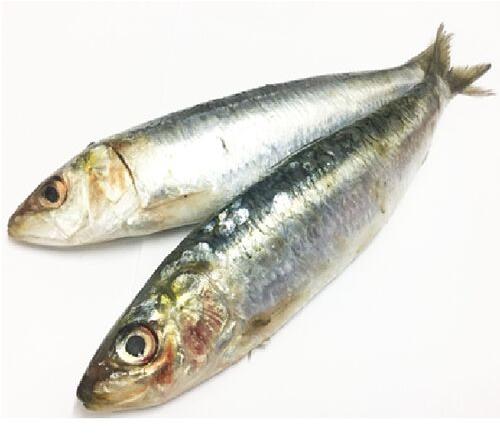
We offer the best product range of Fresh Oligoplites Saurus Fish, Fresh Silver-Pomfret Fish, Fresh Black Pomfret Fish, Fresh Horse Mackerel Fish and Fresh Trachurus Trachurus Fish.
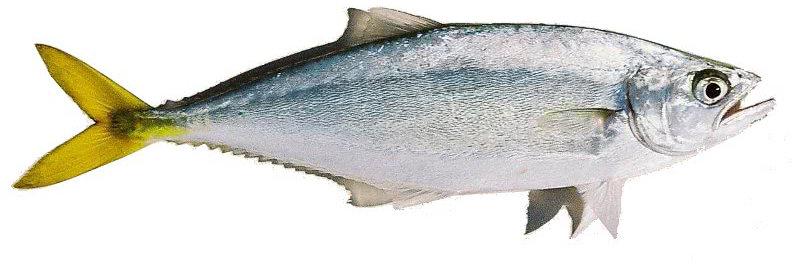
Also known as the Oligoplites Saurus it is a species from the family Carangidae. The largest variety of the same is around 1 foot long. In most cases is found in the shallow waters of areas like Gulf of Mexico and Atlantic coast. You would find them in Australian, and Pacific and Indian oceans as well. It has spines located in front of its anal fin and the sting that they give using the same can hurt anyone.
Some features of the Oligoplites Saurusmake it different from the others. They have a small mouth with beak-like teeth and sandpaper type of skin. There are small gill openings and a serrated spine which is seen on top of the head. The species is found in the weight range of 1 kg but some of the rare varieties can grow up to 3 kg weight too.
Usually, the Oligoplites Saurusis capable of eating small fish and shrimp and thus it finds its place in the predator category. In the initial phases, the Oligoplites Sauruswas not considered worth eating. However, now large scale farming of the same has started happening and this encouraged its consumption as well. The Oligoplites Saurushas a soft and oily taste and appears quite similar to the Bluefish.
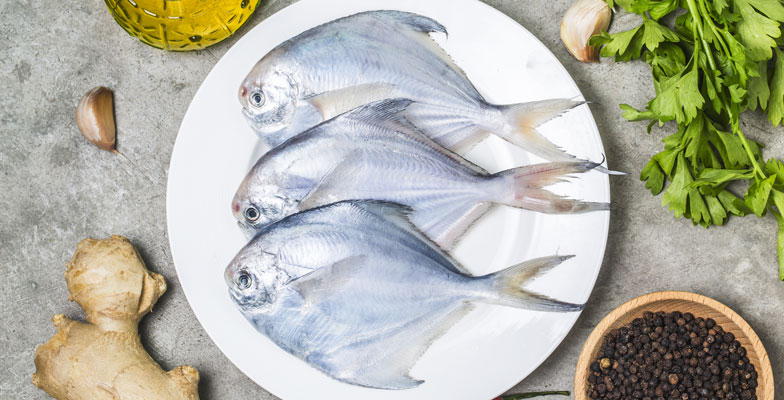
Residing in the coastal areas of Middle East, South and South East Asia the Silver Pomfret is a famous species of butterfish. Having migrated some time back you can also find the fish in the Mediterranean region. All the fish in this family are known to have flat bodies, long fins and forked tail fins. An inshore species you would find them mostly in groups near muddy bottoms of the sea.
The Silver pomfret would usually be found in Silver or white colour and at a maximum, they are able to grow to a weight of anywhere between 4-6 kgs. Nowadays, however less weighted species with an average weight of 1-2 kg are more prominent in this category. The entire Indo Asia Pacific region loves the silver Pomfret for its unique taste. When cooked properly the fish has a soft and buttery taste which is why it is so popular. Especially in India, the Silver Pomfret commands a high price in the markets.
In areas like Mumbai, the Silver Pomfret is known as Pamplet and in South India as Vawali. In areas like Korea, the species is known by the name byeongeo. It is grilled into gui and then eaten as a side dish to your daily food.
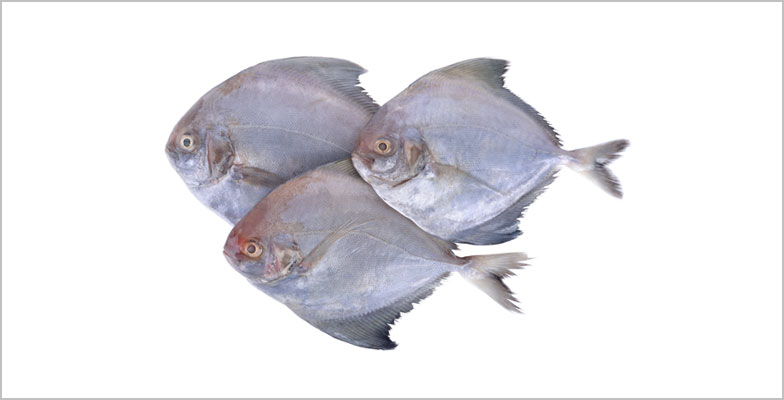
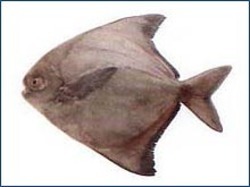
TThis Indo west Pacific region occupant is found from Australia to Japan and from Africa to Borneo. The intensity of black colour differs for most varieties, where some are much dark in comparison to others. Even though it is one of the most commercial species there is no danger of it getting endangered. The Black pomfret can grow to a length of a maximum 29 inches. Its flesh stays together and can be easily used for any form of wet cooking too. Overall too you can consider it as a very good fish for cooking.
The Black pomfret has very tiny scales on its body and thus it is easy to scrape them off before preparing for cooking. Taste of the black pomfret is quite mild and not bland at all. You would notice a dark strip under its skin but that does not harm the taste of the fish. While cooking its skin shrinks thus making it perfect for being used for baking or steaming.
TYou would find the black pomfret in the Asian markets. Their basic size varies from anywhere between 8 to 11 inches and 5 to 7 inches. Mostly the small fish are stored in bags while the larger ones are frozen packed on foam trays.
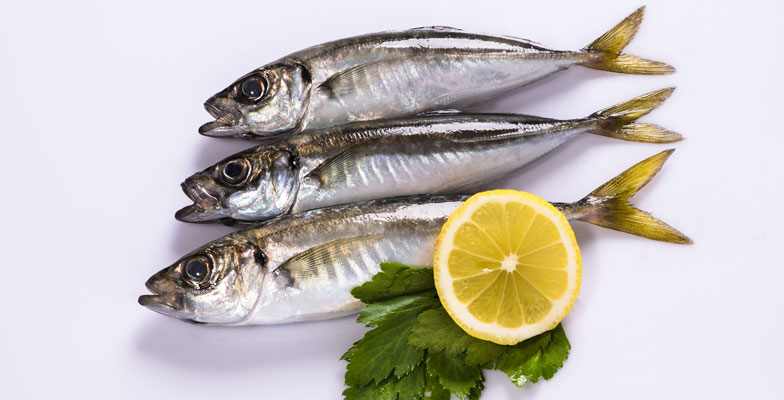
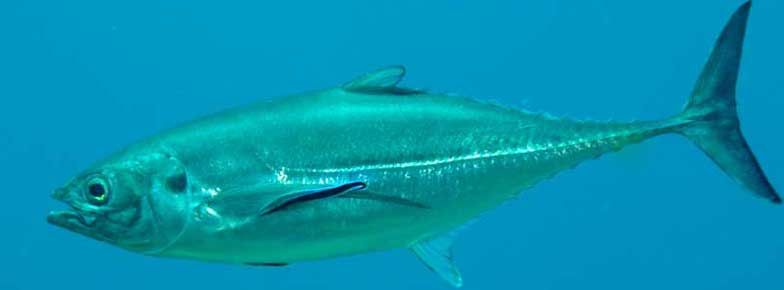
The Magalaspis Cordyla or Trachurus Trachurus can be widely found in the Indopacific region. Its expanse starts from South Africa in the west to Tonga in the east. The fish usually can be seen in the topmost layers of inshore and offshore ocean waters.
Trachurus Trachurus is known for its torpedo shape and that is why it is also known by the name Torpedo Scad. You can visibly notice its finlets which are seen close to its dorsal and anal fins. The largest species of this fish was known to weigh around 4 kg with a length of 80 centimetres. However, the majority of Trachurus Trachurus found lies in the length range of less than 40 centimetres. The spawning of this breed happens between March and July and due importance is given to its reproductive cycle at that time.
The Trachurus Trachurus is a predatory fish and it avidly feeds on crustaceans and cephalopods amongst others. As this species grows the kind of diet it consumes changes however fish remains a common element. In India and regions surrounding it, the Trachurus Trachurus is given a lot of leverage. This is probably because of interest in its consumption in nearby countries like Malaysia and Indonesia. Often the Trachurus Trachurus is used by Anglers and used as a bait to catch other fish.
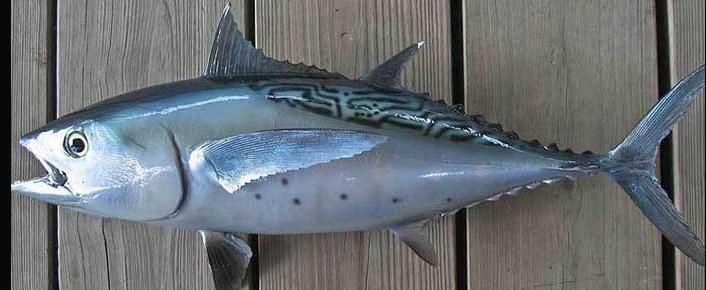
Also known as Bonito the Euthynnus Alletteratusis probably the most common tuna that is seen in the Atlantic Ocean. You can find it in the warm and tropical waters of areas like Atlantic, Mediterranean, Brazil and New England states. Considered to be a high migratory species it weighs around 36 pounds and mostly the lightest of all species present.
You can identify the Euthynnus Alletteratusby the dark spots that can be seen on its ventral and fins. It also has some worm-like markings on its back which is easy to identify. Since the fish has sufficient oil content and sticks well to the hook it is often used as a bait for the larger fishes. However, due to its dark colour, many people do not consider it worth eating.
But in the rest parts of the world like the West Indies, the Euthynnus Alletteratusis used in dried, smoked, and frozen form. Its body size is short in comparison to the other tuna fish and that is why probably the name is given. The Euthynnus Alletteratushas a compact and streamlined body and its snout is small as compared to the head. Maximum Euthynnus Alletteratuscan reach a weight of 12 kgs though its average weight lies around 7 kg.
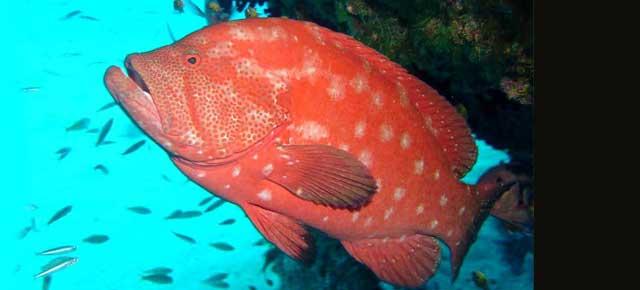
Goes by the name Tomato Hind thanks to its colour the Red Ref cod has a pointed snout and a concave profile. Usually, the colour of this fish ranges from orange-red to orange-brown and it may even have spots all over its body. In certain areas, the colour of the fish may be different than the other. In the Indian Ocean, its body is reddish brown while in the Pacific Ocean its colour may be yellowish brown with spots on the head.
You would find them living around coastal areas and reefs where hunting of crustaceans is quite easy for them. The maximum the Red Ref cod can grow is around 22 inches in length. A pretty widespread species the Red Ref cod is majorly liked by humans. People often catch it using bait, hooks and traps. Often the Tomato Hind can be found trading fresh in live markets in Hong Kong.
Though there is no concern for the fish to become endangered if the rate at which it is being consumed is maintained it might fall under the same category.99% of the diet consumed by Red Ref cod is crustaceans though it might comprise of other fishes as well. You would find the jaws of the Tomato hind having small canines in the front and palatines at the back.
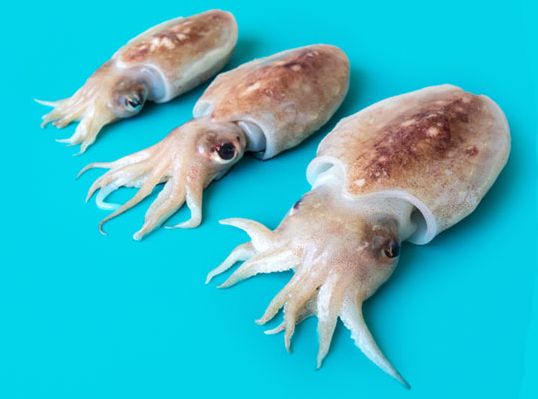
Also called the cuttles these molluscs fall under the order of Sepiida. They are known for having an internal shell which goes by the name the cuttlebone. Their distinctive feature is the presence of large W shaped pupils, two tentacles and eight arms. These tentacles have suckers using which they trap their prey and hold it tightly. Their Average size ranges from 15-20 centimetres though the longest variety seen went up to a length of 50 centimetres.
The diet of a cuttlefish includes other cuttlefish, shrimps, molluscs, crab and octopus. The average life expectancy of the cuttlefish is between one to two years and their predators are sharks, dolphins, seals, fishes etc. Similar to other molluscs these also have abundant stores of ink in their bodies. This ink is released when these fish are supposedly attacked.
The cuttlefish ink is used for multiple purposes like making the food sweet, flavour rice and pasta, and for dyeing plastics and other materials. Cuttlefish also have a camouflage facility which they use to change the colour of their skin. This trick is aptly used to hunt and scare their prey and attack them.

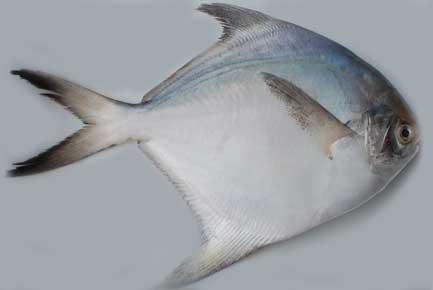
The tropical Pumpus Argenteus can be traced at the coasts from the Persian Gulf to Borneo. Also considered as a butterfish the Pumpus Argenteus can grow up to size 23 inches. However, the most common species size ranges to around 10 inches with a weight of about 9 ounces. Though the Pumpus Argenteus is popular commercially it does not fall in the endangered category and might expand its range further by 2050.
Having soft white flesh and a non- fleshy flavour the Pumpus Argenteus is consumed in a lot of places. When cooked the flesh disintegrates and provides a suitable flavour to the dish. Unfortunately, the fillets of the fish are pretty soft and cannot be used for preparing the soup. Mostly the fish is steamed whole with just a few slashes across its skin. It is this quality which makes the Pumpus Argenteus a prized catch for many.
The fin rays of the White Pomphret hold together well and you usually find less ribs to handle. With the same slashes, you can also bake the pomfret and consume without any worries. You can easily find the Pumpus Argenteus in countries like the Philippines, China and Southeast Asian countries. Though premium in nature its prices have dipped due to increased supply.
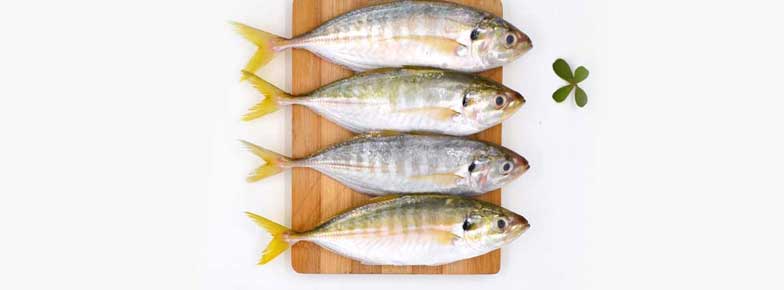
Also popular as the one finlet scad, the yellowtail scad is a fish that is most often seen inhabiting the Indo Pacific region from Africa to Japan, Australia and Hawaii. Its highly prominent adipose eyelet and finlet type extensions make it distinct from other fishes in this species. You will find the Yellowtail scad near the coastal areas and preying upon crustaceans and small fishes.
Many fisheries nurture this fish and it is usually caught using the netting and hook and line methods. Normally this fish is considered extremely prized and consumed with fervour in most regions where it is found. Both its jaws have a single row of teeth however in slightly older ones you may see two or three lines of teeth. Its caudal and dorsal fins would be yellowish green in colour and the pelvic fins are white while rest of the fins are hyaline.
The Yellowtail scad is very popular among humans and in countries like South Arabia, Malaysia its catch is too high. Most of its catch happens in the months between January and April In countries of South East Asia this fish is cooked by boiling, steaming and frying. It can also be preserved using methods like drying and salting.
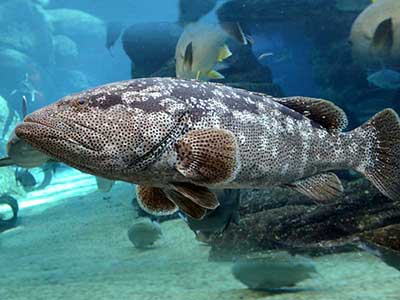
Malabar Reef Cod can be easily found in the waters of the Indo West Pacific region. You can find them in Africa, Tonga and the Red Sea along with other countries. In the Eastern Mediterranean region, the fish can be found in the Levantine Sea. Mostly the Malabar Reef cod are found in groups in places like lagoons, mangroves, sandy and muddy areas, coral and rocky reefs etc.
The average size for a Malabar reef cod is around 39 inch though at times longer varieties up to 92 inches have also been seen. Colour of this species is light to dark brown and it has a few spots on its body. As it grows old the number of such spots increases on a regular basis. You would also notice some brown diagonal stripes on the body.
The younger variety would have wide, brown stripes across the body. Its tail fin is rounded and the by the time they age the colour becomes much more uniform. In many countries, the Malabar reef cod is harvested for food and sport and even grown in aquaculture. This species is often found to harbour many parasites and hence you have to be careful while consuming the same.
 Jeelanimarine (Jeelani Marine)
 A-1 Yash Residency Mandavi Ratnagiri 415612, Mandangad, Maharashtra, India
 Share us via