Write a Review
Our Products
Leading Manufacturer, Supplier & Retailer of Dried Cinnamon and Nutmeg.
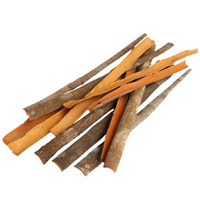
Cinnamon is the inner bark of a tropical evergreen tree. Cinnamon comes in quills, strips of bark rolled one in another. The pale brown to tan bar strips is generally thin, the spongy outer bark having been scraped off. Cinnamon is very similar to cassia, though cassia tends to dominate the market. Cinnamon is also available ground, and can be distinguished from cassia by its lighter colour and much finer powder. Cassia is an aromatic bark, similar to cinnamon, but differing in strength and quality. Cassia bark is darker, thicker and coarser, and the corky outer bark is often left on. The outer surface is rough and grayish brown, the inside bark is smoother and reddish-brown. Cassia is less costly than cinnamon and is often sold ground as cinnamon. When buying as sticks, cinnamon rolls into a single quill while cassia is rolled from both sides toward the centre so that they end up resembling scrolls. Geographical Sources : It is indigenous to China. Also cultivated in Indonesia, Ceylon, India and Vietnam. Composition : Cassia contains max. 4% essential oil, 75 to 90% of which are composed by cinnamic aldehyd. Taste and Aroma : Strongly aromatic, sweet, warm, but slightly bitter and mucilaginous. Traditional Uses :Cassia is used as popular ingredient in foods, beverages, perfumery, toiletries and cosmetics. Oil of cassia is extensively used in liquors and biting products. Also used in preparing sweet pickles, chutney and fruit relishes. Cinnamon is also used in sweet and savory dishes, rice dishes, chocolate desserts, cakes drinks and to flavor wine. Cinnamon Oleoresin is used as popular flavour for processed foods.
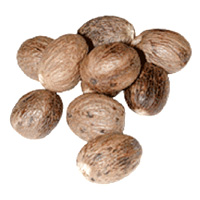
Nutmeg, spice consisting of the seed of the Myristica fragrans, a tropical, dioecious evergreen tree native to the Moluccas or Spice Islands of Indonesia. Geographical Sources : The nutmeg tree, Myristica fragrans, is indigenous to the Moluccas in Indonesia but has been successfully grown in other Asian countries and in the Caribbean, namely Grenada. Banda Islands, Malayan Archipelago, Molucca Islands, and cultivated in Sumatra, French Guiana Composition :Nutmeg and mace contain 7 to 14 percent essential oil, the principal components of which are pinene, camphene, and dipentene. Nutmeg on expression yields about 24 to 30 percent fixed oil called nutmeg butter, or oil of mace. Dried kernel of the seed. Varieties :Whole nutmegs are grouped under three broad quality classifications:
Method of Processing :When fully mature it splits in two, exposing a crimson-coloured aril, the mace, surrounding a single shiny, brown seed, the nutmeg. The pulp of the fruit may be eaten locally. After collection, the aril-enveloped nutmegs are conveyed to curing areas where the mace is removed, flattened out, and dried. The nutmegs are dried gradually in the sun and turned twice daily over a period of six to eight weeks. During this time the nutmeg shrinks away from its hard seed coat until the kernels rattle in their shells when shaken. The shell is then broken with a wooden truncheon and the nutmegs are picked out. Dried nutmegs are grayish-brown ovals with furrowed surfaces. Large ones may be about 1.2 inches long and 0.8 inch in diameter. Traditional Ethnic Uses :it is used to flavour many kinds of baked goods, confections, puddings, meats, sausages, sauces, vegetables, and such beverages as eggnog. The spices in their ground form are mainly used in the food processing industry, principally in the seasoning of meat products; they are also used in soups, sauces, baked goods and spice mixes Both spices have similar taste qualities; mace is more popular because of its light orange colour in light coloured foods. Nutmeg, in general, tends to be sweeter and more delicate. These products are also used in the perfumery and pharmaceutical industries. Taste and Aroma :Nutmeg has a characteristic, pleasant fragrance and slightly warm taste.
 MR. VIVEK KARWA, MR. VIVEK KARWA (KARWA EXPORTS PVT. LTD.)
 ROOM NO. 407, 4TH FLOOR, CITY CENTRE, 63/2, THE MALLKANPUR, Mall Road, Uttar Pradesh, India
 Share us via