
 GST : 09AMPPJ0457M1ZI
 Write a Review
Our Services
We offer a complete product range of Drone Survey Service, Existing Survey Service, Quantity Surveying Service and Cross Section Survey Service
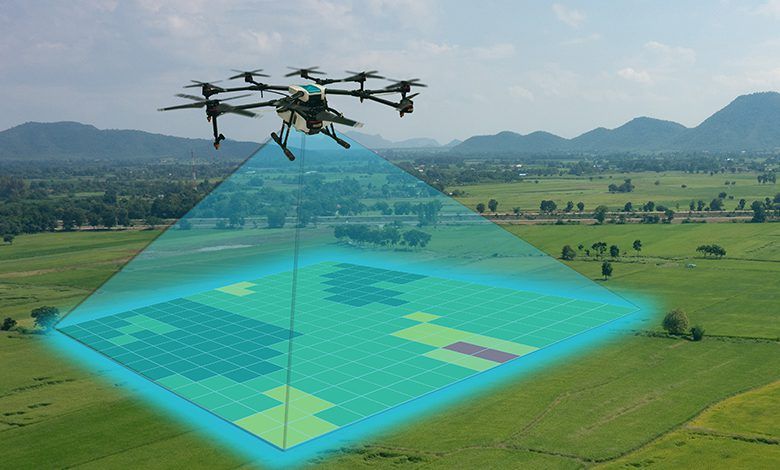
A drone survey uses unmanned aerial vehicles (UAVs) equipped with sensors like cameras and LiDAR to capture data from above, creating high-resolution maps, 3D models, and other geospatial information. This method is faster, more cost-effective, and safer than traditional surveying, especially for large or hard-to-reach areas. It is used across industries like civil engineering, agriculture, and urban planning.

Existing Surveyor – Accurate Documentation of Developed Sites
An Existing Surveyor specializes in conducting surveys of already developed or partially developed land, buildings, and infrastructure. Unlike preliminary land surveys, an existing survey focuses on documenting current site conditions, boundaries, and structures to provide accurate records for renovation, redevelopment, or compliance purposes. This type of survey is crucial for architects, engineers, property developers, and government authorities who require reliable data about the present state of a property.
Using modern instruments like Total Station, GPS/DGPS, Auto Levels, Drones, and GIS mapping tools, existing surveyors capture detailed measurements of land, roads, utilities, drainage systems, and built-up areas. The collcted data is then converted into CAD drawings, contour maps, or digital 3D models, which are used for planning extensions, upgrades, or legal verifications.
Key Applications of Existing Surveys:
Property Documentation: Verifying current boundaries and building dimensions.
Renovation & Redevelopment: Providing base maps for architects and engineers to plan modifications.
Infrastructure Upgrades: Surveying roads, pipelines, and electrical networks before expansion.
Legal & Compliance Needs: Preparing accurate reports for government approvals and dispute resolution.
As-Built Drawings: Recording completed construction for project handover and records.
An Existing Surveyor works closely with real estate developers, construction companies, and municipal bodiesto ensure that projects are based on updated site information. Their surveys help prevent costly errors, ensure legal compliance, and provide clarity for future planning*
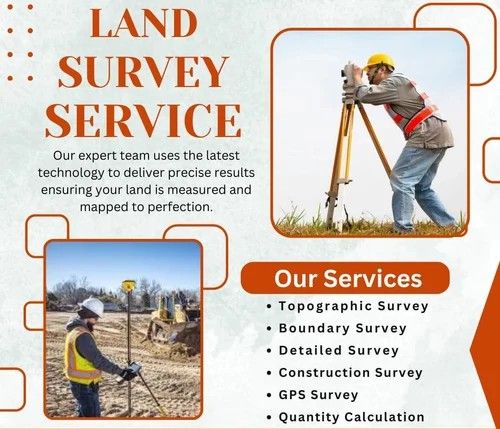
Quantity Surveying by TS" most likely refers to using a Total Station (TS), DGPS AND DRONE a modern surveying instrument, for quantity surveying tasks, which involves using the TS for site surveys to gather data like distances and angles to estimate and cost construction materials and labor. This method uses the TS's ability to measure and record coordinates and distances, which are then downloaded and processed on a computer for accurate measurements and map production.

Cross Sectional Survey – Accurate Terrain Profiling for Infrastructure Projects
A Cross Sectional Survey is a specialized type of land and engineering survey used to measure and represent the shape, elevation, and profile of the ground at regular intervals along a specific alignment. This survey is essential for infrastructure projects such as roads, railways, canals, pipelines, bridges, and drainage systems, as it provides accurate data on terrain variations and ground levels.
Using advanced instruments such as Total Station, GPS/DGPS, Auto Level, and Drone Technology, surveyors collect detailed information at fixed intervals along the alignment. This data is then used to create cross-sectional drawings** that represent the vertical profile of the land in relation to the project design.
Key Applications of Cross Sectional Surveys:
 Mr. PJ Khan (ICS Technologies)
 1B1, Geeta Puri, Gomti Nagar, Lucknow, Uttar Pradesh - 226010, India
 https://www.mysurveyor.in
 Share us via