Write a Review
Our Products
We offer the best product range of FLOW CHANNEL (HYDRAULIC BENCH ACCESSORIES), HYDRAULIC RAM (HYDRAULIC BENCH ACCESSORIES), FLUID PROPERTIES (HYDRAULIC BENCH ACCESSORIES), METACENTRIC HEIGHT (HYDRAULIC BENCH ACCESSORIES) and KAPLAN TURBINE (HYDRAULIC BENCH ACCESSORIES).
The channel consists of a clear acrylic working section of large depth to width ratio incorporating undershot and overshot weirs at the inlet and discharge ends respectively. Water is fed to the streamlined channel entry via a stilling tank to reduce turbulence. Water discharging from the channel is collected in the volumetric tank of the Hydraulics Bench and returned to the sump for recirculation. A dye injection system incorporated at the inlet to the channel permits flow visualization in conjunction with a graticule on the rear face of the channel. Models supplied with the channel include broad and sharp crested weirs, large and small diameter cylinders and symmetrical and asymmetrical aerofoils which, in conjunction with the inlet and discharge weirs, permit a varied range of open channel and flow visualization demonstrations.
RANGE OF EXPERIMENTS
FEATURES
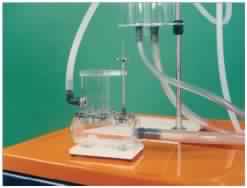
If flowing water is suddenly brought to rest in a long pipe, a phenomena known as water hammer occurs, wherein a pressure wave travels along the pipe. This principle is used in the hydraulic ram to pump water.The Hydraulic Ram comprises an acrylic base incorporating pulse and non-return valves and a supply reservoir on a stand which is fed by the Hydraulics Bench. An air vessel above the valve chamber smooths cyclic fluctuations from the ram delivery. The weights supplied may be applied to the pulse valve to change the closing pressure and hence the operating characteristics.
RANGE OF EXPERIMENTS
UTILITIES REQUIRED

This apparatus provides an introduction to the fundamental properties of liquids that affect their behavior in practical applications.A clear understanding about the physical properties of fluids is essential before studying the behavior of fluids in static or dynamic applications.This apparatus introduces students to the following properties of fluids: Density and relative density (specific gravity) Viscosity Capillarity capillary elevation between flat plates and in circular tubes Buoyancy (Archimedes principle) Atmospheric pressure The apparatus consists of a collection of components that demonstrate individual fluid properties. The components are stored on a common support frame with circular spirit level and adjustable feet for leveling. The apparatus is designed to stand on a suitable bench top where some of the components can be operated independent from the support frame. A freestanding dual scale lever balance is also supplied to support several of the demonstrations.
RANGE OF EXPERIMENTS
COMPNENTS
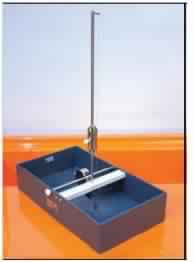
This equipment allows a thorough investigation of the factors affecting the stability of a floating body. The position of the metacentre can be varied to produce stable and unstable equilibrium. The equipment consists of a rectangular floating pontoon, the centre of gravity of which can be varied by an adjustable weight which slides and can be clamped in any position on a vertical mast. A single plumb-bob is suspended from the mast which indicates the angle of heel on a calibrated scale. A weight with lateral adjustment allows the degree of heel to be varied and hence the stability of the pontoon determined.
RANGE OF EXPERIMENTS

This demonstration turbine provides a simple low cost introduction to the Kaplan (axial flow) turbine showing its construction, operation and performance. A tapering, spiral shaped volute conveys water to the runner via a ring of guide vanes that are adjustable in angle to vary the flow through the turbine. Water enters the runner tangentially at the periphery, flows axially outward through the blades towards the hub then exits axially via a draft tube. Power generated by the turbine is absorbed by a Prony friction brake consisting of a pair of spring balances attached to a brake belt that is wrapped around a pulley wheel driven by the runner. The load on the turbine is varied by tensioning both spring balances which increases the friction on the pulley wheel. Brake force is determined from the difference in the readings on the two spring balances and the torque calculated from the product of this force and the pulley radius. The head of water entering the turbine is indicated on a Bourdon gauge and the speed of rotation is measured using a non-contacting tachometer (not supplied).The volute of the Kaplan turbine incorporates a transparent front cover for clear visualisation of the runner and guide vanes.
RANGE OF EXPERIMENTS
UTILITIES REQUIRED
 Mass International (Mass International)
 #93, Preet Nagar, Jagadhri Road, Cantt , , Ambala, Haryana, India
 Share us via