 Write a Review
Our Products
Our Complete range of products are FLUID FRICTION APPARATUS (HYDRAULIC BENCH ACCESSORIES), CAVITATION DEMONSTRATION, Fluid Mechanics Apparatus, Hydraulic Bench and IMPACT OF JET ON VANES.

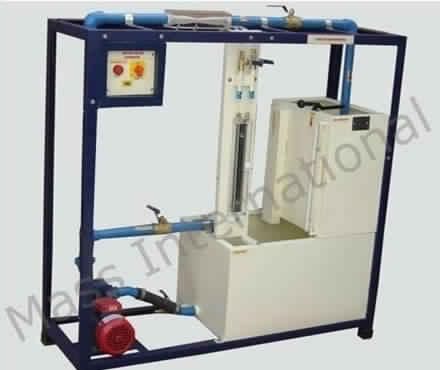
The unit consists of a tubular steel framework which supports the network of pipes and fittings for test. Pipe friction experiments are carried out using four smooth pipes of different diameters, plus one roughened pipe. Short samples of each size test pipe are provided loose so that the students can measure the exact diameter and determine the nature of the internal finish. A system of isolating valves is provided whereby the pipe to be tested can be selected without disconnecting or draining the system. A selection of pipe fittings and valves are fitted around the network and are fitted with pressure tapings. A clear acrylic pipe section incorporates a Venturi, orifice plate and Pitot tube. Pressure tappings are fitted with quick action self-sealing connections. Probe attachments are provided with tubing so that any pair of pressure tapings can be rapidly connected to appropriate instrumentation, eg. a manometer
RANGE OF EXPERIMENTS

The apparatus consists of Venturi-shaped test section manufactured from clear acrylic to allow full visualization of flow conditions inside the section.The test section incorporates tappings that allow the static pressure upstream of the contraction, inside the throat and downstream of the expansion to be measured. Each tapping is connected to a Bourdon gauge of appropriate range.A flow control valve upstream of the test section allows the flow through the test section to be regulated without raising the static pressure in the test section, allowing Cavitation to be clearly demonstrated. Conversely a flow control valve downstream of the test section allows the static pressure in the test section to be elevated a technique used to prevent cavitation from occurring.The closure of the downstream valve is restricted to prevent damage to the instrumentation. The test section and Bourdon gauges are mounted on a plate with feet.
DEMONSTRATION CAPABILITIES
PRODUCT SPECIFICATIONS
Fluid Mechanics& Particle Lab. (Close Circuit Type)(Chemical, Mechanical & Civil Lab) (With & Without Data Logging)(Computerized & Non Computerized)
DESCRIPTION
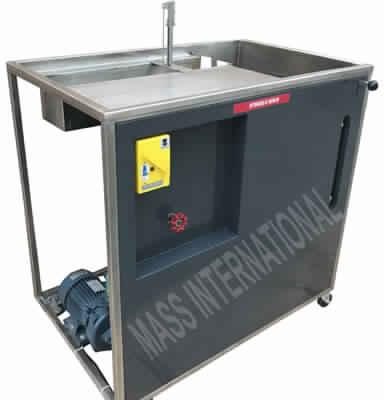
The present set-up is a self-contained, water re-circulating unit provided with a top tray and a sump tank. Various hydraulics experiments can be conducted on this set-up. A Centrifugal Pump is fitted for water circulation. Flow control valve and by-pass valve are fitted in water line to conduct the experiment on different flow rates. Flow rate of water is measured with the help of measuring tank and stop watch. Water collected on the top tray from experimental set-up, drains and return to sump tank.
EXPERIMENTS
Following experiments can be carried out with common basic table, with separate experimental set-ups (supplied at extra cost), which can be connected to hydraulic bench with flexible pipe:

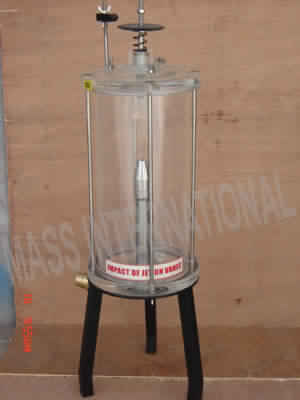
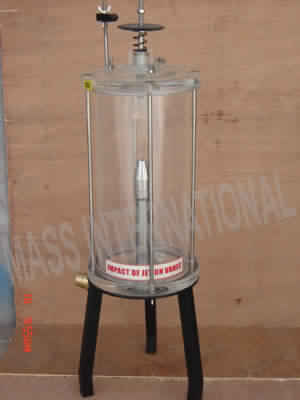
The setup consists of a clear fabrication section. Water is fed through a nozzle and discharged vertically to strike a target carried on a stem, which extends through the cover. A weight carrier is mounted on the upper end of the stem. The dead weight of the moving parts is counter balanced by a compression spring. The vertical force exerted on the target plate is measured by adding the weights supplied to the weight pan until the mark on the weight pan corresponds with the level gauge. A total of two targets are provided, a flat plate and a hemispherical cup.
RANGE OF EXPERIMENTS
FEATURES
UTILITIES REQUIRED
The apparatus consists of a glass tube with one end having bell mouth entrance; connected to a constant headwater tank, at the other end a valve is provided to vary the flow rate. The tank is of sufficient capacity to store water; a capillary tube is introduced centrally in the bell mouth for feeding dye from a small container placed at the top of tank, through PVC tubing. By varying the rate of flow, the Reynolds number is changed. This also changes the type of flow. Visual observation of dye (Thread) will indicate the type of flow, which can be confirmed from the Reynolds number computed. The set-up can be connected to Hydraulic Bench with flexible pipeline.
RANGE OF EXPERIMENTS
THE APPARATUS CONSISTS OF A GLASS TUBE WITH ONE END HAVING BELL MOUTH ENTRANCE; CONNECTED TO A CONSTANT HEADWATER TANK, AT THE OTHER END A VALVE IS PROVIDED TO VARY THE FLOW RATE. THE TANK IS OF SUFFICIENT CAPACITY TO STORE WATER; A CAPILLARY TUBE IS INTRODUCED CENTRALLY IN THE BELL MOUTH FOR FEEDING DYE FROM A SMALL CONTAINER PLACED AT THE TOP OF TANK, THROUGH PVC TUBING. BY VARYING THE RATE OF FLOW, THE REYNOLDS NUMBER IS CHANGED. THIS ALSO CHANGES THE TYPE OF FLOW. VISUAL OBSERVATION OF DYE (THREAD) WILL INDICATE THE TYPE OF FLOW, WHICH CAN BE CONFIRMED FROM THE REYNOLDS NUMBER COMPUTED. THE SET-UP CAN BE CONNECTED TO HYDRAULIC BENCH WITH FLEXIBLE PIPELINE.
RANGE OF EXPERIMENTS

The Setup is designed to demonstrate the properties of Newtonian fluids and their behaviour under hydrostatic conditions (fluid at rest). This enables students to develop an understanding and knowledge of a wide range of fundamental principles and techniques, before studying fluids in motion. These include the use of fluids in manometers to measure pressure and pressure differences in gases and liquids. Some simple exercises are included to show how the behaviour of a fluid changes when flow is involved and the relevance of concepts such as frictional losses. The apparatus is constructed from PVC and clear acrylic and consists of a vertical reservoir containing water that is connected to a series of vertical manometer tubes. These tubes can be used individually or in combination for the different demonstrations of hydrostatic principles and Manometry. One tube includes changes in cross section to demonstrate that the level of a free surface is not affected by the size or the shape of the tube. The right hand manometer tube is separate from the other tubes and incorporates a pivot and indexing mechanism at the base that enables this tube to be inclined at fixed angles of 5, 30, 60 and 90 (vertical). The reservoir incorporates a hook and point gauge with Vernier scale, mounted through the lid, that enables large changes in level to be measured with better precision than a simple scale. A vertical transparent piezometer tube through the lid of the reservoir enables the static head above the water in the reservoir to be observed when the air space above the water is not open to atmosphere. Connections at the top of the reservoir and each of the manometer tubes enables a syringe to be connected using flexible tubing that permits the static pressure of the air to be varied positively or negatively as required for the various demonstrations. The syringe and flexible tubing for filling the equipment etc. are stored at the rear of the apparatus when not in use for convenience. A small flow can be induced through the interconnecting pipework between the various manometer tubes to provide a simple but clear demonstration of the effect of friction created by the motion of the fluid. This is useful to the student before performing demonstrations using more advanced Fluid Dynamics accessories. The equipment is designed to demonstrate the basic principles of hydrostatics and Manometry using water for safety and convenience. The use of a safe, soluble food dye in the water makes observation of the level changes clearer without affecting the operation of the apparatus. Alternative liquids, with different densities, can be used in the U tube manometer if required to extend the range of the demonstrations.
RANGE OF EXPERIMENTS
COMPNENTS

The apparatus is used to demonstrate that the pressure at the bottom of a liquid column in a vessel depends only on the height of the column but not on the shape of the vessels. The equipment consists of a tapered glass socket fitted into a base block held to a stand by a rod. The other side of the base block also has a rod holding a pivot supporting a lever. One end of the lever is a pressure disc against the bottom of the base block while the other end of the lever has a sliding weight hanger with weights. Glass vessels of different shapes can alternatively fit on the tapered glass socket. Height of water column is measured by a scale.
TECHNICAL DETAILS
Tapered glass socket with base block, rod holder, lever and pressure disc. Glass vessels: straight, offset, reduced and conical. Weight hanger and weight. Stand and a pan Dimensions / Weight: 200 x 300 x 770 mm / ca. 3.4 kg.
The whole setup is well designed and arranged in a good quality painted structure.

The experimental set up consist of a circular transparent cylindrical tank in which four circumferential jets have been placed along the circumference of the cylinder near its bottom which helps in the formation of free vortex. (It is assumed that the torque exerted by these jets is negligible). The Orifice is provided with a reducing bush so that a reduced diameter can be investigated. The plate can also be rotated with the help of a variable speed motor so that the cylinder rotates about its vertical axis with the help of a V belt and forced vortex is formed. Conditions were allowed to steady state and the depth of flow at any particular point was observed not to change over a period of time. The experimental procedure involves measurement of the resulting free surface that represents the variation of the sum of the pressure head and datum head.
RANGE OF EXPERIMENTS

It demonstrates that the buoyancy acting on a body submerged in a liquid corresponds to the weight of the displaced liquid. The equipment consists of a solid stainless steel cylinder fits exactly into a hollow acrylic cylinder. Both cylinders have hooks for attachment to a spring balance hung on a stand. A beaker holding a liquid provides the buoyancy.
TECHNICAL DETAILS
Cylinder dimension: 40mm Diameter x 80 mm Long Spring balance: 1 kg Beaker: 1000 m Dimensions / Weight: 200 x 300 x 770 mm / ca. 3 kg
The whole setup is well designed and arranged in a good quality painted structure.
 Mass International (Mass International)
 #93, Preet Nagar, Jagadhri Road, Cantt , , Ambala, Haryana, India
 Share us via








