Write a Review
Our Products
Our product range contains a wide range of Drywall Screws
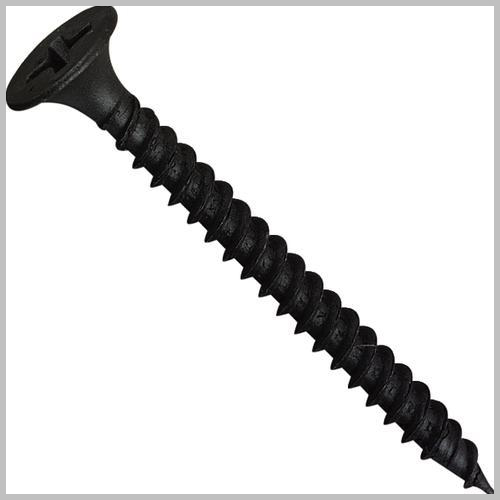
Drywall Screw is a specialized self-tapping screw with a cylindrical shaft. These screws almost always have a Phillips Bulge Head rather than a slotted head, which provides additional control for installers. In addition of a standard drill, installers also use a tool known as a drywall dimpler, which has an adjustable nose to install a drywall screw without tearing the paper on each sheet. A standard drywall screw can be readily identified by its black finish. This black coloring comes from a phosphate mineral coating that is applied to these screws. This coating helps to minimize rusting and corrosion as the screws are exposed to wet joint compound or paint.
Features| 1)The primary benefit offered by drywall screws is their Bugle Head. This means that the entire screw lies flush with the surface of the sheet, creating a smooth and even finish. | |
| 2)Less prone to getting pulled through the wood due to Bugle Head. | |
| 3)This type of head also helps prevent the drywall screw from breaking the paper surface, a common problem with nails. | |
| 4)Drives fast and efficient. | |
| 5)The black head adds to the decorative appeal. | |
| 6)Fairly thin, so they are less likely to split the wood. | |
| 7)Threaded through entire length thereby maximizing gripping power. | |
| 8)Good Corrosion resistance due to black phosphate coating. | |
| 9)Easy to install and remove. | |
| 10)Head does not sink into the wood easily as does with other wood screws. | |
| 11)Precise cutting edges to improve drill performance with less effort. | |
| 12)Relatively Cheap. | |
| 13)At least 3 times the pull-out strength of nails. |
| 1)Original and primary application is to stitch Drywall to wood studs. Also used in many interior wood and fixture fastening applications. | |
| 2)Used to rapidly attach drywall to metal studs for commercial buildings. | |
| 3)Used where flat surface required after drill. | |
| 4)Used where already pre-drilled holes are prepared for fitting. |
| 1)For the specified anchor size, select carbide or core drill bit with nominal diameter as listed below in Table. | |
| 2)Drill hole to depth listed below. | |
| 3)Essentially clean holes with brush and blower. | |
| 4)Remove debris with hole cleaning pump, compressed air or with a brush. | |
| 5)If the holes are wet or flooded, clean hole with brush. | |
| 6)Insert Capsule into hole. | |
| 7)Spin in Welfast Stud as per required anchorage depth using a rotary hammer drill. | |
| 8)Allow adhesive to cure for the time as listed below. | |
| 9)When cured, tighten nut applying the necessary tightening torque. | |
| Technical Descriptions Suitable for :
|
 Himanshu Shah (Om Fastener)
 106, Narayan Dhuru Street, Mumbai, Nagdevi, Maharashtra - 400003, India
 Share us via