My ExportersIndia

For Buyer

For Seller

For Help

Termiticide

Our Complete range of products are Chlorpyriphos 1.5% D.P Insecticide, Thiamethoxam 25% WG Insecticide, Thiamethoxam 75% SG Insecticide, Fipronil 4% + Thiamethoxam 4% SC Insecticide and Imidacloprid 17.8% SL Insecticide.
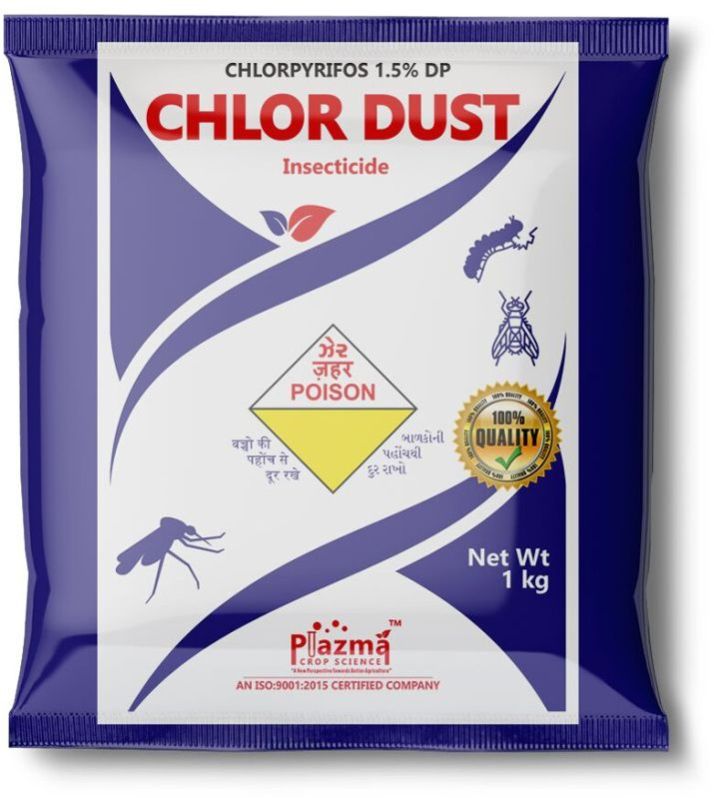
Chlorpyriphos 1.5% D.P Insecticide

  • Min. Order (MOQ) 25 Kilogram
  • Brand Name Plazma Crop Science
  • Country of Origin India
  • State Powder
  • Packaging Type Plastic Packet
  • Packaging Size 1 Kg
  • Technical Name Chlorpyriphos 1.5% D.P
  • Generic Name Chlor Dust

An organophosphorus dust insecticide for the control of crop pests only.

Caution : Toxic to aquatic organisms hence should not be used near water bodies, aquaculture or pisciculture. It is toxic to honeybees, spray application should be avoided during foraging period of bees. Product is highly toxic to birds hence avoid use near bird habitat.

Direction of Use

Knapsack below duster, hand operated rotary duster, battery operated knapsack sprayer cum duster etc.

Precaution
  • Keep away from foodstuffs, empty foodstuff containers and animals food.
  • Avoid contact with mouth, eyes and skin.
  • Avoid inhalation the dust particles. Dust in the direction of wind.
  • Wash thoroughly the contaminated clothes and parts of the body after dusting.
  • Do not smoke, drink, eat and chew anything while dusting.
  • Wear full protective clothing while dusting.
Symptoms Of Poisoning

Headache, giddiness, vertigo, Nausea, Vomiting, Blurred vision, Diarrhoea, Convulsions, Sweating, execessive, lacrimation and salivation may occur

First Aid
  • If swallowed, induce vomiting by tickling the back of throat. Repeat it until the vomitus is clear. Do not induce vomiting if the patient is unconscious.
  • If clothing and skin are contaminated, remove the cloths and wash the contaminated skin with copious amount of soap and water.
  • If eyes are contaiminated, flush with plenty of saline/clean water for about 10 to 15 minutes.
  • If inhaled, remove the patient to fresh air.
Antidote
  • Atropinize the patient immediately and maintain full atropinization by repeated doses of 2 to 4 mg. of atropine sulphate intravenously at 5 to 10 minutes interval. As much as 25 to 50 mg. of atropine may be required in a day. The need for further atropine administration is guided by the continuance of symptoms. Extent of salivation is a useful criterion for dose adjustment.
  • Dissolve 1-2 gm of 2 PAM in 10 ml distilled water and inject intravenously very slowly for 10-15 minutes.
Disposal Of Used Container
  • Packages shall be broken and burried away from habitaion.
  • The used packages shall not be left outside to prevent their reuse.
  • Packages or surpuls materials and washing from the machines and contianers should be disposed off in safe manner so as to prevent environmental of water pollution.
Storage Conditions
  • The pesticides shall be stored in a separate rooms or premises form the rooms or pesticides meant for storing other articels, particularly articels offood, shall be kept in separate almirah under locke and key depending upon the quantity and nature of the insecticides.
  • The rooms or premisies meant for storing the insecticide shall be well built. Dry well lit and ventilated and of sufficient dimension to avoid conteminated with vapour.
View Complete Details

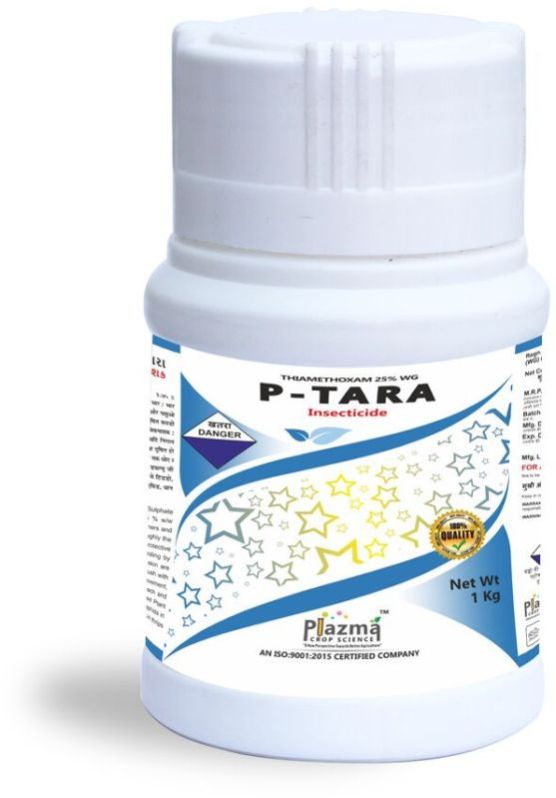
Thiamethoxam 25% WG Insecticide

  • Min. Order (MOQ) 25 Kilogram
  • Application Agriculture
  • Brand Name Plazma Crop Science
  • Purity 100%
  • State GRANULE
  • Country of Origin India
  • Packaging Type Plastic Bottle
  • Packaging Size 1 Kg
  • Technical Name Thiamethoxam 25% WG
  • Generic Name P-Tara

Thiamethoxam 25 % WG is broad spectrum systemic insecticide having quick stomach and contact action and is recommanded for its use to control Stem Borer, Gall Midge, Leaf Folder, Brown Plant Hopper (BHP), while Backed Plant Hopper (WBPH) Green Leaf Hopper (GLH) , Thrips, in rice; jassids, aphids and whiteflies in cotton; hoppers in mango; aphids in Wheat; aphids in Mustard; Whiteflies in Tomato; Whiteflies, Jassids in Brinjal; mosquito bug in Tea, aphids in Potato, Psylla in citrus, aphid in Cumin, soil drenesh in Rice, Aphid in Cumin and GLH thrips , shorl maggat in Rice (Nursary) . It contains 250g Thiamethoxam as an active ingredient in a kg of the product (w/w).

Direction of Use

Measure out requred quantity of the product and mix it well with a small quantity of water. Add the remaining quantity of water as specified with thorough agitation for total coverage of crop with suitable sprayer.

P.P. Equipment:- Knapsack sprayer, foot sprayer, compression knapsack sprayer, Compression knapsack battery sprayer, Battery operated kpower sprayer and ASPEE-HTP power sprayer.

Time of Application

    • Mango: Hoppers (Apply first spray during initial pest appearance and repeat one or two sprays at 15 days interval depending on the level of pest intensity)
    • Potato: Foliar-application- Apply first spray during initial pest appearance and repeat 2-3 sprays at 10-15 days interval depending on the level of pest intensity.

Soil drench: Apply root zone before appearance of pest as soil drench, once during the crop season.

    • Cotton: Apply first spray at 25-30 DAS or at the time of first pest appearance and repeat 2-3 sprays at 15 days interval depending on the pest intensity.
    • Wheat: Apply first spray during initial pest appearance and repeat one or two sprays at 15 days interval depending on the level of pest intensity.
    • Tea: Apply first spray during initial pest appearance and repeat 2-3 sprays at 15-21 days interval depending on the level of pest intensity.
    • Tomato: Apply first spray during initial pest appearance and repeat 2-3 sprays at 10-15 days interval depending on the level of pest intensity.

Soil drench: Apply root zone before appearance of pest as soil drench, once during the crop season.

  • Rice: One spray at 25-30 DAT in the early stage of crop for control of early rice pests such as Stem Borer, Gall Midge and the other spray at the booting leaf stage (@ 50 to 55 DAT) for the control of late rice pests such as GLH, BPH, WBPH etc.
  • Brinjal: Apply first spray during initial pest appearance and repeat 2-3 sprays at 10-15 days interval depending on the level of pest intensity.
  • Okra: Apply first spray during initial pest appearance and repeat one or two sprays at 15 days interval depending on the pest intensity.
  • Mustard: Apply first spray during initial pest appearance and repeat one or two sprays at 15 days interval depending on the level of pest intensity.
  • Citrus: Apply first spray during initial pest appearance and repeat 2-3 sprays at 15-21 days interval depending on the level of pest intensity.

Precaution

  • Keep away from foodstuffs, empty foodstuff containers and animals food.
  • Avoid contact with mouth, eyes and skin.
  • Avoid inhalation the spray mist. Spray in the direction of wind.
  • Wash thoroughly the contaminated clothes and parts of the body after spraying.
  • Do not smoke, drink, eat and chew anything while spraying.
  • Wear full protective clothing while mixing and spraying.

Symptoms Of Poisoning

Decrease spontaneous movement, tonic conulsion, ptosis may occur.

First Aid

  • If swallowed, induce vomiting by tickling the back of throat. Repeat it until the vomitus is clear. Do not induce vomiting if the patient is unconscious.
  • If clothing and skin are contaminated, remove the cloths and wash the contaminated skin with copious amount of soap and water.
  • If eyes are contaiminated, flush with plenty of saline/clean water for about 10 to 15 minutes.
  • If inhaled, remove the patient to fresh air.

Antidote

No specific antidote is known. Treat symptomatically.

Disposal Of Used Container

  • Packages or surplus materials and washing form machines and containers should be dispose off in a safe manner as to prevent environment and water pollution.
  • The used packages shall not be left outside to prevent their reuse.
  • Packages shall be broken and burried away from habibtation.

Storage Conditions

  • The package containing the insecticide should be stored in orignal containers inseparate rooms or premises away from rooms or premises used for storing othe article particularly articles of food or shall be kept in separate almirahs under lock and key.
  • The rooms or premises menat for storing the insecticide shall be built, dry, well lit and ventlated and of sufficient dimension to avoid contamination with vapour.
View Complete Details

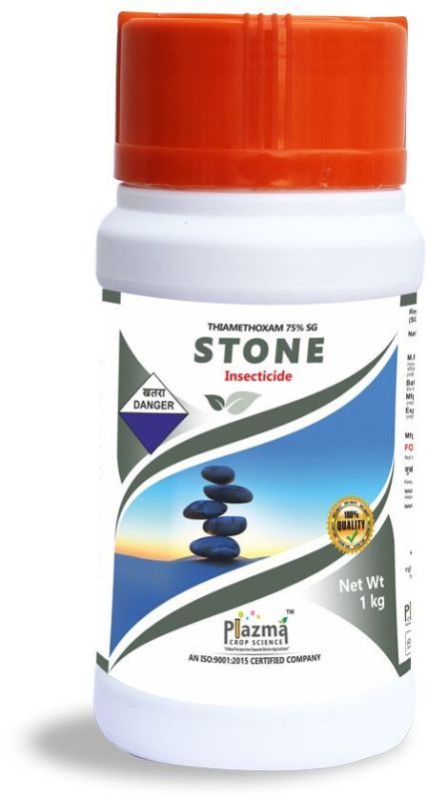
Thiamethoxam 75% SG Insecticide

  • Min. Order (MOQ) 25 Kilogram
  • Application Agriculture
  • Brand Name Plazma Crop Science
  • Purity 100%
  • State GRANULE
  • Country of Origin India
  • Packaging Type Plastic Bottle
  • Packaging Size 1 Kg
  • Technical Name Thiamethoxam 75% SG
  • Generic Name Stone

Thiamethoxam 75% w/w SG is a broad spectrum systemic insecticide, recommended for its use to control termites in Groundnut, Termite & Early shoot borer in sugarcane, Greenleaf hopper & brown plant hopper in rice and Jassids & thrips in cotton crop.

Direction of Use

Direction for use in Groundnut, Sugarcane & cotton: Measure out required quantity of the product and mix it well with a small quantity of water. Add the remaining quantity of water as specified with thorough agitation and apply as soil drenching in crops.

Direction for use in Rice: Measure out required quantity of the product and dissolve in 500ml of water to make solution for mixing and broadcasting with sand @20 kg/ha.

Time of Application

It contain 750 g Thiamethoxam as an active ingredient in one kg of the product.

Precaution

Do not use cooking utensils for preparing solutions. Use sticks for stirring the solution. Wear gloves to avoid contact with the skin. Also avoid inhalation and contact with eyes. Wear protective clothing, mask, goggles, boots while preparing the solution. Do not blow nozzles with mouth. Do not eat, drink or smoke while handling or applying the product. Do not store unused solution. Clean sprayer, buckets and other utensils with water daily after use. Wash hands with soap and plenty of water and change clothes after the work is over. Also wash the contaminated clothes. Do not allow drifting onto rivers, lakes, ponds ditches or other waterways. Do not allow discharging left over applied material or empty containers to contaminated waterways. The product should not be applied during flowering of the crop. Do not use the product where bees are actively foraging. Do not allow drift to flowering weeds, hedges or flowering crops in the vicinity of the treatment area. Do not apply if a high amount of aphids honeydew is present in the treatment area. Do not apply on flowering crops between 5 days before start of flowering and 5 days after flowering. In case of any sign of poisoning immediately consult the doctor.

Symptoms Of Poisoning

Poisoning may cause symptoms of decrease in spontaneous movement, toxic to convulsion and ptosis.

First Aid

Remove the affected person from the danger zone to a well-ventilated rooms or to fresh air and protect from undercooling.

In case of suspected poisoning: Immediately call a physician.

In case of skin contact: Remove contaminated clothing and thoroughly wash the affected parts of the body with soap and water.

In case of eye contact: Rinse eyes with clean water for several minutes and immediately call a physician.

In case of ingestion: Repeatedly administer medicinal charcoal in a large quantity of water.

Note: Never give anything by mouth to an unconscious person. Do not induce vomiting.

Antidote

No specific antidote is known. Apply symptomatic therapy.

Disposal Of Used Container

  • Packages or surplus material and washings from the machines and container should be disposed off in a safer manner so as to prevent environment pollution.
  • The used packages shall be not left outside to prevent their re-use.
  • Packages shall be broken and buried away from habitation.

Storage Conditions

  • The packages containing the insecticides should be stored in original container in separate rooms or premises away from the rooms or premises used for storing other articles, particularly, food or shall be kept in separate almirahs under lock and key.
  • The rooms or premises meant for storing the insecticides shall be well lit, dry, well lit and ventilated and of sufficient dimensions to avoid contamination with vapors.
View Complete Details

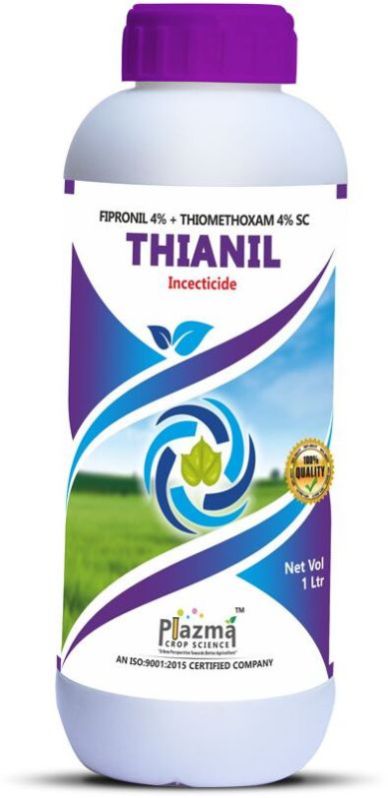
Fipronil 4% + Thiamethoxam 4% SC Insecticide

  • Min. Order (MOQ) 25 Litre
  • Brand Name Plazma Crop Science
  • Application Agriculture
  • Purity 100%
  • State Liquid
  • Country of Origin India
  • Packaging Type Plastic Bottle
  • Packaging Size 1 Ltr.
  • Technical Name Fipronil 4% + Thiamethoxam 4% SC
  • Generic Name Thianil

Fipronil 4% + Thiamethoxam 4% SC is a unique combination of a new generation phenyl pyazole compound. Fipronil and a nconicotinoid, thiamethoxam. The combination product formulation presents excellent synergism through contact, systemic and residual activity on the target pests. Fipronil which remains on the surfaced of the plants. Thiamethoxam is translocated in plants and provide long term inherent protection against target insects-pest. It is a safe to use formulation.

Direction of Use

Method of application : It should be applied as foliar spray. No specific soil and condition are prescribed. Uniform coverage is necessary for effective control of insects-pests. A simple knapsack sprayer fitted with hollow cone nozzle type can be used for spraying.

Shake well before use Warning:

  • Not to be used on crops and pests other than mentioned on label and leaflet.
  • No to be used for post harvest application.
  • Do not spray during active bee for aging period of the day
  • More toxic to fish, hence harmful to aquatic organism therefore, not be used near aquaculture and rice-fish farming. Do not contaminate lakes, rivers, ponds and streams.
Time of Application

Preparation of Spray Solution: Mix the recommended dose in ¼ of the recommended quantity of water to the spray tank with agitation. Add remaining quantity of water with continuous agitation. Ensure complete dispersion of the product in mix water before spraying of the spray solution. Maintain agitation while spraying.

Apply as soon as the insect population begins to appear in the field but before it reaches Economic Threshold (ETL). Weather should be clear, calm, no rains and no strong winds.

No. of application: 2 sprays are required at an interval of 15 days, depending upon the pest infestation. Not more than two sprays in a season.

Re-entry Period: Do not allow entry into treated area until spray has dried.

Precaution

Protective clothing should be worn while mixing and spraying. Wash contaminated clothes and body parts of the body after application. Avoid inhalation. Do not smoke, drink, eat and chew anything during application.

Symptoms Of Poisoning

It may causes irritability, lethargy and muscle tremors and in extreme cases possibly convulsions may occur. Decrease spontaneous movement, tonic conclusion, ptosis may occur.

First Aid

Remove the person from the contaminated environment.

In case of skin contact: Wash material off the skin in flowing water or shower with soap. If irritation persists consult a physician immediately. Eye Contact: Immediately flush with sufficient amount of water for atleast 15 minutes.

Inhalation: Remove the victim to fresh air and keep him warm and quiet. Get a medical attention immediately. If not breathing, clear the airways and give artificial respiration. If breathing is difficult, give oxygen.

Ingestion: Do not induce vomiting unless told to by doctor. Do not give anything to unconscious person. Have person sip a glass of water if able to swallow. Get medical attention immediately.

Antidote

No specific antidote is known. Apply symptomatic therapy.

Disposal Of Used Container
    • Packages or surplus material and washing from the machines and containers should be disposed off in a safe manner so as to prevent environmental and water pollution.
    • The used packages shall not be left outside to prevent their re-use.
    • Packages shall be broken and buried away from the habitation.

“DANGERIOUS TO BE USED EMPTY CONTAINER”

Storage Conditions
  • The packages containing insecticide shall be stored in separate rooms or premises away from the rooms or premises used for storing other articles particularly food articles or shall be kept in separate almirahs under lock and key depending upon the quantity and nature of the insecticide. Keep out of reach of children.
  • The store rooms should be well built well lit, well ventilated and of sufficient dimensions. The conditions of the store should be dry and cool.
View Complete Details

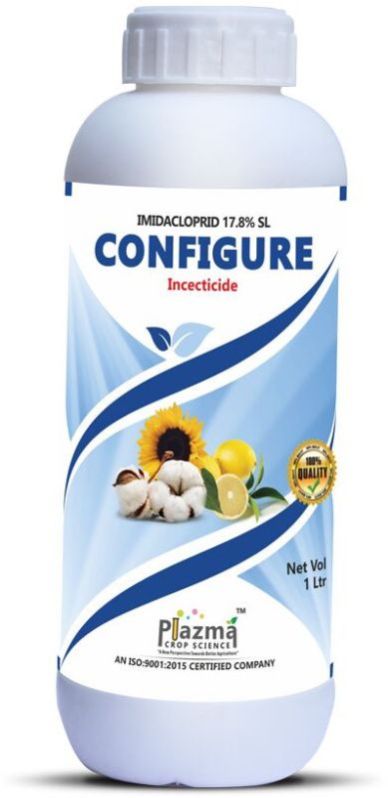
Imidacloprid 17.8% SL Insecticide

  • Min. Order (MOQ) 25 Litre
  • Brand Name Plazma Crop Science
  • Application Agriculture
  • Purity 100%
  • State Liquid
  • Country of Origin India
  • Packaging Type Plastic Bottle
  • Packaging Size 1 Ltr.
  • Technical Name Imidacloprid 17.8% SL
  • Generic Name Configure
( Systemic Insecticide )

Imidacloprid 17.8% SL is a systemic insecticide containing Imidacloprid active ingredient balance auxiliaries and inert material. It is used as a spray for the control of sucking and other insects in different crops.

Direction of Use

Plant Protection Equipment: Hand operated knapsack sprayer or foot sprayer is recommended and tractor mounted sprayer can also be used.

Precaution
  • Keep away from foodstuffs, empty foodstuff containers and animals feed.
  • Aviod contact with eyes, mouth and skin.
  • Aviod inhalation the spray mist. Spray in the direction of wind.
  • Wash thoroughly the contaminated clothes and part of the body after spraying.
  • Do not smoke, drink eat and chew anything while spraying.
  • Wear full protective clothing while mixing and spraying.
Symptoms Of Poisoning

Apathy, myotonia, tremor, difficult breathing, myospasms may occur.

First Aid
  • If swallowed, induce vomiting by tickling the back of throat. Repeat it until the vomitus is clear. Do not induce vomiting if the patient unconscious.
  • If clothing and skin is contaminated, remove the clothes and wash the contaminated skin with copious amount of soap and water.
  • If eyes are contaminated, flush with plenty of saline/clean water for about 10 to 15 minutes.
  • If inhaled, remove the patient to fresh air.
Phytotoxicity

The product is not Phytotoxic when used as per field recommendation.

Antidote

No specific antidote. Treat symptomatically.

Disposal Of Used Container
  • The packages shall be broken and buried away from habitation.
  • The used packages shall not be left outside to prevent their re-use.
  • Packages or surplus material and washing should be disposed in a safe manner so as to prevent environment or water pollution.
Storage Conditions
  • The package containing the insecticide shall be stored in separate rooms or premises away from the rooms or premises used for stored other articles shall be kept in separate Almirahs under lock and key, depending on the quantity and nature of insecticides
  • The rooms or premises meant for storing the insecticide shall be well built, dry, and well lit and ventilated and sufficient dimensions to avoid contamination with vapour.
View Complete Details

Imidacloprid 30.5% SC Insecticide

  • Min. Order (MOQ) 25 Litre
  • Brand Name Plazma Crop Science
  • Application Agriculture
  • Purity 100%
  • State Liquid
  • Country of Origin India
  • Packaging Type Plastic Bottle
  • Packaging Size 1 Ltr.
  • Technical Name Imidacloprid 30.5% SC
  • Generic Name Configure Super
( Systemic and Contact Insecticide )

It is a systemic insecticide containing imidacloprid active ingredient, balance auxillaries and inert material. It is used for control of termites in buildings and for the control of Jassids, Aphids & Thrips in cotton and brown plant hopper and white Backed Plant hopper in rice .

Recommendation

It is used for control of termites in building as follows :

Pre-construction: The chemical emulsion shall be applied uniformly at the prescribed rate in all the stages of treatment. hand operated sprayer or watering can should be used for application of chemical emulsion.

Treatment of masonry foundations:

  • Bottom surface and sides of foundation pits upto a height of 30 cm should be trated @5 ltr chemical emulsion per sq. mtr. of surface area.
  • Back fill earth in immediate contact with the foundation structure should be treated @7.5 ltr. per sq. mtr. of the vertical surface of the substructure for each side.
  • Treatment of rcc foundations: treatment should start at a depth of 50 cm below ground level @ 7.5 ltr. per sq.mtr.
  • Treatment of top surface of plinth filling: the top surface of the consolidated earth within plinth walls shall be treated with chemical emulsion at the rate of 5 ltr/m2 of the surface before the sand bed or sub-grade is laid.
  • Soil treatment along external perimeter of building: earth along the external walls of the building should be rodded at intervals of 15 cm and to a depth of 30 cm exposing the foundation wall surface. chemical solution should be poured along the wall @ 7.5 ltr. per sq. mtr. of vertical surface.
  • Treatment of soil under apron along external perimeter of building: top surgface of the earth over which the apron is to be laid shall be treated with chemical solution @ 5 ltr per sq. mtr. of the vertical surface.

Post construction:

  • Soil treatment along external perimeter of building : earth along the external walls of the building should be rodded at intervals of 15 cm and to a depth of 30 cm exposing the foundation wall surface. chemical solution should be poured along the wall @ 7.5 ltr per sq. mtr of vertical surface.
  • Treatment of soil under apron along external permeter of building: top surface of the earth over which the apron is to be laid shall be treated with chemical solution @ 5 ltr per sq. mtr. of the vertical surface.
  • Treatment of soil under floor: to prevent entry of termites from cracks, soil under floor should be treated. drill 12 mm holes at the junction of floor and wall at 30 cm interval to reach the soil below squirt the chemical solution @ 1 ltr per hole and seal.
  • Treatment of voids in masonry: the movement of termites through masonry walls may be restricted by drilling holes in masonry wall at about 45 degree angle preferably from both sides of the plinth wall at 30 cm interval and squirt the chemical in holes till refusal and seal the holes.
  • Treatment of upper floors: in case of infestation in upper floors, trat ground floor of the existing building as described above.

(B) Agricultural Crops: It should be used for control of Jassids, Aphids & Thrips in cotton and brown plant hopper and white Backed Plant hopper on rice @ 21-26.25 gm a.i./ha (60-75 ml formulation) diluted in 500-750 lit water. Waiting period for cotton & rice is 26 & 37 days respectively.

Direction of Use

Imidacloprid 30.5 % SC shall be applied at 0.075% a.i. concentration i.e.2.1 ml formulated product diluted in 1 litre of water for the control of termites during pre and post construction of building. Treatment should be as per IS 6313 (Part-2) 2001 for pre-constructional chemical treatment and IS 6313(part-3)2001 for post construction treatment.

Precaution

poisonous. handle with care. do not touch or inhale the contents. while handling the contents use rubber gloves and face mask.

Symptoms Of Poisoning

apathy, myatonia, tremor, difficult breathing & myospasms.

First Aid

if the product gets into the eyes, rinse it out immediately with plenty of water. incase of poisoning measure blood pressure and pulse rate frequently. since bradycardia and drop in blood pressure may occur, artificial breathing and heart action are recommended. Eliminate the active ingredient through gastic lavage and saline laxatives.

Antidote

There is no known specific antidote. follow attached directions. Treat symptomatically.

Disposal Of Used Container
  • The packages shall be broken and buried away from habitation.
  • The used packages shall not be left outside to prevent their re-use.
  • Packages or surplus material and washings should be disposed off in safe manner so as to prevent environment or water pollution.
Storage Conditions
  • The packages containing the insecticide shall be stored in seperate rooms or premises away from the rooms or premises used for storing other articles particularly articles or shall be kept in separate almirahs under lock and key depend upon the quantity and nature of the insecticides.
  • The rooms or premises meant for storing the insecticides shall be well built, well lit, dry, well ventilated and of sufficient dimension to avoid contamination with water vapour.
View Complete Details

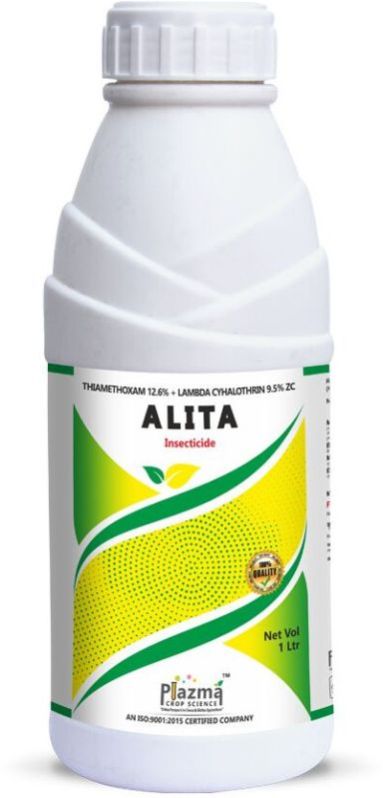
Thiamethoxam 12.6% + Lambdacyhalothrin 9.5% ZC Insecticide

  • Min. Order (MOQ) 25 Litre
  • Brand Name Plazma Crop Science
  • Application Agriculture
  • Purity 100%
  • State Liquid
  • Country of Origin India
  • Packaging Type Plastic Bottle
  • Packaging Size 1 Ltr.
  • Technical Name Thiamethoxam 12.6% + Lambdacyhalothrin 9.5% ZC
  • Generic Name Alita

Thiamethoxam 12.6% + Lambda-cyhalothrin 9.5% ZC is a combination insecticide having quick stomach and contact activity and is recommended to control Aphids, jassids, Thrips & Bollworms in Cotton, Aphid, shootfly, steam borer in Maize, Leaf hopper, leaf eating caterpillars in Groundnut, Stem fly, semilooper, girdle beetle in Soyaben, Thrips & fruit borer in Chilli, Thrips, semilooper, tea mosquito bug in Tea, Thrips, whiteflies, fruit borer in Tomato crop.

Direction of Use

Measure out required quantity of the product and mix it well with a small quantity of water. Add the remaining quantity of water as specified through agitation for total coverage of crop with suitable sprayers.

Time of Application

The product should not be applied during flowering of the crop. DO NOT use the product where bees are actively foraging. DO NOT allow spray drift to flowering weeds, hedges or flowering crops in the vicinity of the treatment area. DO NOT spray if a high amount of aphid honeydew is present in the treatment area. DO NOT spray on flowering crops between 5 days before start of flowering and end of flowering. Not to be used on crops when honey bees are pollinators / foraging. This product is also toxic to fish

Precaution

Do not use cooking utensils for preparing sprays. Use stick for stirring the spray solution. Wear hand gloves to avoid contact with the skin. Also avoid inhalation and contact with eyes. Wear protective clothing, mask, goggles, boots, while spraying and do not expose yourself to spray drift. Do not blow nozzles with mouth. Do not eat, drink or smoke while handling or applying the product. Do not store unused spray solution. Clean sprayers, buckets and other utensils with water daily after use. Wash hands with soap and plenty of water and change clothes after the work is over. Also wash the contaminated clothes. DO NOT allow spray to drift onto rivers, lakes, ponds, ditches or other waterways. DO NOT allow discharging left over spray material or empty containers to contaminate waterways.

Symptoms Of Poisoning

Poisoning symptoms in rodents are non-specific, may cause symptoms of ataxia, salivation, lachrymation and decreased breathing etc.

First Aid

Remove the affected person from the danger zone to a well-ventilated room or to fresh air and protect from under cooling.

IN CASE OF SUSPECTED POISONING: Immediately call a physician.

IN CASE OF SKIN CONTACT: remove contaminated clothing and thoroughly wash the affected parts of the body with soap and water.

IN CASE OF EYE CONTACT: Rinse eyes with clean water for several minutes and immediately call a physician.

IN CASE OF INGESTION: Repeatedly administer medicinal charcoal in a large quantity of water.

NOTE: Never give anything by mouth to an unconscious person. Do not induce vomiting.

Phytotoxicity

As in comman.

Antidote

No specific antidote is known. Apply symptomatic therapy.

Disposal Of Used Container
  • Packages or surplus materials and washings from the machines and containers should be disposed off in a safe manner as to prevent environmental pollution.
  • The used packages shall not be left outside to prevent their reuse.
  • Packages shall be broken and buried away from habitation.
Storage Conditions
  • The packages containing the insecticides should be stored in original containers in separate rooms or premises away from the rooms or premises used for storing other articles, particularly, articles of food or shall be kept in separate almirahs under lock and key.
  • The rooms or premises meant for storing the insecticide shall be well built, dry, well lit and ventilated and of sufficient dimensions to avoid contamination with vapour.
View Complete Details

Imidacloprid 18.5% + Hexaconazole 1.5% FS Insecticide

  • Min. Order (MOQ) 25 Litre
  • Brand Name Plazma Crop Science
  • Application Agriculture
  • Purity 100%
  • State Liquid
  • Country of Origin India
  • Packaging Type Plastic Bottle
  • Packaging Size 1 Lt.
  • Technical Name Imidacloprid 18.5% + Hexaconazole 1.5% FS
  • Generic Name Haxida

Imidacloprid 18.5% + Hexaconazole 1.5% FS is a combination of insecticide + fungicide used as seed treatment for the control of insects pests namely termites, thrips, jassids, root grubs on groundnut and termites. Aphids on wheat and disease like collar rot, stem rot, tikka leaf spot, and rust on groundnut and smut & rust on wheat.

Direction of Use

Seed Treatment: Any small quantity of seed can be readily treated on the farm my mixing the proper amount of this combination formulation and seed in a closed mixing drum or a concrete mixer. Roll the seed until each grain is uniformly coated with the formulation. Seed treatment on commercial basis can be carried out by specialized seed dressing companies for the optimization of Insecticide + Fungicides spectrum of Imidacloprid 18.5% + Hexaconazole 1.5% FS.

Time of Application

Plant Protection Equipment: Manually/Mechanically operated seed dressing rotating drum.

Precaution

Protective clothing should be worn while mixing and spraying. Wash contaminated clothes and body part after application. Avoid inhalation, do not smoke, drink, eat & chew anything during application.

Symptoms Of Poisoning

Apathy, myatania, tremor, difficult breathing and myospasms

First Aid

If ingested: If person is conscious and alert, rinse mouth with water and give 1 or 2 glass of water to drink. Never give anything by mouth to an unconscious person. Call the doctor. Do not induce vomiting until and unless desired by attending physician.

If inhaled: Take the patient to fresh air and take care of body temperature. If patient is not breathing or breathing with difficulty, give artificial respiration, preferably with mouth to mouth breathing. Consult a physician.

In case of skin contact: Wash thoroughly the affected parts of the body with soap and plenty of water including hairs and under finger mails. If pain, redness or irritation persists, consult a doctor. All the contaminated clothes should be segregated and thoroughly washed with soap and wash separately before use.

In case of eye contact: Rinse gently with plenty of water at least for 15 minutes. If pain irritation, redness or photophobia persist consult eye specialist.

Phytotoxicity

Imidacloprid 18.5% + Hexaconazole 1.5% FS is not phyotoxic when used as per recommendations.

Antidote

There is no known specific antidote. Treat symptomatically.

Disposal Of Used Container
  • Packages or surplus material and washings from the machines and containers shall be disposed off in a safer manner so as to prevent environment or water pollution.
  • The used packages shall be not left outside to prevent their re-use.
  • The packages shall be broken and buried away from habitation.
  • Dangerous to re-use empty container.
Storage Conditions
  • The packages containing the pesticide shall be stored in separate rooms or premises away from the rooms or premises used for storing other articles particularly food articles or shall be kept in separate almirah under lock and key depending upon the quantity and nature of the pesticides.
  • The store rooms should be well built, well-lit, ventilated and of sufficient dimensions. The condition of the store should be dry and cool.
View Complete Details

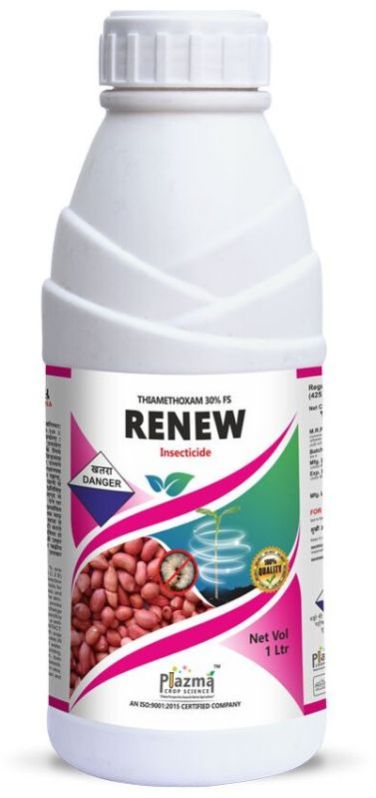
Thiamethoxam 30% FS Insecticide

  • Min. Order (MOQ) 25 Litre
  • Brand Name Plazma Crop Science
  • Application Agriculture
  • Purity 100%
  • State Liquid
  • Country of Origin India
  • Packaging Type Plastic Bottle
  • Packaging Size 1 Ltr.
  • Technical Name Thiamethoxam 30% FS
  • Generic Name Renew

Thiamethoxam 30 % FS is broad- spectrum systemic insecticide that is well suited for seed treatement used to control early season sucking pests. Recommended as seed treatment to control Jassids, aphids and Whitefly in cotton, shoot fly on sorghum and Maize, termites in wheat, jassid in okra, Thrips, GLH and Whorl Maggot in rice, jassid and thrips in sunflower, stem fly in soybean and thrips in chilli crop. Due to its fast action on sucking pest, it limits the transmission of leaf curl virus.

Direction of Use

For small lots, mix the required quantity of Thiamethoxam 30 % FS with 10-20 ml of water for each kg of seed to be treated. Add the slurry to the seed and rotate or stir the container(Plastic drum or bag) until the seeds are uniformly covered(usually less than a minute).

It is recommended for application as slurry with continuously operating commercial seed dressing equipment. For preparation of slurry, proceed as follows:

  • Put 1/2 of the required water top the mix tank
  • Add the required quantity of Thiamethoxam 30 % FS while stirring continuously.
  • Allow the product to disperse.
  • Switch the agitation system or stir manually.
  • Top up with the remaining volume of water.
  • Maintain agitation of the slurry during the whole time of use.
  • The slurry has to be used within 24 hours after preparation.

Application Procedure:

  • Prepare this slurry as descried.
  • Fill the seed into the receptacle.
  • Start mixing the seed.
  • Apply the required amount of slurry by pouring onto the mixing seed.
  • Mix for about 30 seconds to one minutes to achieve a homogenous treatment. An extended mixing will lead to abrasion and dust forming.
Precaution

Do not use cooking utensils for preaparing slurry. Use stick for stirring the slurry solution. Avoid contact with skin, eyes and clothing. Aviod inhalation of fog and vapours. Wear hand gloves to avoid contact with the skin. Wear protective clothing, mask goggles and boots, while mixing. Do not eat, drink or smoke while handling or applying the product. Wash hands with soap and plenty of water and change clothes after the work is over. Also wash the contaminated clothes.

Symptoms Of Poisoning

Possoning may cause symptoms of decrease in spontaneous movement, toxic convulsion and ptosis.

First Aid

Remove the affected person to a well-ventilated area or fresh air and protect him from undercooling.

IN CASE OF SKIN CONTACT: Remove contaminated clothing and thoroughly wash the affected parts of the body with soap and water.

IN CASE OF EYE CONTACT: Rinse eyes with clean water for several minuites.

IN CASE OF INGESTION: Repeatedly administer medicinal charcoal in a large quantity of water.

NOTE: Never give anything by mouth to an unconscious person. Do not induce vomiting.

Phytotoxicity

No phytotoxic, if applied as per recommendation.

Antidote

No specifice antidote is known. Apply symptomatic therapy.

Disposal Of Used Container
  • Packages or surplus materials and washings from the machines and containers should be disposed off in a safe manner as to prevent environmental and water pollution.
  • The used packages shall not be left outside to prevent their re-use.
  • Packages shall be broken and burried away from habitation.
Storage Conditions
  • The packages containing the insecticides should be stored in original containers in sparate rooms or premises away from the rooms or premised used for storing other articles particularly articles of food or shall e kept in separate almirahs under lock and key.
  • The rooms or premises meant for storing the insecticides shall be well built, dry, well lit and ventilated and of sufficient dimension to aviod contamination with vapour.
View Complete Details

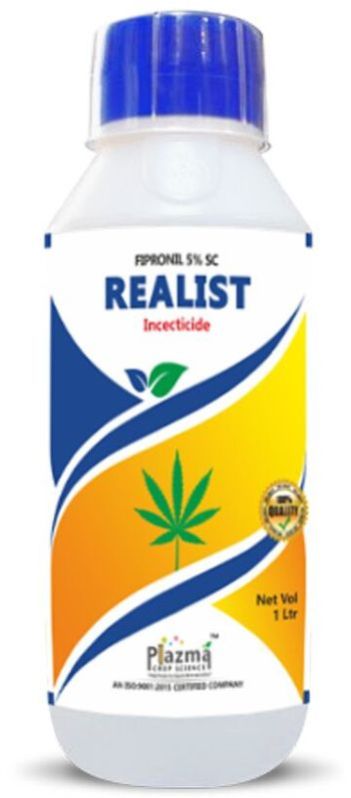
Fipronil 5% SC Insecticide

  • Min. Order (MOQ) 25 Litre
  • Brand Name Plazma Crop Science
  • Application Agriculture
  • Purity 100%
  • State Liquid
  • Country of Origin India
  • Packaging Type Plastic Bottle
  • Packaging Size 1 Ltr.
  • Technical Name Fipronil 5% SC
  • Generic Name Realist

Fipronil 5% SC is an insecticide which is used to control insects like stem borer, brown plant hopper, green leaf hopper, rice leaf folder, rice gall midge, white backed plant hopper, whorl maggot in rice.DBM in cabbage, thrips, aphids & fruit borer in chills, early shoot borer & root borer in sugarcane and Aphids, Jassids, Thrips, White fly and Boll worm in Cotton.

Direction of Use

Plant Protection Equipments :- High volume nozzle fittted to sprayers like knap-sack, Air pressure Foot Pump, Hard rocker or power operated spraying machine may be used.

Time of Application

Rice : The Fipronil application must be given between 25 to 30 days after transplanting.

Cabbage : The first spray is to be given at 30 to 35 days after transplanting or when pest incidence is noticed, which-ever is earlier. Repeat 2 to 3 sprays at 7 to 10 days interval.

Chilli:- First spray is to be given at 40 to 50 days after transplating or when pest incidence is noticed , which ever is earlier. repeat 2 to 3 spray at 1 to 10 days interval.

Surgargane:- For earlier shootborer foliar application at 35 days after planting (DAP) and for root borer dranching of soil at planting.

Precaution
    • Keep away from foodstuffs, empty foodstuff containers and animals food.
    • Avoid contact with mouth, eyes and skin.
    • Avoid inhalation the spray mist. Spray in the direction of wind.
    • Wash thoroughly the contaminated clothes and parts of the body after spraying.
    • Do not smoke, drink, eat and chew anything while spraying.
    • Wear full protective clothing while mixing and spraying.

Warning :- Fipronil is toxic to aquatic animals &honey bee hence avoid the use near aquatic environment & during to rassing period of honey bee

Symptoms Of Poisoning

Irritability, lethargy, muscle tremors, convulsions may occur.

First Aid
  • If swallowed, induce vomiting by tickling the back of throat. Repeat it until the vomitus is clear. Do not induce vomiting if the patient is unconscious.
  • If clothing and skin are contaminated, remove the cloths and wash the contaminated skin with copious amount of soap and water.
  • If eyes are contaiminated, flush with plenty of saline/clean water for about 10 to 15 minutes.
  • If inhaled, remove the patient to fresh air.
Phytotoxicity

The product is not phytotoxic when used as per field recommendation.

Antidote

No specific antidote is known. Treat. Symptoamtically.

Disposal Of Used Container
  • It shall be the duty of manufactures formulators and operator to dispose packages or surplus materials and washings from the machine and container shall be disposed off in a safe manner so as to prevent environmental and water pollution.
  • The used packages shall not be left outside to prevent their re-use.
  • Packages shall be broken and burried away from habitation.
Storage Conditions
  • The packages containing the insecticides shall be stored in separate rooms or premises away from the rooms or premises used for storing other articles particularly food articles or shall be kept in separate almirahs under lock and key depending upon the nature of the insecticide.
  • The rooms or premises meant for storing the insecticides shall be well lit, well built, dry, cool, ventilated and of sufficient dimensions to avoid contamination with vapour.
View Complete Details

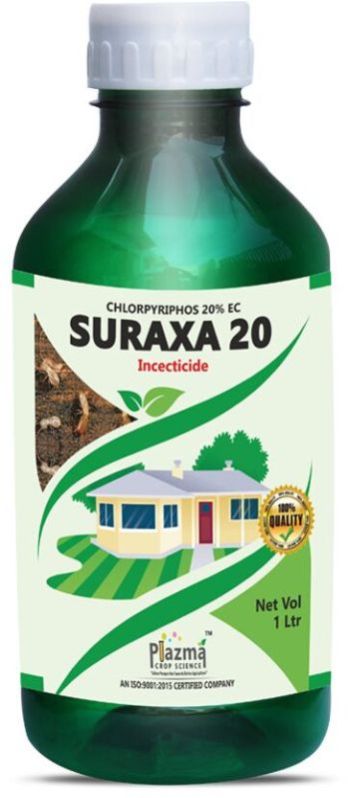
Chlorpyriphos 20% E.C Insecticide

  • Min. Order (MOQ) 25 Litre
  • Brand Name Plazma Crop Science
  • Application Agriculture
  • Purity 100%
  • State Liquid
  • Country of Origin India
  • Packaging Type PLASTIC BOTTLE
  • Packaging Size 1 Ltr
  • Technical Name Chlorpyriphos 20%E.C
  • Generic Name Suraxa 20

It is a contact and stomach poisonous emulsifiable concentrate formulation based on chlorpyriphos technical.


*Caution : Toxic to aquatic organisms hence should not be used near water bodies, aquaculture or pisciculture. It is toxic to honeybees, spray application should be avoided during foraging period of bees. Product is highly toxic to birds hence avoid use near bird habitat.

Direction of Use

P.P. Equipment:-P.P. Equipment:-Knapsack sprayer, foot sprayer, compression knapsack sprayer, compression knapsack battery sprayer and ASPEE-HTP power sprayer.

Precaution

  • Keep away from foodstuffs, empty foodstuff containers and animals food.
  • Avoid contact with mouth, eyes and skin.
  • Avoid inhalation the spray mist. Spray in the direction of wind.
  • Wash thoroughly the contaminated clothes and parts of the body after spraying.
  • Do not smoke, drink, eat and chew anything while spraying. 6. Wear full protective clothing while mixing and spraying.

Symptoms Of Poisoning

Headache, giddiness, vertigo, nausea, vomiting, blurred vision, diarrhoea, convulsions, sweating, excessive lacrimation, and salivation may occur.

First Aid

  • If swallowed, induce vomiting by tickling the back of throat. Repeat it until the vomitus is clear. Do not induce vomiting if the patient is unconscious.
  • If clothing and skin are contaminated, remove the clothes and wash the contaminated skin with copious amount of soap and water.
  • If eyes are contaiminated, flush with plenty of saline/clean water for about 10 to 15 minutes.
  • 4. If inhaled, remove the patient to fresh air.

Phytotoxicity

The product is not phytotoxic when used as per field recommendation.

Antidote

  • Atropinize the patient immediately and maintain full atropinization by repeated doses of 2 to 4 mg. of atropine sulphate intravenously at 5 to 10 minutes interval. As much as 25 to 50 mg. of atropine may be required in a day. The need for further atropine administration is guided by the continuance of symptoms. Extent of salivation is a useful criterion for dose adjustment.
  • Dissolve 1-2 gm of 2 PAM in 10 ml distilled water and inject intravenously very slowly for 10-15 minutes.

Disposal Of Used Container

  • It shall be the duty of manufactures formulators and operator to dispose packages or surplus materials and washings from the machine and container shall be disposed off in a safe manner so as to prevent environmental and water. pollution.
  • The used packages shall not be left outside to prevent their re-use.
  • Packages shall be broken and burried away from habitation.

Storage Conditions

  • The pesticides shall be stored in separate rooms or primeses away from the rooms or promises used for storing other articles or shall be kept in separate almirahs under lock and key depending upon the quantity and nature of the insecticides
  • The rooms or premises meant for storing the insecticide shall be well built, dry, well lit and ventilation and of sufficient dimension to avoid contamination with vapour
View Complete Details

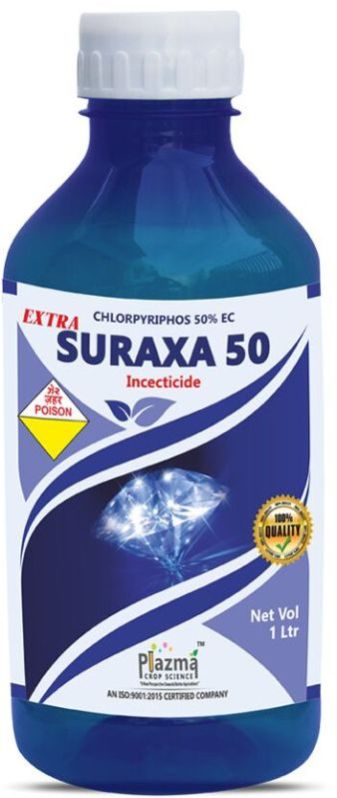
Chlorpyrifos 50% E.C. Insecticide

  • Min. Order (MOQ) 25 Litre
  • Brand Name Plazma Crop Science
  • Application Agriculture
  • Purity 100%
  • Country of Origin India
  • State Liquid
  • Packaging Type Plastic Bottle
  • Packaging Size 1 Ltr.
  • Technical Name Chlorpyrifos 50% E.C.
  • Generic Name Suraxa 50

Chlorpyrifos 50% EC is used to control Termites in Buildings, during construction and in existing buildings and bollworm in cotton crops.

*Caution : Toxic to aquatic organisms hence should not be used near water bodies, aquaculture or pisciculture. It is toxic to honeybees, spray application should be avoided during foraging period of bees. Product is highly toxic to birds hence avoid use near bird habitat.

Recommendation

For protecting buildings from termite attack at pre and post construction stages, apply chlorpyrifos 50% EC @ 0.5% concentration

Direction of Use
  • EQUIPMENT USED IN APPLICATION: Knapsack sprayer, Knapsack power sprayer, motorized Knapsack sprayer cum duster, compression Knapsack sprayer, compression Knapsack battery sprayer, wheel barrow sprayer and HTP power sprayer.
  • For Termite control - Methods of application and equipment for use : 1. During construction : Mix 1 Ltr. of chlorpyrifos 50% EC with 99 L of water to get a 0.5% chlorpyrifos emulsion and apply at the following stages. Satge 1 - Treat the bottom surface and sides (upto 30cm. Height) of the excavations made for column pits, wall trenches and basements @ 5L per sq. m of surface area. Stage 2 - Treat the refill. Earth on both sides of all built up walls (approximately width 30cm and depth 45cm) @ 7.5 per sq.m of substructure. Stage 3 - Treat the entire levelled surface (before laying the floor) @ 5L per sq.m In case of RCC framed structures with columns and plinth beams and RC basements, the treatment can start at a depth of 50cm, below ground level. Wherever pipes, wastes and conduits enter soil, loosen the soil for a distance of 15cm. And 7.5cm deep and thoroughly drench with chlorpyriphos 50% EC emulsion. Note:All applications should be done when the surface is dry to facilitate better absorption. Treatment of existing build i) Dig shovel width trenches along the external wall of the building exposing the foundation wall surfaces upto a depth of 50 cm. And made 30 cm-50cm, deep rod holes. 15 cm apart all along this trench and pour Chlorpyriphos 50% Ec emulsion @1.75 litrs per running meter. ii) treat the back fill each with earth Chlorpyrifos 50% EC emulsion @ 0.5 L per running meter as it is returned to the trench directing the spray towards the wall surface. PS- If there is concrete or masonry apron around the building, drill 12mm holes as close as possible to the plinth wall 30 cm apart and pump insecticides. A) RCC framed Structures: Excavate shovel width trenches exposing the sides of the column and plinth beams upto 30 cm. (or bottom of the plinth beams) and treat the back fill earth with Chlorpyrifos 50% emulsion as it is returned to the trench, @ 7.5 L per sq.m of the vertical surface of the structure. B) Internal treatment (Soil under floors): Soil below any openings of the floor is to be charged with the chemical so as to deny access to termites. 1. Drill 12 mm holes at the junction of floor and walls along the cracks on the floor and along constructional joints at 30 cm. Intervals to reach the soil below. Squirt the emulsion @ 1 L per hole or till refusal and seal the holes properly. 2. Drill holes in the masonary wall at about 45% angle preferably from both sides of the plinth wall at 30 cm. Interval and soak the masonary with Chlorpyrifos 50% Ec properly as above. Upper Floors:- Termites damages upper floors, flats passing through casings of telephone, pipe, woodson walls stair cases, false ceiling etc. To prevent damage treat ground floor of existing building as in above section.
Precaution
  • Keep away from foodstuffs, empty foodstuff containers and animals food.
  • Avoid contact with mouth, eyes and skin.
  • Avoid inhalation the spray mist. Spray in the direction of wind.
  • Wash thoroughly the contaminated clothes and parts of the body after spraying.
  • Do not smoke, drink, eat and chew anything while spraying. 6. Wear full protective clothing while mixing and spraying.
Symptoms Of Poisoning

Headache, giddiness, vertigo, nausea, vomiting, blurred vision, diarrhoea, convulsions, sweating, excessive lacrimation, and salivation may occur.

First Aid
  • If swallowed, induce vomiting by tickling the back of throat. Repeat it until the vomitus is clear. Do not induce vomiting if the patient is unconscious.
  • If clothing and skin are contaminated, remove the clothes and wash the contaminated skin with copious amount of soap and water.
  • If eyes are contaiminated, flush with plenty of saline/clean water for about 10 to 15 minutes.

If inhaled, remove the patient to fresh air.

Antidote
  • Atropinize the patient immediately and maintain full atropinization by repeated doses of 2 to 4 mg. of atropine sulphate intravenously at 5 to 10 minutes interval. As much as 25 to 50 mg. of atropine may be required in a day. The need for further atropine administration is guided by the continuance of symptoms. Extent of salivation is a useful criterion for dose adjustment.
  • Dissolve 1-2 gm of 2 PAM in 10 ml distilled water and inject intravenously very slowly for 10-15 minutes.
Disposal Of Used Container

The empty containers should never be reused and should be destroyed and burried in a safe place. Dispose off packages or surplus material and washings in safe manner so as to prevent environmental and water pollution

Storage Conditions

The package containing the formulated grade insecticides should be stored in original containers in a separate room or almirah under lock and key depending on the quantity of insecticides, away from the reach of children, food stuffs, animal feeds and other articles and keep in cool and dry place. The premises for storage should be well built well lit sufficient in dimension and well ventilated
View Complete Details

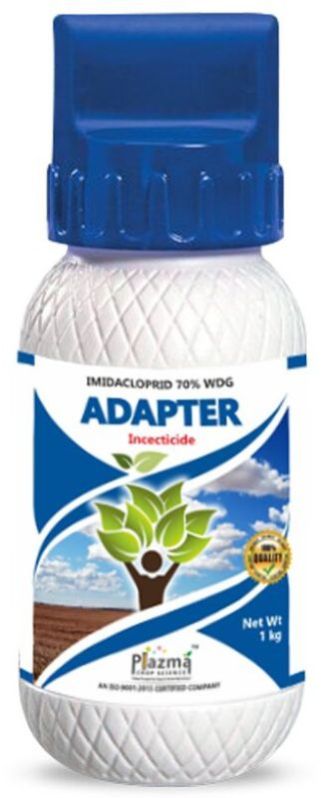
Imidacloprid 70% WG Insecticide

  • Min. Order (MOQ) 25 Kilogram
  • Brand Name Plazma Crop Science
  • Application Agriculture
  • Purity 100%
  • State GRANULE
  • Country of Origin India
  • Packaging Type Plastic Bottle
  • Packaging Size 1 Kg
  • Technical Name Imidacloprid 70% WG
  • Generic Name Adapter

Imidacloprid 70 %WG is recommended for the control of sucking pests Viz Jassids, Aphids & Thrips in cotton, Brown Plant hoppers & White backed Plant hoppers in rice, aphid, jassid and thrips in okra , aphid and jassid in cucumber, thrips & whitefly in Tomato crops.

Direction of Use

Spray with hand operated Knapsack sprayer.

Compatibility:- It is compatible with generally used fungicides, insecticides and urea.

Precaution

Poisonous, Handle with care, Do not touch or inhale the contents while handling the contents use rubber gloves and face mask.

Symptoms Of Poisoning

Apathy, Myatonia, Tremor, Difficult breathing & Myospasms.

First Aid

If the product gets into the eyes, rinse it out immediately with plenty of water. In case of posoning measure blood pressure and pulse rate frequently. Since bradycardia and drop in blood pressure may occur, artificaial breathing and heart action are recommended. Eliminate the active ingredient through gastric lavage and saline laxative.In case of skin contamination, wash with soap and water.

Antidote

There is no known specific antidote. Follow attached directions. Treat symptomatically.

Disposal Of Used Container

  • The packages shall be broken and buried away from habitation.
  • The used packages shall not be left outside to prevent their re-use.
  • Packages or surplus material and washing should be disposed off in safe manner so as to prevent environment or water polluition.

Storage Conditions

  • The packages containing the insecticides shall be stored in sparate romms or premises, away from the rooms or premises used for storing other articles of shall be kept in separate almirahs under lock and key depending upon the quantity and nature of the insecticides
  • The rooms or premises meant for storing the insecticides shall be well built well lit, dry, k well ventilated and of sufficient dimenstions to avoid contamination with water vapour.
View Complete Details
Tell Us What are you looking for? Will call you back

Contact Us