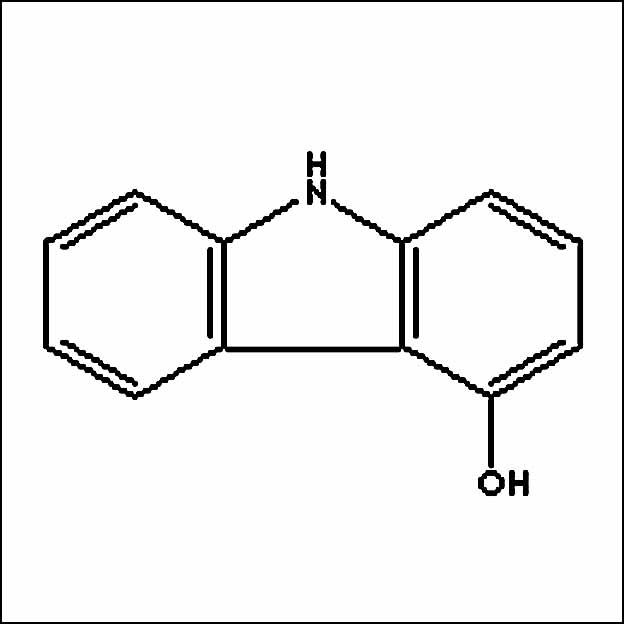
PRODUCT IDENTIFICATION
CAS NO : 52602-39-8
EINECS NO : 258-034-9
FORMULA: C12H9NO
MOL WT: 183.21
H.S. CODE: 2933.90
SYNONYMS : 9H-carbazol-4-ol;
PHYSICAL AND CHEMICAL PROPERTIES
PHYSICAL STATE : brown powder
MELTING POINT : 169 - 173 C
STABILITY : Stable under ordinary conditions.
APPLICATIONS
Carbazole, azafluorene, is a group of organic heterocyclic compounds containing nitrogen atom in dibenzopyrrole system; white crystalline solid, insoluble in water, melts at 244 C. Carbazole and its derivatives are widely used as an intermediate in synthesis of pharmaceuticals, agrochemicals, dyes, pigments and other organic compounds. 4-Hydroxycarbazole is used as an intermediate for the synthesis of pharmaceutical especially for carvedilol used to treat high blood pressure and to prevent cardiac arrhythmias and angina.
SALES SPECIFICATION
APPEARANCE: brown powder
ASSAY: 96.0% min
MELTING POINT: 163 - 165 C
GENERAL DESCRIPTION OF PYRROLE
Pyrrole is one of a class of organic heterocyclic compounds of five-membered diunsaturated ring structure composed of four carbon atoms and one nitrogen atom. The simplest member of the pyrrole family is Pyrrole itself; colorless to pale yellow oil with with pungent taste and similar to chloroform odor; insoluble in water; soluble in alcohol, ether, and dilute acids; boils at 129 - 131 C; polymerizes in light. Pyrrole rings are components of larger aromatic rings including the amino acids proline and hydroxyproline; and in coloured natural products as joined rings and attached to straight chains. Pyrrole and its derivatives are widely used as an intermediate in synthesis of pharmaceuticals, medicines, agrochemicals, dyes, photographic chemicals, perfumes and other organic compounds.
GENERAL DESCRIPTION OF PAHs
Polycyclic aromatic hydrocarbons (also called polynuclear hydrocarbons) have two or more single or fused aromatic rings if a pair of carbon atoms is shared between rings in their molecules. In particular, the term 'PAH' refers to the compounds consisting of only carbon and hydrogen atoms while the wider term 'polycyclic aromatic compounds' includes the alkyl-substituted derivatives and functional derivatives such as nitro- and hydroxy-PAH as well as the heterocyclic analogues, which contain one or more hetero atoms in the aromatic structure. PAHs exist in various combinations that manifest various functions such as light sensitivity, heat resistance, conductivity, emittability, corrosion resistance and physiological action. The simplest examples are naphthalene having two benzene rings side by side and biphenyl having two bond-connected benzene rings. PAHs are not found in synthetic products and are non-essential for the growth of living cells. The general characteristics of PAH describe high melting- and boiling-points (they are solid), low vapour pressure, and very low water solubility, decreasing with increasing molecular weight whereas resistance to oxidation, reduction, and vapourization increases. Vapour pressure tends to decrease with increasing molecular weight. PAHs are highly lipophilic and readily soluble in organic solvents. The lower molecular weight PAHs of 2 or 3 ring groups such as naphthalenes, fluorenes, phenanthrenes, and anthracenes have toxicity which tends to decrease with increasing molecular weight. PAHs are not synthesized chemically for industrial purposes but are isolated from concentrated coal-tar products (or from pyrolysis of coal hydrocarbons) followed by subsequent purification through repeated distillation and crystallization. Some PAHs such as naphthalene are also obtained from the concentration of the high boiling residual oil (and asphalt) derived from crude petroleum refinery processing. These PAHs are mostly used as intermediaries in pharmaceuticals, agricultural products, photographic products, thermosetting plastics, lubricating materials, and other chemical industries. General uses are;
Acenaphthene: Intermediate for naphthalic acids, naphthalic anhydride (intermediate for pigments) and for acenaphthylene (intermediate for resins); Intermediate for dyes, soaps, pigments, pharmaceuticals, insecticide, fungicide, herbicide and plant growth hormones. It is used to manufacture plastics and as an agent for inducing polyploidy.
Acridine: Dye and pharmaceutical manufacturing
Anthracene: Its oxidation yields anthraquinone, the parent substance of a large class of dyes and pigments; .diluent for wood preservatives; scintillant (for detection of high-energy radiation)
Fluoranthene: manufacturing fluorescent and vat dyes, pharmaceuticals and agrochemicals.
Fluorene: basic subsance for production of dyes, pigments, pesticides, thermoset plstic and pharmaceuticals; manufacturing fluorenone (mild oxidizing agent)
Naphthalene: In the production of phthalic anhydride, carbaryl insecticide, beta-naphthol, tanning agents, moth repellent, and surfactants - naphthalene: main use: production of phthalic anhydride (intermediate for polyvinyl chloride plasticizers); also, production of azo dyes, surfactants and dispersants, tanning agents, carbaryl (insecticide), alkylnaphthalene solvents (for carbonless copy paper), and use without processing as a fumigant (moth repellent)
Phenanthrene: manufacturing phenanthrenequinone (intermediate for pesticides); manufacturing diphenic acid (intermediate for resins)
Pyrene: manufacturing perinon pigments
Quinoline: solvent for resins & terpines; decarboxylation agent; parent compound to make drugs, fungicides, biocides, alkaloids, dyes, rubber chemicals and flavoring agents
Precise PAHs, specific refined products are used also in the field of electronics, functional plastics and liquid crystals. Pharmaceutical and agricultural PAHs obtained coal tar are such materials as indole, indolizine, indene, quinoline, quinalidine, isoquinoline and their derivatives. High boiling-point special solvent are such materials as tetoralin, decaline, methyl-
naphthalenes. Coumarins and dihydrocoumarins which can be obtained coal tar are PAHs used in perfumery. Thermosensitive paper sensitizer PAHs are such materials as p-benzylbiphenyl and ethylbiphenyl.
 Users should verify the drug license and prescription before buying or selling medicines. For more details, kindly Click Here.
 Business Type Manufacturer / Supplier / Retailer
 Number of Employees 6 - 20
 Year of Establishment 2003
 Address B/106, 1st Floor, Gopal Chambers, Salabatpura, Salabatpura, Surat, Gujarat, 395003, IN






 For Buyer
  For Seller
  Help
Help 
 Twitter
 WhatsApp
 Facebook
 Linkedin