
Company Information

 Member Since 8 Years
 Nature of Business Exporter Year of Establishment 2007
Ask for more detail from the seller
Contact Supplier
Pharmacological action
pharmacodynamics
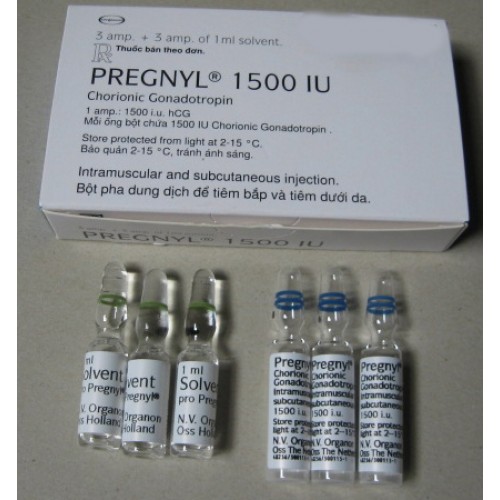
pregnyl contains human chorionic gonadotrophin (hcg) which has luteotrophic (lh) activity.
In the female pregnyl substitutes the endogenous mid-cycle lh surge to induce the final phase of follicular maturation, leading to ovulation.
In the male pregnyl stimulates leydig cells to promote the production of testosterone.
Pharmacokinetics
maximal plasma hcg levels will be reached in males approximately 6 and 16 hours after a single intramuscular or subcutaneous injection of hcg, respectively and in females after approximately 20 hours. Hcg is approximately 80 per cent metabolized, predominantly in the kidneys. Intramuscular and subcutaneous administration of hcg were found to be bioequivalent regarding the extent of absorption and the apparent elimination half-lives of approximately 33 hours. On basis of the recommended dose regimens and elimination half-life, cumulation is not expected to occur.
Preclinical safety data
no particulars.
Indications
in the female as part of a regimen to induce:
- ovulation induction in subfertility due to anovulation or impaired follicle-ripening.
- preparation of follicles for puncture in controlled ovarian hyperstimulation programs (for medically assisted reproductive techniques).
- luteal phase support.
In the male:
- hypogonadotrophic hypogonadism. Cases of idiopathic dysspermias have also shown a positive response to gonadotrophins.
- delayed puberty associated with insufficient gonadotrophic pituitary function.
- cryptorchidism, not due to anatomical obstruction.



Connect with us





 For Buyer
  For Seller
  Help
Help 

 Amsterdam

 Send Enquiry