
Company Information
 Member Since 8 Years
 Nature of Business Supplier
Ask for more detail from the seller
Contact Supplier
In refrigeration and cooling installations, any residual heat created must be expelled to the surrounding air through heat exchangers. Fans therefore pump cold air through the heat exchanger to improve the heat dissipation. There is a whole range of options for designing and configuring especially efficient, quiet and durable fans. A new, passive component, the so-called diffuser, provides for a substantial improvement in efficiency and noise. Its pressure-boosting effect minimises exit losses and makes it easier to adapt the fan to commercially available heat exchangers.
Every medium is only able to absorb a certain amount of heat energy for each degree Kelvin. The possible temperature difference and the amount of heat to be expelled define the cooling air flow required. This air volume has to be delivered by a fan through the heat exchanger under consideration. Because refrigeration technology appliances are usually operated with high operating factors, an economical use of the drive energy input is important, for every additional watt costs money. A suitably configured fan impeller is used to generate a volume flow of air. Here it is important to avoid stripping and back-flows as these create energy losses and unwanted noise. This procedure is state of the art which all manufacturers now more or less command.
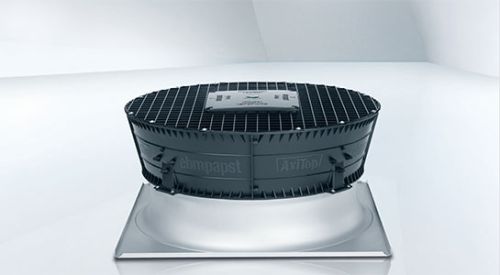
ebm-papst is going one step further. AxiTop - the diffuser for axial fans - substantially reduces losses downstream of the impeller outlet.
To deliver an airflow through a heat exchanger, a sufficient pressure differential is needed to overcome the flow resistance of the exchanger. Normally, the delivered air flows at high speed from the exit side of the fan and is dissipated into the environment. Dissipation means that the kinetic energy of the flow is converted into heat that is no longer technically utilised. The AxiTop diffuser is designed to decelerate the flow, allowing a large proportion of the dynamic kinetic energy to be converted into static pressure. This reverse-conversion boosts the pressure increase of the impeller. If all components are aerodynamically optimised, this allows efficiency to be significantly enhanced, making it possible to reduce the fan speed and thus noise emissions.



Connect with us





 For Buyer
  For Seller
  Help
Help 
 DUBAI
DUBAI  Send Enquiry