
Company Information
 Member Since 12 Years
 Nature of Business Manufacturer
Ask for more detail from the seller
Contact Supplier
We are offering concrete admixture plants.
concere admixtures other than water, aggregates, or cement that is used as an ingredient of concrete or mortar to early hardening and control setting, workability, or to provide additional cementing properties.
why is concerte admixture used?
over years, attempts have been made to obtain concrete with certain desired characteristics such as high compressive strength, high workability, and high performance and durability parameters to meet the requirement of complexity of modern structures. The properties commonly modified are the, accelerate or retard setting time heat of hydration, workability, water reduction, air-entrainment, dispersion and impermeability and durability factors.
types of concere admixtures;
accelerators
retarders
water-reducing agents
super plasticizers
air entraining agents etc.
1. Water-reducing admixture: these admixtures are used for following purposes:
to achieve a higher strength by decreasing the water cement ratio at the same workability as an admixture free mix. To achieve the same workability by decreasing the cement content so as to reduce the heat of hydration in mass concrete.to increase the workability so as to ease placing in accessible locations. Water reduction more than 5% but less than 12%
the commonly used admixtures are ligno-sulphonates and hydrocarbolic acid salts.
plasticizers are usually based on lignosulphonate, which is a natural polymer, derived from wood processing in the paper industry.
2. Super plasticizers:these are more recent and more effective type of water reducing admixtures also known as high range water reducer. The main benefits of super plasticizers can be summarized as follows: give 16–25%+ water reduction.
3. Accelerators: an admixture which, when added to concrete, mortar, or grout, increases the rate of hydration of hydraulic cement, shortens the time of set in concrete, or increases the rate of hardening or strength development. Which increase the strength at 24 hours by at least 120% at 20ºc and at 5ºc by at least 130% at 48 hours.
4. Set retarders: the function of retarder is to delay or extend the setting time of cement paste in concrete. These are helpful for concrete that has to be transported to long distance, and helpful in placing the concrete at high temperatures. When water is first added to cement there is a rapid initial hydration reaction, after which there is little formation of further hydrates for typically 2–3 hours.
5. Air entrained admixtures: addition for hydraulic cement or an admixture for concrete or mortar which causes air, usually in small quantity, to be incorporated in the form of minute bubbles in the concrete or mortar during mixing, usually to increase its workability and frost resistance.
brief description concrete admixture production line
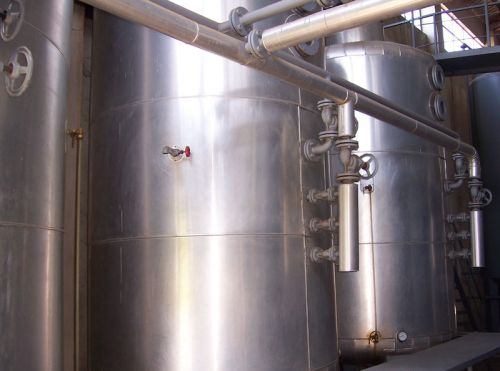
the raw materials for admixture production delivered in jumbo bags. They dissolved in water and then stored in the respective raw material tanks.
initially one of the two blending vessels filled with water and the venturi pump switched on. The dissolving process starts with the delivery of the jumbo bags to the loading hoist by a forklift. Each jumbo bag would weigh between 1000 – 750 kg. The loading hoist a wire rope hoist of 2000 kg capacity . The hoist lifts the bag from the ground level and load it on to the vibratory feeder. The powder then get transferred from the vibratory feeder to the venturi loading hopper. With the venturi circulation pump on, the powder start dissolving in the water.
once the required quantity of powder has dissolved in the water, the resulting solution transferred to the liquid raw material tank. These raw material tanks also equipped to receive raw materials directly in liquid form.
whenever the finished product manufactured the required raw materials as per the recipe transferred from the raw material tank through a flowmeter or will be weighed by loadcell to one of the blending vessels. The recipe determine the number of liquid raw materials, the sequence and the quantity to be added.
some recipes require a small quantity of liquid and powder raw materials added manually. These materials transferred to the operating platform via the safety gate and added manually through the vessel charging hole on top of the blending vessel. Minor liquid additions, can be loaded via a diaphragm pump on a weigh scale. Once the manufacturing is completed the product transferred to the finished product storage tanks. From the finished product tanks the product loaded on to the delivery tankers through the finished product transfer pumps.
belending vessel; there one or two blending vessels which supported on the floor directly. Belending vessel aisi 304 materials
loading hoist; the loading hoist including pendant 2000 kg wire rope hoist. The hoist using to lift jumbo bags of 1000 -750 kg from the floor level.
vibrotary feeder, the hoist unload the big bag into the vibratory feeder, the vibrator a low noise one. (75 db – 80 db). The vibratory feeder tray stainless steel 304 and it at an angle of 30o. The tray fitted with a vibratory feeder that transfer the powders into the next stage which is the venturi loading hopper.
venturi loading hopper; the venturi have a venturi loading hopper into which the vibratory feeder empty the powder material. The venturi loading hopper have an outlet at the top which would take the dust and fumes to the wet scrubber. The bottom of the venturi loading hopper connected to the venturi. The conical portion of the venturi loading hopper have about 400 - 500 litres capacity and the conical portion have an 60o inclination or more to ensure free flow of material.
wet scruber; the wet scrubber is to remove the dust generated in the venturi loading hopper and the blending vessels. There are three inlets to the wet scrubber – one from the venturi loading hopper and one from each blending vessel the wet scrubber has a water column through which the air with dust will pass through. The dirty water used back in the process. The clean air taken outside the building. The wet scrubber and all its internals ss 316 and 4 mm thickness and the ducting ss 304 sch 10 150 nb pipe.
pumps there transfer pumps, according to prosseses one under each blending vessel and tanks. The pumps with their motors supplied by the us. And also all nececesery pipes and piping works.
the plant operated by a plc system and scada. Plc includes design, procurement , assembly and commissioning of the system as per the customer’s requirements.



Connect with us





 For Buyer
  For Seller
  Help
Help 
 Turkey
  Send Enquiry