
Company Information
 Member Since 4 Years
 Nature of Business Service Provider
 GST No. 06AAFCC0655B1Z8
Ask for more detail from the seller
Contact Supplier
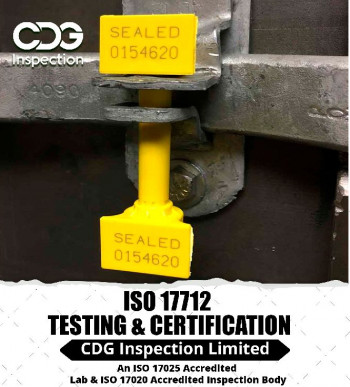
CDG is an ISO 17021 accredited inspection body & ISO 17025 accredited testing laboratory for ISO 17712 standards. We provide accredited ISO 17712 certification services in Mumbai.ISO 17712 is a set of rules which establish procedures for the unification and classification of security seals for fitting on mechanical cargo containers. It defines the types of seals that can be used for this purpose, but also establishes the basic general requirements and tests that seals must pass in order to be certified under this standard.
Compliance with these regulations is an essential requirement for security seals to be accepted for domestic and international transport of goods.
ISO 17712 is an International Standard which establishes uniform procedures for the classification, acceptance and withdrawal of acceptance of mechanical freight container seals. It provides a single source of information on mechanical seals which are acceptable for securing freight containers in international commerce.
The ISO 17712 establishes “uniform procedures for the categorization, acceptance, and withdrawal of mechanical freight container seals. It gives a single source of information on mechanical seals which are acceptable for securing freight containers in international commerce.”
Benefits of ISO Pas 17712:2013 Freight Containers
• Minimize container tampering and thefts
• Enlarge correct collection of taxes and duties
• Get better border security
• Facilitate trade
• Significant enlarge in inspection rate
• Speed up logistic procedures
• Enlarge safety
• Minimize corruption
The ISO 17712 establishes “uniform procedures for the classification, acceptance, and withdrawal of mechanical freight container seals. It provides a single source of information on mechanical seals which are acceptable for securing freight containers in international commerce.” The current ISO 17712 standard requires independent confirmation in three areas:
1. Testing to determine a seal’s physical strength (as barriers to entry). ISO 17712 defines three types of classes of seal strength or barrier capacity: “I” for Indicative; “S” for Security; and “H” for High Security. C-TPAT requires the use of “H” class seals. Suppliers must use independent third party test laboratories to validate a seal's classification. Labs must be accredited according to ISO/IEC 17025 (General requirements for the competence of testing and calibration laboratories) to perform testing specific to ISO 17712.
2. Auditing of manufacturer’s security-related business processes. Poor security-related practices can undercut the effectiveness of a high-quality security seal. ISO 17712's Annex A defines over two dozen required practices, such as facility risk assessments and access controls to production and storage areas. Suppliers’ conformance with Annex A should also be demonstrated through an independent certification provider that is accredited to audit compliance with the ISO standards.
3. Seals be designed and constructed with tamper indicative features that generate tell-tale evidence of tampering. Seal manufacturers must be able to demonstrate to, and obtain certification from, an accredited auditor from an independent third-party organization that their high security seals have built-in tamper evidence features. If an independent third-party organization accredited to ISO 17020 verifies conformity, it will provide the manufacturer with a certificate of compliance that documents that the seals submitted for review do reflect tell-tale evidence of tampering generated by attempts to defeat a correctly closed and affixed seal. Considering that most seals are tampered with in order to introduce illegal contraband or to pilferage a container, this is a welcomed improvement for high security seals –particularly those that are U.S. bound and those affixed to C-TPAT containers and trailers.



Connect with us





 For Buyer
  For Seller
  Help
Help 

 Manesar, Gurugram, Haryana


 Send Enquiry