
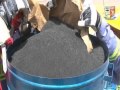


 700 - 1,400 / Metric Ton
Company Information
 Member Since 2 Years
 Nature of Business Service Provider
 GST No. 20**********Z3
Ask for more detail from the seller
Contact Supplier
Introduction
Copper slag is an industrial by-product generated during the smelting and refining of copper. It is the residue left after the extraction of copper from copper ores. This material has gained prominence for its versatile applications in various industries, owing to its physical, chemical, and mechanical properties. Copper slag is commonly recognized as an environmentally friendly and cost-effective material with significant potential for reuse in construction, abrasive, and metallurgical applications.
Formation of Copper Slag
Copper slag is formed during the pyrometallurgical process of copper production. In this process, copper concentrate, typically in the form of chalcopyrite (CuFeS₂), is heated in a furnace along with fluxing agents such as silica (SiO₂) to separate the desired metal from impurities. During smelting, the molten copper sinks to the bottom of the furnace, while lighter impurities, combined with flux, form a glassy, molten slag that floats on top. Once cooled and solidified, this slag becomes the material referred to as copper slag.
The composition and properties of copper slag depend on several factors, including the type of ore, the smelting process, and the cooling method used. Typically, copper slag contains 25-45% iron oxide (Fe₂O₃), 30-40% silica (SiO₂), and trace amounts of other oxides such as aluminum, calcium, and magnesium.
Properties of Copper Slag
Copper slag possesses unique physical and chemical properties that make it suitable for a wide range of applications:
Physical Properties:
Chemical Properties:
Thermal Properties:
Advantages of Using Copper Slag
Copper slag offers numerous advantages that make it a preferred choice in industrial and construction applications:




Connect with us





 For Buyer
  For Seller
  Help
Help 

 Adityapur, Jamshedpur, Jharkhand
 Send Enquiry