Company Information
 Member Since 8 Years
 Nature of Business Retailer
Ask for more detail from the seller
Contact Supplier
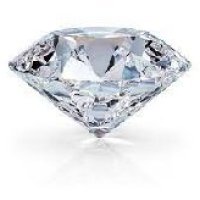
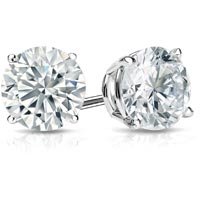
Diamond is a solid form of carbon with a diamond cubic crystal structure. At room temperature and pressure it is metastable and graphite is the stable form, but diamond almost never converts to graphite. Diamond is renowned for its superlative physical qualities, most of which originate from the strong covalent bonding between its atoms. In particular, it has the highest hardness and thermal conductivity of any bulk material. Those properties determine the major industrial applications of diamond in cutting and polishing tools and the scientific applications in diamond knives and diamond anvil cells.
Because of its extremely rigid lattice, diamond can be contaminated by very few types of impurities, such as boron and nitrogen. Small amounts of defects or impurities (about one per million of lattice atoms) color diamond blue (boron), yellow (nitrogen), brown (lattice defects), green (radiation exposure), purple, pink, orange or red. Diamond also has relatively high optical dispersion (ability to disperse light of different colors).
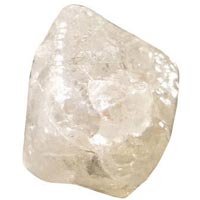
Most natural diamonds have ages between 1 billion and 3.5 billion years. Most were formed at depths of 150 to 250 kilometers (93 to 155 mi) in the Earth's mantle, although a few have come from as deep as 800 kilometers (500 mi). Under high pressure and temperature, carbon-containing fluids dissolved minerals and replaced them with diamonds. Much more recently (tens to hundreds of million years ago), they were carried to the surface in volcanic eruptions and deposited in igneous rocks known as kimberlites and lamproites.
Diamonds can be produced synthetically in a high pressure, high temperature method (HPHT) which approximately simulates the conditions in the Earth's mantle. An alternative, and completely different growth technique is chemical vapor deposition (CVD). Several non-diamond materials, which include cubic zirconia and silicon carbide and are often called diamond simulants, resemble diamond in appearance and many properties. Special gemological techniques have been developed to distinguish natural diamonds, synthetic diamonds, and diamond simulants.s



Connect with us





 For Buyer
  For Seller
  Help
Help 
 Johri Bazar, Jaipur, Rajasthan
  Send Enquiry