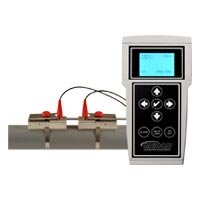
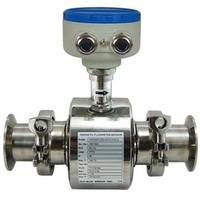
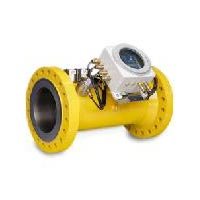
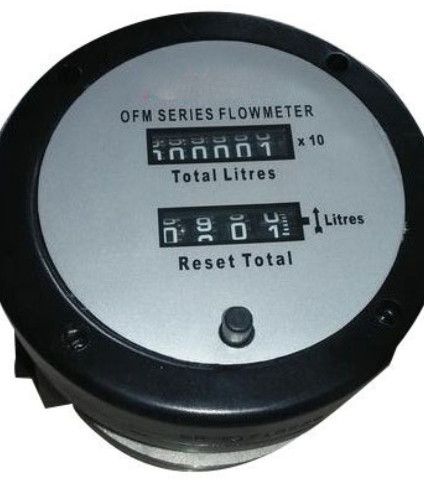
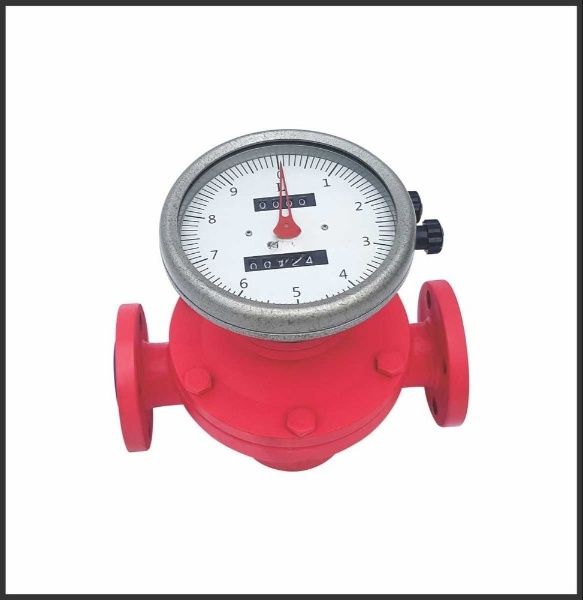
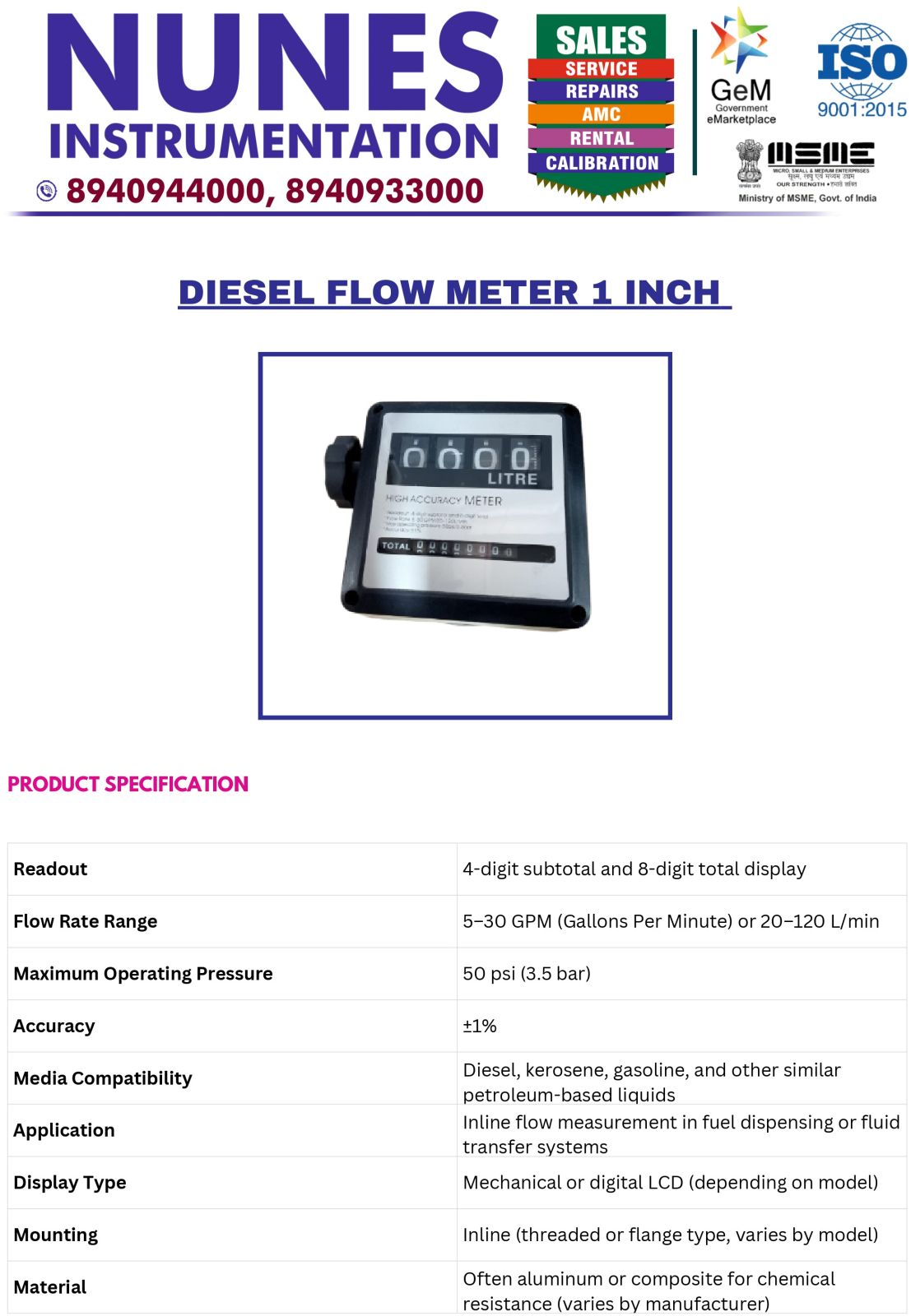
A Diesel Fuel Flow Meter is a flow-measurement instrument designed for accurately measuring the volume (and often rate) of diesel (and other petroleum fuels) flowing through a pipeline segment. In the specified line-size range (25 NB to 100 NB) it is suitable for medium-duty industrial fuel handling, bunkering, diesel-tank-feed systems, generator supply lines, fuel-transfer skids, etc.
The unit typically uses a positive-displacement (e.g., oval gear) or turbine principle, providing high accuracy, good repeatability, minimal sensitivity to viscosity changes, and robust construction for fuel-service environments. For example, one Indian supplier lists: line size 25 NB to 100 NB, operating temperature up to ~70 °C, flow range ~20-120 L/min, accuracy ~1%.
Key Features
- High accuracy volumetric measurement of diesel and fuel oils — ensures correct billing/transfer and inventory control.
- Minimal sensitivity to fuel viscosity changes (important when temperature varies or fuel grade changes) — ensures reliability.
- Robust construction for fuel-service conditions: compatible with diesel, low sulphur fuel oils, light/heavy fuel oils, non-corrosive fluids.
- Available in a wide size range (25 NB-100 NB) making it suitable for various fuel line applications from small generator feed lines to bulk fuel transfer lines.
- Integral totaliser/display for cumulative flow monitoring and optionally flow rate display.
- Some models provide remote/pulse output or digital interface for integration with automation (SCADA, PLC) or inventory management systems.
- Easy maintenance and calibration — beneficial for procurement in industrial fuel systems where downtime must be minimal.
- Low pressure drop designs (especially in well-designed positive displacement meters) reducing pumping costs and pressure loss.
Applications
Here are typical use-cases where this Diesel Fuel Flow Meter would be used (relevant to your instrumentation procurement context):
- Generator fuel supply lines in industrial plants — to monitor fuel consumption accurately for cost allocation and maintenance scheduling.
- Marine or bunkering fuel transfer systems where accurate volumetric metering of diesel or fuel oil is critical for fuel custody and transfer.
- Fuel storage and dispensing facilities (diesel bunkers, tank farms) where volumetric flow metering ensures correct inventory and sales/distribution measurement.
- Fuel-oil transfer between tanks and burners (in power plants, heating plants) — ensures accurate monitoring of fuel usage and process control.
- Vehicle fueling stations, diesel bowser feed lines, forecourt fuel transfer systems — for accurate billing and leak monitoring.
- Petrochemical and refinery internal fuel circuits — to monitor internal fuel usage, optimize process efficiency, and detect anomalies
 1.50 Lakh / 20000 Piece Get Latest Price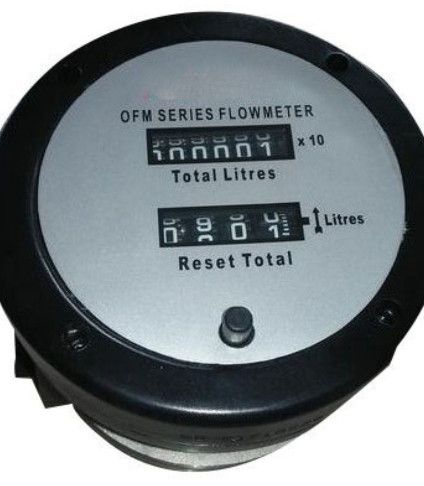


 Member Since 9 Years
 Nature of Business Manufacturer
 GST No. 33AAIPN8819N1Z3
  Address 11A/1, 11A/2, Sundaram Street, Rathinapuri, Coimbatore, Tamil Nadu, 641027, IN






 For Buyer
  For Seller
  Help
Help 
 Twitter
 WhatsApp
 Facebook
 Linkedin