
Company Information
 Member Since 9 Years
 Nature of Business Retailer
Ask for more detail from the seller
Contact Supplier
Dill originated in Eastern Europe. Zohary and Hopf remark that "wild and types of dill are widespread in the Mediterranean basin and in West Asia."
Although several twigs of dill were found in the tomb of Amenhotep II, they report that the earliest archeological evidence for its cultivation comes from late Neolithic lake shore settlements in Switzerland.[2] Traces have been found in Roman ruins in Great Britain.
In Semitic languages it is known by the name of Shubit. The Talmud requires that tithes shall be paid on the seeds, leaves, and stem of dill.The name dill comes from Old English dile, thought to have originated from a Norse or Anglo-Saxon word dylle meaning to soothe or lull, the plant having the carminative property of relieving gas. In tamil it is known as Sada kuppi. In Sanskrit, this herb is called Shatapushpa. In Gujrati it is known as hariz. In romanian Romania) it is called Mărar.
Dill Seed Uses
Fresh and dried dill leaves (sometimes called "dill " to distinguish it from dill seed) are used as herbs, mainly in Sweden, the Baltic, in Russia, and in central Asia.
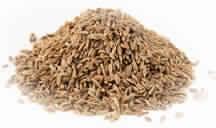
Dill seed is used as a spice, with a flavor somewhat similar to caraway but also resembling that of fresh or dried dill . Dill seeds were traditionally used to soothe the stomach after meals. Dill oil can be extracted from the leaves, stems and seeds of the plant.
In Arabic, dill seed is called ain jaradeh (means cricket eye) used as a spice in cold dishes like fattosh and pickles. In Lao cuisine and parts of northern Thailand and Vietnam, dill is known in English as Laotian coriander and Lao cilantro. In the Lao language, it is called Phak See, and in Thai, it is known as Phak Chee Lao. In Lao cuisine, the herb is typically used in mok pa (steamed fish in banana leaf) and several coconut milk-based curries that contain fish or prawns. Lao coriander is also an essential ingredient in Vietnamese dishes like chả cá and canh cá thì là.
In India, dill is prepared in the manner of yellow Moong dal as a main-course dish. It is considered to have very good anti-gas properties, and hence it is used as mukhwas, or an after-meal digestive. It is also traditionally given to mothers immediately after childbirth.
Cultivation
Successful cultivation requires warm to hot summers with high sunshine levels; even partial shade will reduce the yield substantially. It also prefers rich, well drained soil. The seeds are viable for 3–10 years. The seed is harvested by cutting the flower heads off the stalks when the seed is beginning to ripen. The seed heads are placed upside down in a paper bag and left in a warm dry place for a week. The seeds then separate from the stems easily for storage in an airtight container.
Companion Planting
When used as a companion planting, dill draws in many beneficial insects as the umbrella flower heads go to seed. Fittingly, it makes a good companion plant for cucumbers. It is a poor companion for carrots and tomatoes.
All information is given in good faith but no guarantee of accuracy is made nor can we anticipate every possible application of our product nor variations in manufacturing equipment and methods. Our products are therefore sold without warranty express of implied , and on the condition that the purchaser relies on his own ability to determine the suitability of each product for a particular purpose. Statement concerning the possible use of our products are not intended as recommendations for use. No liability is accepted for infringement of any patents.



Connect with us





 For Buyer
  For Seller
  Help
Help 
 Deesa, Banaskantha, Gujarat
  Send Enquiry