
Company Information
 Member Since 3 Years
 Nature of Business Manufacturer Year of Establishment 2023
Ask for more detail from the seller
Contact Supplier
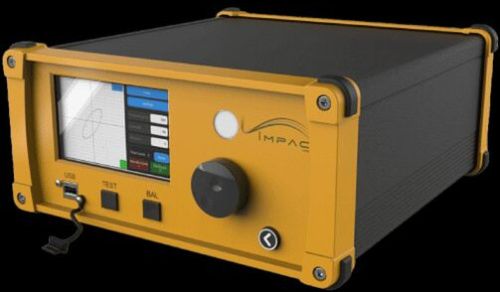
Eddy current testing relies on the scientific principle of electromagnetic induction. Within an eddy current probe, an alternating current traverses a coiled wire, producing a fluctuating magnetic field. When the probe and its magnetic field approach a conductive material, like a metal test object, a circular motion of electrons, comparable to swirling water in a river, initiates within the metal. This phenomenon, known as an eddy current, circulates through the metal. Consequently, this eddy current testing machines generates a magnetic field in the metal, which then engages with the coil and its associated field via mutual inductance. Any changes in metal properties, such as microstructure, hardness, or material grade, change the amplitude and phase of the eddy current and the resulting magnetic field. This, in turn, affects the electrical impedance of the coil. These signals are processed by the software in the instrument & plotted as impedance amplitude and phase angle, while in an MPI Machine, defects are visually indicated on the surface. Changes, if any, are indicated on the screen & on an Andon system.
Features
Advanced Eddy Current Technology: Our Eddy Current testing Machine Instruments utilize the latest in Eddy current testing technology to accurately identify and sort materials based on their hardness and material properties.
User-Friendly Interface: Our Eddy Current testing Machine Equipment is designed with the end user in mind, featuring an intuitive interface and clear displays that simplify operation and data analysis.
Flexible Integration: The Eddy Current testing Machine are compatible with a wide range of material handling systems, making it easy to integrate into your existing production lines or quality control processes.
Customizable Configurations: Our Eddy Current Machine can be tailored to suit your specific sorting requirements, with customizable options such as adjustable frequency ranges, multi-channel capabilities, and various pro
Frequency Range | 2 Hz-100Khz |
Simultaneous Excitation | Up to 8 frequencies |
Signal Gain | 0 dB to 86 dB in steps of 0.5 dB |
Phase | 0 deg to 359 deg in steps of 1 |
Isolated Digital Inputs & Outputs (Only in Line Model) | OK, Not OK, Trigger, Done |
Communication Interfaces | RS485 (Only in Line Model), Ethernet, 2X USB2.0 |
Test Coils | Round, Square, Rectangular, Customized |
Touch Screen Size (In Lab model) | 12” |
Display Connector (In Line model) | HDMI |
Power Supply | 110V-220V AC, 47-63 Hz |



Connect with us





 For Buyer
  For Seller
  Help
Help 

 Phase 9, Mohali, Punjab
 Send Enquiry