


Company Information
 Member Since 16 Years
 Nature of Business Retailer
 GST No. 27AAIPB6904A1Z9
Ask for more detail from the seller
Contact Supplier
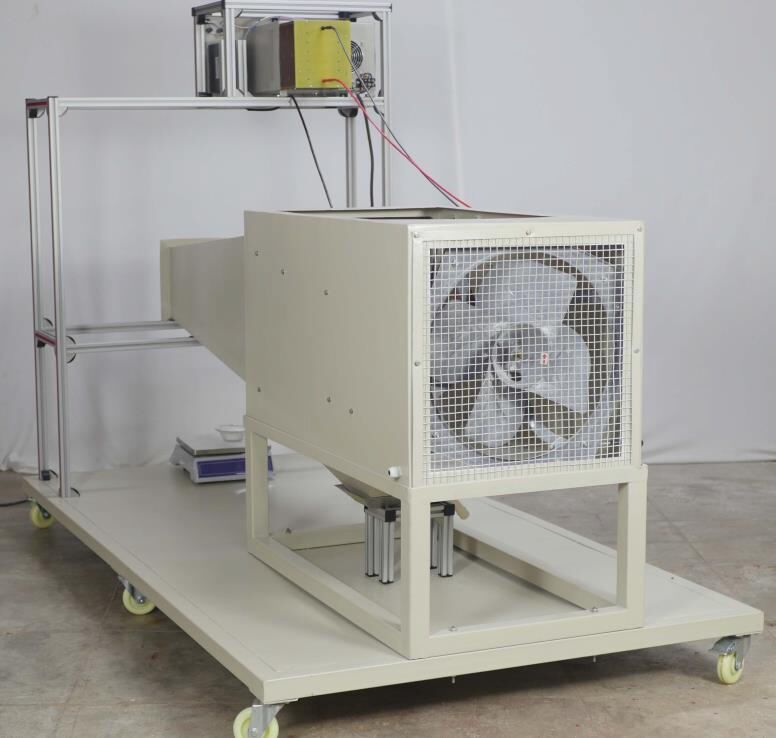
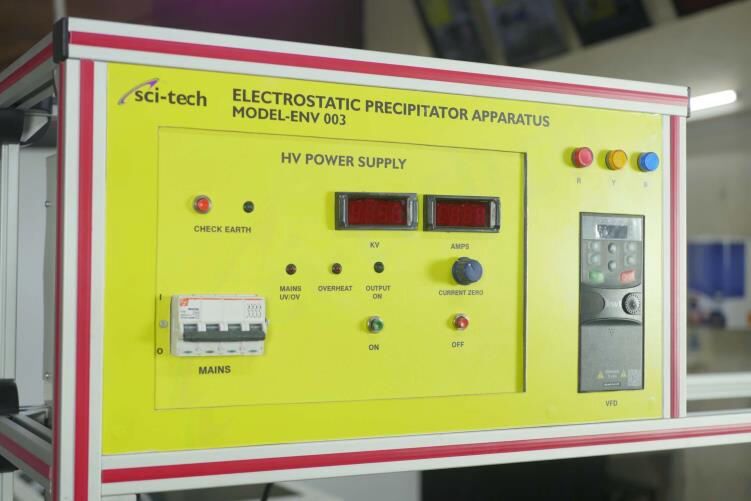
Sci-tech Electrostatic Precipitator (ESP) TrainerModel ENV 003 uses the induced electrostatic charge to remove the particles from the flow air stream. This system is designed to give the students an understanding of the electrostatic precipitator system.
The apparatus comprises of a laboratory scale electrostatic precipitator unit, dust feeding system and a digital weighing meter. A venturi type flow meter is provided to measure the incoming air flow rates.
This ESP is a plate type precipitator. It contained of a row of thin wires and followed by a stack of large flat metal plate. The air flow will flow through the thin wires and passes though the metal plate. High negative voltage is applied between the wires and plates. The ESP has a dimension of 600x1000x600mm with a fan. The operating voltage for the ionizer is about 7000 VDC while for collector is about 8000 VDC.
Air flow rates can be varied by controlling the fan speed. Dust tank is provided to inject the dust into the system. Digital weighing meter is provided to measure the dust collection by the ESP.
EXPERIMENTS CAPABILITIES
• Understanding of electrostatic precipitator system
• Demonstration of basic separation
• Effect of input velocity against separation efficiency
• Effect of particle size on separation efficiency
• Effect of input charge (ionization strength) on the separation efficiency
TECHNICAL DATA
Experiment Test: Electrostatic Precipitator (ESP) System
Apparatus Frame: Epoxy coated steel frame
ESP type: Plate type
ESP size: 600x1000x600mm
Fan rating: 1/4hp TEFC motor & drive
Operating voltage: 7000VDC (ionizer); 8000VDC (collector)
Voltage Gradient: 11,158VDC/inch (Ionizer) & 24,768 VDC/inch (Ionizer)
Air flow meter: Digital anemometer
Hand held Anemometer range: Air velocity: 0 - 2m/s; Temperature: 0 - 65oC
Dust tank: Plexi-glass container
Digital Analytical balance: weighing capacity: 50 kg; resolution: 0.5 g;
Digital Instrumentation with (optional) sensors for digital indicators & air velocity transmitter.
Optional:
‘Sci-Cal’ Computer Control Software & Interface
EXPERIMENTS CAPABILITIES
• Understanding of electrostatic precipitator system
• Demonstration of basic separation
• Effect of input velocity against separation efficiency
• Effect of particle size on separation efficiency
• Effect of input charge (ionization strength) on the separation efficiency




Connect with us





 For Buyer
  For Seller
  Help
Help 

 Dahisar, Mumbai, Maharashtra
 Send Enquiry