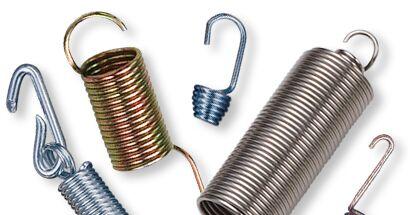
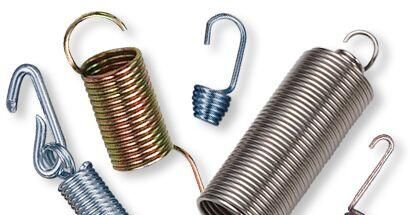
Most extension springs are wound with initial tension. This is an internal force that holds the extension spring's coils together. The measure of the initial tension is the load necessary to overcome the internal force and begin coil separation. Unlike a compression spring that has zero load at zero deflection, an extension spring can have a preload at zero deflection (see graph). This built-in load, called initial tension, can be varied within limits, decreasing as the spring index increases.
Note that there is a range of stress (and, therefore, force) for any extension spring index that can be held without problems. If the designer needs an extension spring with no initial tension, the spring should be designed with space between the coils. Read more on initial tension.
Initial Tension (P1) is determined by extending the extension spring to a given length (L1) ensuring coil separation. The spring then is extended an equal distance to (L2). The amount of initial tension is equal to two (2) times the load achieved at (L1) minus the load at (L2).
The formula for Initial Tension Simplified
is (Pi) = 2P1 - P2.

 Member Since 9 Years
 Nature of Business Supplier
 Address Decatur, GA 30035, US






 For Buyer
  For Seller
  Help
Help 
 Twitter
 WhatsApp
 Facebook
 Linkedin