
Company Information
 Member Since 14 Years
 Nature of Business Retailer
Ask for more detail from the seller
Contact Supplier
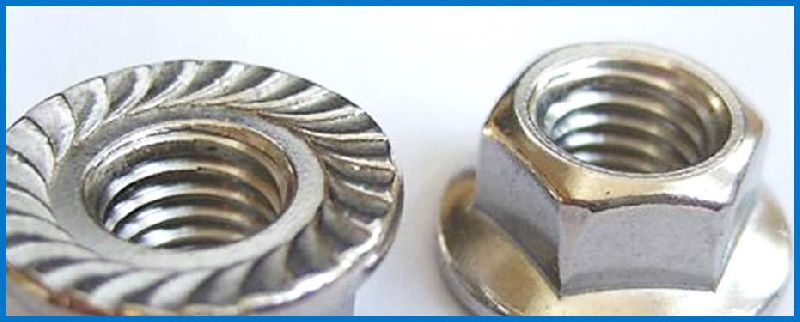
Flange lock nuts are one piece, all-metal prevailing torque hex flange nuts. Being all-metal, they do not have the temperature and chemical limitations of non-metallic (such as nylon) insert type lock nuts. The protruding circular flange increases the nut's bearing surface allowing them to be used with irregular and oversized holes. Commercial and industrial applications include lawn and garden equipment and truck manufacturing. Flange lock nuts are also called:
flange style automation lock nut, prevailing torque flange nuts, deformed thread flange lock nuts.
They are often used with 150 ksi hex flange bolts. Lock washers are not used with prevailing torque lock nuts.
By definition, "Prevailing-torque locking fasteners have a self-contained feature which creates frictional interference between the threads of the mating components." Consequently, unlike free spinning lock nuts, there is a resistance to rotation during both assembly and disassembly requiring them to be wrenched; that resistance is called prevailing torque. The advantage is that disassembly is unlikely even if preload diminishes completely because of the remaining rotational resistance. Despite the fact they are called "lock nuts," flange lock nuts are not permanently locked in place so they can be adjusted or removed after installation. However, their "locking" feature does resist loosening without the nuts being seated, which allows them to be used as stop nuts or spacers for rotating or other components.
Threads are standard right-hand and Unified inch coarse series (UNC, Unified National Coarse) or Unified inch fine (UNF, Unified National Fine).
Flange lock nut size refers to its nominal thread diameter. Typically, sizes range from about 1/4" to 1". Size is specified in inches, usually fractional rather than decimal.
Nut width and thickness vary with the size of the flange lock nut.
Flange lock nuts need to be fully engaged with the bolt/screw threads for the locking feature to be effective. To ensure full thread engagement, bolts/screws should be long enough to allow at least two full threads to extend beyond the nut face after tightening. Conversely, there should be two full threads exposed on the head side of the nut to make sure the nut can be properly tightened.
Grade G is common as are phosphate & oil and yellow zinc plated finishes. Some nuts are available from domestic (USA) manufacturers.
Flange lock nuts are reusable but only for a limited number of times because the prevailing torque declines each time the nut is used. Always follow the manufacturer's recommendations regarding nut reuse, thread lubricants and torque values. Do not apply standard torque values to prevailing torque lock nuts because the joint may not be tightened to the correct clamping force due to the additional friction of the locking element.
It is possible that the locking feature, which consists of deformed threads, may damage the threads of the nut or bolt. The possibility is reduced when the strength grades of the nut and bolt are compatible. For example, Grade G nuts are suggested for use with bolts having a specified minimum ultimate tensile strength of not less than 120, nor greater than 150 ksi. The chance of damage is greatest if the hardness of the mating fastener is vastly different; for example, using a non-heat treated low carbon steel bolt or screw with a heat treated nut.
Prevailing torque lock nuts are not considered suitable for long threaded assemblies because extended nut travel along the threads could damage the nut's locking feature. Therefore, the length of the bolt or screw should not be much longer than that needed to ensure full thread engagement with the nut.
Serrated Flange NutsSerrated Flange NutSerrated flange nuts are hex flange nuts with a serrated bearing surface. The nut turns freely until the serrations contact and displace material on the mating surface as the nut is tightened; less torque is needed to install than remove because the gripping action of the serrations create a ratchet-type locking feature that is resistant to vibration. If the mating surface is painted or plated, corrosion can occur if the nut's wiping action removes the surface treatment. The protruding circular flange increases the bearing surface of the nut allowing it to be used with irregular and oversized holes. Used in commercial and industrial applications, serrated flange nuts are also called:
serrated face lock nuts, serrated tooth nuts, spin lock nuts, whiz lock nuts.
Because the serrations must contact the mating surface to "lock", serrated flange nuts are not used with flat or lock washers.
Threads are standard right-hand and Unified inch coarse series (UNC, Unified National Coarse) or Unified inch fine (UNF, Unified National Fine).
Serrated flange nut size refers to its nominal thread diameter. Typically, sizes range from about #6 to 5/8". Sizes less than 1/4" are listed as a number size (the larger the number the larger the size) while sizes that are 1/4" and larger are specified in inches, usually fractional rather than decimal.
Nut width and thickness vary with the size of the serrated flange nut.
Steel, zinc plated, is a common material and finish; stainless steel is also available.
Serrated flange nuts are reusable. However, always follow the manufacturer's recommendations regarding nut reuse, thread lubricants and torque values.
Flange Lock Nuts DimensionsPhysical Properties of Grade G Nuts (strength equivalent to Grade 8 nuts)
Material: Medium Carbon Steel, Heat Treated
Proof Load Strength: 150,000 psi min
Rockwell Hardness: Dia 1/4 to 5/8 – Rc 24/32
Dia 3/4 to 1" – Rc 26/34
| D1 | D2 Max | H Max | M | S Max |
| M4 | - | 5.5 | - | 7.0 |
| M5 | 11.8 | 7.1 | 4.7 | 8.0 |
| M6 | 14.2 | 9.1 | 5.7 | 10.0 |
| M8 | 17.9 | 11.1 | 7.6 | 13.0 |
| M10 | 21.8 | 13.5 | 9.6 | 15.0 |
| M12 | 26.0 | 16.1 | 11.6 | 18.0 |
| M14 | 29.9 | 18.2 | 13.3 | 21.0 |
| M16 | 34.5 | 20.3 | 15.3 | 24.0 |
| M20 | 42.8 | 24.8 | 18.7 | 30.0 |
| M24 | 45.0 | 24.0 | - | 36.0 |
| Size | Width Across Flats | Total Thickness | Hex Height | Flange Diameter | Flange Thickness | Prevailing Torque | ||||
|---|---|---|---|---|---|---|---|---|---|---|
| Install | Removal | |||||||||
| F | H | J | B | K | Max | Min | ||||
| Max | Min | Max | Min | Max | Min | In-lb | Ft-lb | In-lb | Ft-lb | |
| 1/4 | 7/16 | .428 | .300 | .140 | .560 | .040 | 40 | 3.3 | 5 | .4 |
| 5/16 | 1/2 | .489 | .365 | .170 | .680 | .050 | 80 | 6.7 | 8 | .7 |
| 3/8 | 9/16 | .551 | .425 | .200 | .810 | .060 | 110 | 9.2 | 12 | 1 |
| 7/16 | 11/16 | .675 | .495 | .230 | .930 | .070 | 135 | 11.2 | 17 | 1.4 |
| 1/2 | 3/4 | .736 | .555 | .260 | 1.070 | .080 | 204 | 17 | 22 | 1.8 |
| 5/8 | 15/16 | .922 | .690 | .320 | 1.330 | .100 | 420 | 35 | 39 | 3.2 |
| 3/4 | 1 1/8 | 1.088 | .825 | .380 | 1.585 | .110 | 540 | 45 | 58 | 4.8 |
| 7/8 | 1 5/16 | 1.269 | .787 | .440 | 1.750 | .120 | 840 | 70 | 88 | 7.3 |
| 1 | 1 1/2 | 1.450 | .900 | .500 | 2.060 | .130 | 1080 | 90 | 120 | |



Connect with us





 For Buyer
  For Seller
  Help
Help 
 Khetwadi, Mumbai, Maharashtra
 Send Enquiry