
Company Information
 Member Since 9 Years
 Nature of Business Retailer
Ask for more detail from the seller
Contact Supplier
FEATURES
In the Process Industry, many chemical reactions are carried out between liquids / slurries and gases, Traditionally, such gas-slurry reactions have been carried out with the help of equipment, where basically, an agitator was used to stir the liquid in the Reactor. This somewhat clumsy method resulted in less than satisfactory performance, due to non-ideal mixing, which led to poor catalyst suspension, negligible gas-liquid interfacial areas, as well as low heat and mass transfer coefficients.
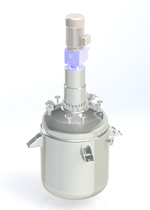
An Omega Kemix Gas - Induction Reactor offers a radial change from this conventional approach. Instead of churning the liquid reaction mass, a hollow agitator pumps gases from the head space to the lowest part of the Reactor vessel, as shown in the picture. A specially designed impeller vigorously disperes these gases into the reactor bottom, resulting in a mixture akin to a boiling liquid. Gas bubbles react with liquid/slurry as the as they rise. Unreacted gases are re-inducted into the liquid.
The self-aspiration agitator of an Omega Gas-Induction Reactor has a highly efficient design, which leads to the following advantages:
| Sr.No. | Gas-Induction Reactor | Conventional Agitated Vessels |
| 1 | Designed for Gas-Liquid reaction applications | Suitable for stirring of liquids and slurries. |
| 2 | Impeller is designed only to pump gas at the bottom of liquid column Hence consumes less power. Usually single impeller is provided irrespective of the capacity. | Impeller designs are not energy efficient. column. Hence, Also, multiple impellers may further add to the energy consumption. |
| 3 | Gas-Induction creates uniform catalyst suspension resulting in optimum use of charged catalyst quantity. | Catalyst suspension may not be uniform and some quantity may settle at the bottom resulting in non participation of this catalyst in the reaction. |
| 4 | Generates huge amount of Gas-Liquid interfacial area resulting in fastest possible reaction time with comparatively lower catalyst loadings. | Interfacial area is very poor as the agitator is designed only for stirring the mass. Extra catalyst quantity is required to improve sluggish rate of reaction. |
| 5 | Faster reaction leads to shortest possible batch time resulting in lesser impurities and higher yields. | Due to sluggish rate of reaction, batch time is longer resulting in many unwanted side reactions and lesser yields. |
| 6 | Vigorous gas-induction leads to boiling heat transfer co-efficients. Hence, fastest possible heating and cooling time. | Due to sub optimal heat transfer co-efficients, heating and cooling times are longer. Utility loads will be higher. |
| 7 | Available with Magnetic seals which are maintenance free and no spares are required to be maintained by user. | Mechanical seals tend to leak frequently resulting in downtime and production loss. Expensive seal spares are required to be stocked by user. |



Connect with us





 For Buyer
  For Seller
  Help
Help 
 MIDC, Mumbai, Maharashtra
  Send Enquiry