Product Specifications
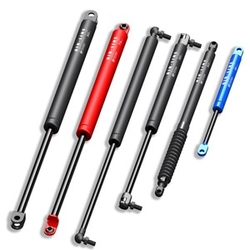
Gas springs are known as gas strut used for supporting doors movements.
gas springs supply force to assist operators lifting heavy loads or opening doors and lids. dampers absorb force to provide controlled motion in compression, extension, or both. the working life of gas springs depends on size, orientation, temperature, and other operational conditions.
they are used in seat adjustments in buses, airplanes, boats, yatches, they also can be used in hospital beds, tables, furniturs, kitchen cabinets.
the gas springs are designed with following factors in mind.
1. total extended length
2. stroke
3. force in newton
4. end fittings
proper size and installation extend the life of gas springs and dampers.
gas springs help lift loads or open doors or lids. engineers can choose from a variety of gas springs, end connectors, materials, force and extension levels, and holding options.they offer a helping hand when you open or close lids, covers, and hatches. they lighten the load when you are lifting or lowering something heavy. but they are almost never appreciated for their efforts. what are these overlooked workers? they are gas springs and dampers.
gas springs are heavy-gauge steel bodies holding pressurized nitrogen gas. the force of the gas pressure extends chrome or nitrite-coated steel shafts for assisted lifting or opening. piston assemblies, seals, and hydraulic fluids complete the package.
load capacity and extension speed depend on the size of the spring, gas pressure, mounting configuration, and ambient temperature. the components can measure as small as 5-in. long when compressed and sizes can be as long as 36 in. at full extension.
although the amount of force the springs supply varies with application conditions, it is related to the internal pressure, p1, as well as how the spring is mounted and where. depending on the rod and tube diameter, springs can come with initial p1 values of 15 to 450 lb.
designers can choose among accessories and options for their applications. but mounting hardware that accommodates the loads weight and center of gravity is paramount.
variations on gas springs include those that lock-open or have multiposition friction nuts that let operators work safely under heavy loads. designers may also opt for springs that let installers adjust gas pressure, stainless-steel construction for corrosive or sterile environments, and other materials and assembly components that provide different life spans and degrees of dependability.
smart specifying
to specify the right gas spring, designers need to know the weight and center of gravity of the load and apply some basic physics and geometry. the goal is to minimize stroke and maximize gas volume so the output force diminishes slowly over time.
Gas springs are known as gas strut used for supporting doors movements.
gas springs supply force to assist operators lifting heavy loads or opening doors and lids. dampers absorb force to provide controlled motion in compression, extension, or both. the working life of gas springs depends on size, orientation, temperature, and other operational conditions.
they are used in seat adjustments in buses, airplanes, boats, yatches, they also can be used in hospital beds, tables, furniturs, kitchen cabinets.
the gas springs are designed with following factors in mind.
1. total extended length
2. stroke
3. force in newton
4. end fittings
proper size and installation extend the life of gas springs and dampers.
gas springs help lift loads or open doors or lids. engineers can choose from a variety of gas springs, end connectors, materials, force and extension levels, and holding options.they offer a helping hand when you open or close lids, covers, and hatches. they lighten the load when you are lifting or lowering something heavy. but they are almost never appreciated for their efforts. what are these overlooked workers? they are gas springs and dampers.
gas springs are heavy-gauge steel bodies holding pressurized nitrogen gas. the force of the gas pressure extends chrome or nitrite-coated steel shafts for assisted lifting or opening. piston assemblies, seals, and hydraulic fluids complete the package.
load capacity and extension speed depend on the size of the spring, gas pressure, mounting configuration, and ambient temperature. the components can measure as small as 5-in. long when compressed and sizes can be as long as 36 in. at full extension.
although the amount of force the springs supply varies with application conditions, it is related to the internal pressure, p1, as well as how the spring is mounted and where. depending on the rod and tube diameter, springs can come with initial p1 values of 15 to 450 lb.
designers can choose among accessories and options for their applications. but mounting hardware that accommodates the loads weight and center of gravity is paramount.
variations on gas springs include those that lock-open or have multiposition friction nuts that let operators work safely under heavy loads. designers may also opt for springs that let installers adjust gas pressure, stainless-steel construction for corrosive or sterile environments, and other materials and assembly components that provide different life spans and degrees of dependability.
smart specifying
to specify the right gas spring, designers need to know the weight and center of gravity of the load and apply some basic physics and geometry. the goal is to minimize stroke and maximize gas volume so the output force diminishes slowly over time.
some manufacturers offer software or design forms for choosing the right spring. engineers can input whether the lid or hatch is mounted horizontally, vertically, or some angle in between and play with mounting points and opening
 Business Type Manufacturer / Exporter / Supplier / Retailer / Distributor / Importer / Trader / Buying House
 Year of Establishment 2004
Seller Detail
Nature of Business Supplier Member Since 16 Years Address SHOP NO 30-31, BUSTAN BUILDING, BEHIND AL MADEENA POLICE STATION, BUSTAN ROAD, AL BUSTAN, AJMAN, UAE. P.O.BOX 6914, AJMAN, UAE., AE
Ask for more detail from the seller
Contact Supplier

Connect with us





 For Buyer
  For Seller
  Help
Help 
 Twitter
 WhatsApp
 Facebook
 Linkedin