
Company Information
 Member Since 1 Year
 Nature of Business Supplier Year of Establishment 1995
Ask for more detail from the seller
Contact Supplier
| Unit | 20%/100 ml |
| Type | Injection |
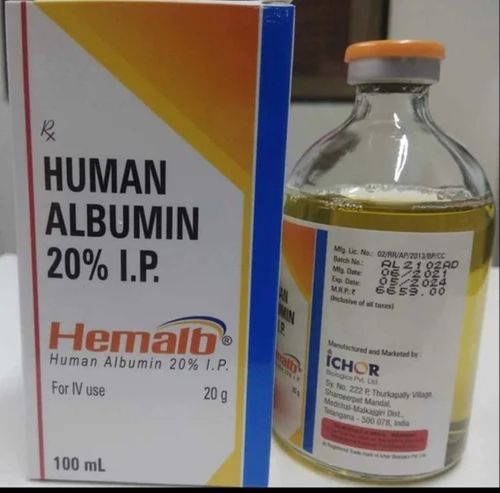
| Brand | Albucel (Intas) |
| Manufacturer | Intas Pharmaceuticals |
| Packaging Size | 1 bottle |
| Composition | Human Albumin |
| Usage/Application | Hospital |
| Prescription/Non prescription | Prescription |
| Storage Temperature | (2 - 8 DegreeC) |
| Deals in | Third Party Manufacturing |
| Treatment | cancer |
Human albumin is a 67-kDa globular protein that is the principal component of circulating plasma proteins, constituting 50% of the total pool.91 Albumin is synthesized in hepatocytes and released into the bloodstream, where 30% to 40% remains. Most circulating albumin crosses capillary membranes into the interstitial space, where it returns to the circulation via lymphatics. Albumin is synthesized at a rate of 10 to 15 g/day in healthy individuals and has a half-life of 12 to 19 days. It carries a net negative charge because of its highly acidic amino acid content.92 Albumin accounts for 75% of plasma oncotic pressure because of its high plasma content and negative charge, which attracts sodium and water. The negative charge also enables albumin to bind and carry an array of molecules, such as bilirubin, bile acids, hormones, anions, fatty acids, metals, drugs, and endotoxin. Albumin provides most extracellular antioxidant activity through an abundance of thiol groups, which are avid scavengers of oxidative and reactive species.93 Albumin exhibits immunomodulatory activity, such as endotoxin binding and the inhibition of proinflammatory pathways involving tumor necrosis factor (TNF)-α and nuclear factor κB. It stabilizes vascular endothelium and modulates vasodilation and platelet aggregation by binding to nitric acid.94 Thus hypoalbuminemia is often associated with increased vasodilation and platelet aggregation.
Serum albumin levels reflect hepatic synthetic function and are therefore a component of the commonly used Child-Pugh staging system for cirrhosis. However, because of the relatively long half-life of albumin, serum levels are commonly normal in patients who present with acute liver failure. Hypoalbuminemia has several nonhepatic causes, such as nephrotic syndrome, severe malnutrition, malabsorption, and protein-losing enteropathy. Additionally, hypoalbuminemia may develop during pregnancy because of expanded intravascular volume.



Connect with us





 For Buyer
  For Seller
  Help
Help 
 Delhi Gate, Delhi
 Send Enquiry