
Company Information
 Member Since 15 Years
 Nature of Business Retailer
 GST No. 27AAIPB6904A1Z9
Ask for more detail from the seller
Contact Supplier
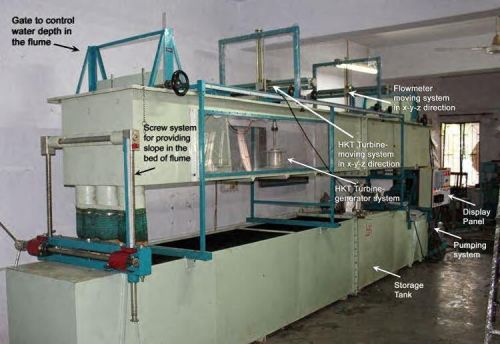
Hydrokinetic energy is the energy generated by the movement of a body of water. The earth 's tides, waves, ocean currents and free-flowing rivers contain an untapped, powerful, highly-concentrated and clean energy resource HK systems are a class of “zero-head” hydropower whereby energy is extracted from the kinetic energy of flowing water, similar to wind turbines, rather than the potential energy of falling water. These systems can be installed in free-flowing rivers or streams. Marine energy, also known as marine and hydrokinetic energy or marine renewable energy, is a renewable power source that is harnessed from the natural movement of water, including waves, tides, and river and ocean currents. Hydrokinetic devices can be placed directly in the stream of flowing water and the kinetic energy of the flowing water is converted to mechanical energy that drives a generator to produce electricity. The main field of application of hydrokinetic turbines is the irrigation canals and waterways, and ocean currents. The main advantage is that they do not require any infrastructure like a penstock or powerhouse to create the head or to install the turbine, and they have an almost negligible environmental impact. Hydrokinetic turbine types: (a) Axial-flow turbine; (b) Cross-flow turbine. Figure 2. Axial flow turbines: (a) Non-submerged generator; (b) Submerged generators. Cross-flow turbines have been developed to overcome the problems of axial flow turbines in water. Specifications 1. Overall Flume Dimensions: 2000L x 400W x 400H in mm 2. Transparent viewing area of H x W x L = 375 x 300 x 1015 mm 3. Blade assembly: 3 Rotor blades technology 4. Electro-magnetic brake system: @ 10Kg-cm 5. Power Generation: 10W ~ 100Watts max. 6. Computer interface & Software: Includes DAQ, SCADA software, interface & software on 11” HMI touch screen & standard in-built computer system. 7. Accessories: All required accessories & tools provided for installation and experimenting. Experimental setupThe prototypes were tested at a water velocity ranging from 0.6 to 1.1 m/s on a special setup designed for testing small scale axial hydraulic turbines [9], [10]. This closed-loop setup is provided with a transparent viewing area of H x W x L = 375 x 300 x 1015 mm, where the prototype is also located. This area is opened at the upper side, creating the conditions for free surface flow. The water velocity can be varied in the range of 0.05 – 1.1 m/s. All tests were performed for the maximum water depth allowed by the experimental bench in order to minimize the influence of the free surface and the turbulence at high water velocities. The hydrokinetic turbine is placed equidistant at 50 mm between the free surface and the bottom of the channel. The sustaining system presented in figure 3 is designed for an easy and safe attachment of the tested turbines. The turbine shaft is coupled to an angular adapter which transmits the horizontal motion into a vertical plane to the torque transducer and the electromagnetic particle brake, (maximum torque of 2 Nm and 0.1% accuracy of full scale), coupled to a data acquisition system. Evaluation of the water velocityThe first step carried out was to evaluate the reference mean water velocity by investigating the velocity field with a Pitot-Prandl tube. The tube is connected to a differential pressure sensor which transmits the data to a central unit for data acquisition and storage. The measured differential pressure, Δp, represents the dynamic pressure of the flow and is used to compute the velocity as V = 2Δp r , where ρ is the water density. For each flow regime, several measurements were conducted in the middle of the channel, moving the Pitot-Prandtl tube on vertical direction, from the free surface to the bottom of the channel. The resulted values corresponding to the reference velocity of the water of 1 m/s are presented in figure. Given the measured velocity distribution, the flowra



Connect with us





 For Buyer
  For Seller
  Help
Help 

 Dahisar, Mumbai, Maharashtra
 Send Enquiry