
Company Information
 Member Since 10 Years
 Nature of Business Supplier
Ask for more detail from the seller
Contact Supplier
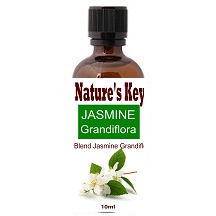
Oil Blend Jasminum grandiflorum
Jasmine oil (blended with fractionated & deodorized coconut oil) does more than just smell exquisite – it deeply relaxes, lifts depression and boosts confidence, helps with sexual problems, sooths coughing and tones and improves skin elasticity, while helping to reduce stretch marks and scars.
Ingredients: Pure jasmine absolute & deodorised fractionated coconut oil
This blend is already prediluted and ready for use.
Essential oils blended with carrier oils may clog diffusers; please clean thoroughly after each use.
FOR EXTERNAL USE ONLY!
Origin: France/Italy/Turkey
Jasmine OilOur Jasmine oil is extracted from Jasminum Gradiflora, of the Oleaceae family and is also known as Spanish Jamsine, Royal Jasmine, Catalonian Jasmine, jasmin, jessamine and common jasmine.
Although expensive, this essential oil does more than just smell exquisite – it deeply relaxes, lifts depression and boosts confidence, eases childbirth, helps with sexual problems, sooths coughing and tones and improves skin elasticity, while helping to reduce stretch marks and scars.
Oil propertiesJasmine essential oil has a sweet, exotic and richly floral smell.
The more common species – Jasminum grandiflorum (also known as royal jasmine, Spanish or Catalonian jasmine or jati) is also used for essential oil extraction.
Origin of Jasmine Oil
Jasmine is an evergreen, fragile, climbing shrub, that can grow up to 10 meters (33 feet) high and has dark green leaves and small white star-shaped flowers, which are picked at night, when the aroma is most intense.
An experienced picker can pick 10,000-15,000 blossoms per night.
Originally from China and Northern India, it was brought to Spain by the Moors, with France, Italy, Morocco, Egypt, China, Japan and Turkey currently producing the best essential oil.
The name Jasmine is derived from the Persian word ‘yasmin’. The Chinese, Arabians and Indians used it medicinally, as well as for an aphrodisiac and for other ceremonial purposes.
In Turkey, the wood is used for making rope stems and jasmine tea is a Chinese favorite (but Jasminum sambac – Arabian jasmine – is normally used for this) and in Indonesia it is used as a popular garnish.
Extraction
Jasmine oil starts it journey as a ‘concrete’, which is made by solvent extraction, after which an ‘absolute’ is obtained from the concrete, by separation with alcohol.
1,000 lbs of flowers yield approximately one pound of liquid concrete, which yields 0.2% aromatic molecules.
Chemical compositionThere are well over 100 constituents found in jasmine oil, but the main chemical components are benzyl acetate, linalool, benzyl alcohol, indole, benzyl benzoate, cis-jasmone, geraniol, methyl anthranilate and trace amounts of p. cresol, farnesol, cis-3-hexenyl benzoate, eugenol, nerol, ceosol, benzoic acid, benzaldehyde, y-terpineol, nerolidol, isohytol, phytol etc.
PrecautionsJasmine oil is non-toxic, non-irritant and generally non-sensitizing, although some people do have an allergic reaction to the oil. Due to its emmenagogue properties it should not be used in pregnancy. Using too much of this oil could impede concentration, as it is a deeply relaxing oil.
Therapeutic propertiesThe therapeutic properties of jasmine oil are anti-depressant, antiseptic, aphrodisiac, anti-spasmodic, cicatrisant, expectorant, galactagogue, parturient, sedative and uterine.
Uses
Jasmine oil tones dry, greasy, irritated and sensitive skin, increases elasticity and is often used to assist with stretch marks and to reduce scarring.
Jasmine oil has great value for treating severe depression, eases childbirth, is beneficial with sexual problems, on the respiratory tract, for muscle pain and for toning the skin.



Connect with us





 For Buyer
  For Seller
  Help
Help 
 United Arab Emirates
  Send Enquiry