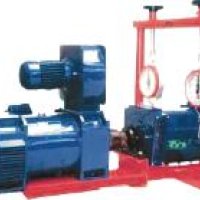
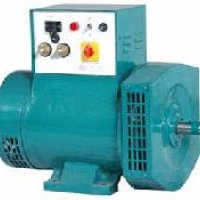
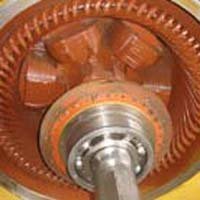
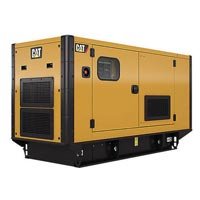
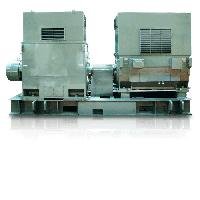
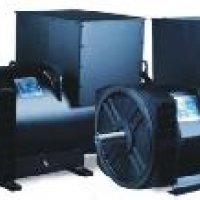
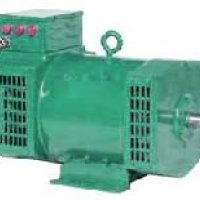
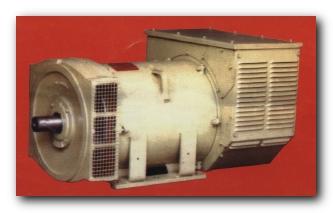
- Single bearing with SAE disc coupling arrangements, also 2 bearing - Protection IP 23S
Insulation
- Main stator and rotor class F or H - Exciter stator and rotor class F or H
COMPOUND EXCITATION SYSTEM
- This system compromises: - A 3 phase compounding transformer - An auxillary winding - 3 phase rectifier bridge - A voltage regulator(optional upto 125 kva) These components are mounted at the rear of the alternator in a substanstial terminal box.
FUNCTION OF THE COMPOUND SYSTEM
The alternator exciter is supplied with D.C Current from the diode bridge which receives two sources of A.C> power - The first supplied by the auxillary winding in the stator being proportional to the voltage of the alternator. - The second supplied by the secondary winding of the 3 phase compounding transformer and being proportional toi the load current and P.F. The resultant current provides an excitation firld current that varies as a function of the load and P.F. to maintain the output voltage resonably constant (self regulating withought A.V.R)
Voltage Regulation
- Alternators upto 125 KVA are supplied withought a regulator, the basic compound excitation system maintaining the voltage to within +- 5% after reaching thermal stability(This is better than most countries main supply.) Electronic AVR can be provided as optional for regulation within +-2%> The alternator voltage is adjustable by a rheostat over the range 380 to 415V, 50 Hz and 440 to 480V, 60 Hz. - Alternators above 125 KVA are supplied with a electronic voltage regulator that maintains the voltage to within +-2% - Voltage adjustment by rheostat - Power factor range 0.8 to 1.0 - including cold to hot drift - Compound "BACK-UP" auto regulation system in case of regulator failure by insertion of a rheostat. Note Alternators can be supplied with windings giving other voltages if so required.
ELECTRICAL PERFORMANCE
Apart from the voltage regulation characteristics the compound excitation system gives you the following advantages: - Voltage build-up from residual magnetism - Protection against low speed operation - Good motor starting, the compound system giving 2.5 to 3 times full load capacity. - Sustained short circuit current of the order of 3 times full load current. - Volts/hertz responsive - with any abdrupt in speed from the engine a corresponding reduction in voltage output releives the engine load allowing for faster re-establishment of correct speed. - Voltage dip on application of full load 0.8 P.F. in the order of 15 to 20%. - Recovery time at constant speed for full load application less than 0.5 seconds. - Over voltage limited in-case of regulator failure the voltage rise is limited to a value supplied by the compound system(adjustable). - 3 phase sensed compound system allows good operation with the unbalanced load system. - Good overload characteristics

 Member Since 19 Years
 Nature of Business Retailer










 For Buyer
  For Seller
  Help
Help 

 Vijay Nagar, Bengaluru, Karnataka
  Send Enquiry
  22,800 / Piece