
Company Information
 Member Since 9 Years
 Nature of Business Retailer
 GST No. 08AAACM8473A1ZL
Ask for more detail from the seller
Contact Supplier
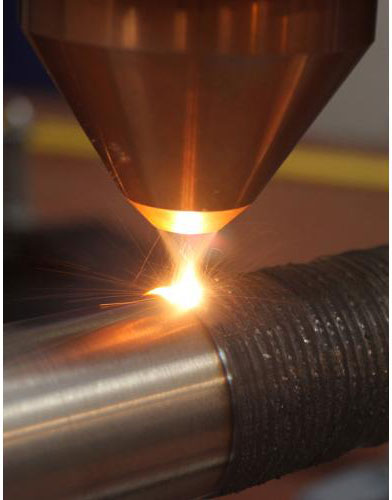
Laser cladding falls into the group of processes commonly known as hard-facing. The laser cladding process is a method of applying a fully dense, metallurgically bonded and virtually pure coating which can be used to increase the wear resistance, corrosion resistance or impact performance of metallic components. In some cases, all three of the properties can be improved. The process utilises a precisely focussed high power laser beam to create a weld pool into which a metallic powder is applied. The powder, which is carried by a stream of inert shielding gas, is blown coaxially through the laser beam. The highly accurate nature of the laser beam allows fully dense cladding with minimal dilution (<5%), yet with a perfect metallurgical bond. Numerous coatings can be applied, the composition of which can be designed to combat the failure mechanisms associated with each component.
Fundamentals Of Laser Cladding
Benefits Of Laser Clad Coatings
The following table gives a broad comparison of coating processes. The data shown is based on typical applications and parameters. There can be exceptions to the below data, based on specific applications and parameters.
| Detail | HVOF Thermal Spray | PTA | Laser Cladding |
|---|---|---|---|
| Heat source | Flame (liquid or gas) | Electric arc | Laser beam |
| Coating thickness (typical) | 0.05 – 1mm | 0.5 – 5mm | 0.2 – 2mm |
| Typical Deposition rates | ≤ 5 kg/hr | ≤ 10 kg/hour | ≤ 5kg/hr |
| Dilution | 0 | 5-15% | ≤ 5% |
| Type of bonding | Mechanical | Metallurgical | Metallurgical |
| Bond strength | ≤ 80 MPa | ≤ 800 MPa | ≤ 800 MPa |
| Heat input | Low – medium | High | Low - medium |
| Porosity | ≤ 1% | < 0.1% | < 0.1% |
| Comparative capital cost | Medium | Low | High |
| Comparative running cost | High | Medium - Low | Low |
| Part No. | Description |
|---|---|
| MET-CLAD HEAD | MET-CLAD laser cladding head |
Technical Overview



Connect with us





 For Buyer
  For Seller
  Help
Help 

 Jodhpur, Rajasthan

 Send Enquiry