
Company Information
 Member Since 13 Years
 Nature of Business Manufacturer
Ask for more detail from the seller
Contact Supplier
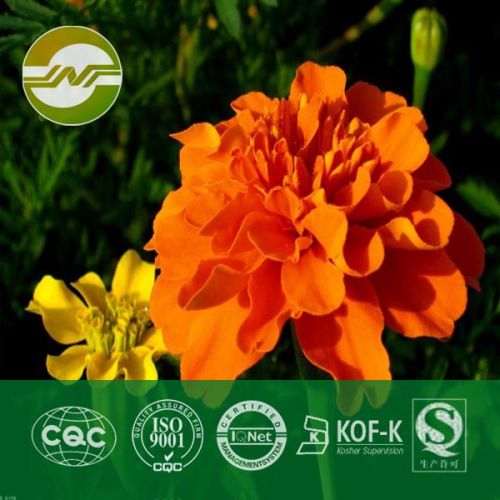
We are offering marigold extract.
Latin name: calendula officinalis
spec: lutein 5%, 20%, 75%, 80%. Hplc
cas no.: 127-40-2
tagetes (marigold) is a genus of 52 species of annual and perennial herbaceous plants in the daisy family (asteraceae or compositae). They are native to the area stretching from the southwestern united states into mexico and south throughout south america,but naturalize now in many countries including china, particularly the species tagetes erecta. Tagets erecta has pinnate green leaves, and yellow floral heads typically 4-6cm diameter. The foliage has a musky, pungent scent. It is said to deter some common insect pests, as well as nematodes. Tagetes are hence often used in companion planting for tomato, eggplant, pepper, and potato.
"marigold" is derived from "mary's gold", and the plant is associated with the virgin mary in christian stories. Tagetes is not to be confused with the genus calendula and other species also called marigold in some areas.
the petals of tagetes are rich in the orange-yellow carotenoid lutein and as such extracts of t. Erecta are used as a food colour (ins-number e161b).
lutein, from latin luteus meaning "yellow", is one of over 600 known naturally occurring carotenoids. Found in green leafy vegetables such as spinach and kale, lutein is employed by organisms as an antioxidant and for blue light absorption. Lutein is present in the plant as fatty-acid ester, with one or two fatty acids bound to the two hydroxyl-groups. Saponification of lutein esters yields lutein in approximately a 1:2 molar ratio. Lutein is also found in egg yolks, animal fats and the corpus luteum. Lutein is a lipophilic molecule and is generally insoluble in water. The presence of the long chromophore of conjugated double bonds (polyene chain) provides the distinctive light-absorbing properties. The polyene chain is susceptible to oxidative degradation by light or heat and is chemically unstable in acids.
the principal natural stereoisomer of lutein is (3r, 3′r, 6′r)-beta, epsilon-carotene-3, 3′-diol.lutein is a natural part of human diet when fruits and vegetables are consumed.for individuals lacking sufficient lutein intake, lutein-fortified foods are available, or in the case of elderly people with a poorly absorbing digestive system, a sublingual spray is available. As early as 1996, lutein has been incorporated into dietary supplements.
the functional difference between lutein (free form) and lutein esters is not entirely known.it is suggested that the bioavailability is lower for lutein esters, but much debate continues.
the marigold extract (lutein: e number e161b) used as a food additive, is derived from the flower petals of the plant tagetes erecta.



Connect with us





 For Buyer
  For Seller
  Help
Help 
 hunan
hunan  Send Enquiry