
Company Information
 Member Since 11 Years
 Nature of Business Exporter Year of Establishment 2012
Ask for more detail from the seller
Contact Supplier
| Sizes available | Lumps |
|---|---|
| Special Features | Most common quality of mica for commercial purposes depends largely on the amount of staining, air inclusions, the degree of flatness, and the colour. The staining is caused by mineral inclusions which occur intergroup with muscovite or between cleavage planes, The most common minerals which occur as inclusions are biotite, quartz, magnetite, hematite, garnet, plagioclase, apatite, clay minerals and the alteration products of biotite and iron oxides. |
| Applications | Mica is used in a number of electrical and electronic appliances in different shapes and sizes. As an insulating material it is used in equipment like condensers, transformers, sheostats, radio and electronic tubes and radar circuits. It is used in the form of washers, discs, tubes and plates |
| Price | Contact us for our firm offer |
| Technical specification | Lepidolite K(Li,Al)3(AlSi3O10) (O,OH, F)2, ; biotite K(Mg, Fe)3(AlSi3O10) (OH)2; phlogopite KMg3(AlSi3O10) (OH)2; muscovite KAl2(AlSi3O10)(OH)2 |
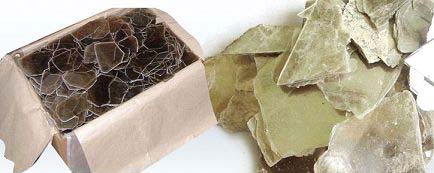
| Brief about product | Mica is a mineral name given to a group of minerals that are physically and chemically similar. They are all silicate minerals, known as sheet silicates because they form in distinct layers. Micas are fairly light and relatively soft, and the sheets and flakes of mica are flexible. Mica is heat-resistant and does not conduct electricity. There are 37 different mica minerals. The most common include: purple lepidolite, black biotite, brown phlogopite and clear muscovite. |
| Colors & packaging available | Mica are of different colours namely: purple, rosy, silver, gray (lepidolite); dark green, brown, black (biotite); yellowish-brown, green white (phlogopite); colorless, transparent (muscovite) packed in 50kg pp bags with 25mt per 1 x 20fcl |



Connect with us





 For Buyer
  For Seller
  Help
Help 

 Lagos
Lagos 
 Send Enquiry