
Company Information
 Member Since 17 Years
 Nature of Business Manufacturer
 GST No. 27AAACF6415D1Z0
Ask for more detail from the seller
Contact Supplier
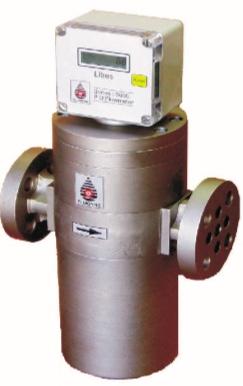
Oscillating Piston Flow Meter
Suppose you are working on an application where you need to measure the flow of a liquid that has a high viscosity. In that case, an oscillating piston flowmeter is what you should consider installing.
The oscillating piston flowmeters are a sort of positive displacement flowmeter and often referred to as volumetric counters. They are flowmeters especially suited for measuring high viscosity liquids. However, they are also most suited for liquids with a low viscosity.
The Configuration of Oscillating Piston Flow meter
The flow meter is one of the oldest types of positive displacement flow meters. This oscillating piston meter is mainly similar to a nutating disc meter. Except that its measurement device is one split ring/ piston that only oscillates within a single plane and this makes it more easy to maintain and durable than any other PD meter.
Oscillating piston flow meters utilize a precision-machined chamber that contains a cylindrical piston. Liquid enters the precision-machined chamber containing an oscillating (rotating) piston. The piston is positioned to divide the chamber into compartments that hold a pre-measured exact volume. Liquid pressure propels the piston to start oscillating and rotate on its axis. The meter's operation itself is based on the movement of this rotating piston. It fills and empties a chamber of a known volume with each turn, i.e. this piston oscillates as the liquid flows.
It also has a central shaft that is constrained to run in a circular groove inside the chamber. The movement has a concentric motion about the centre chamber axis. This results in an off-centre rotating motion because the liquid sequentially enters and exits compartments shaped into the underside of this piston. Since the capacity of the compartments is already known, the volume of liquid metered per revolution is easy to calculate accurately.
The precision-machined chamber has a slotted cylinder that separates the inlet and outlet part. Center piston rotate as the liquid subsequently enters and exit from the chamber. Usually, a hydraulically floating piston does not come into contact with the chamber.
The rotation of this piston activates a reed sensor. It then emits a pulse that corresponds with the volume of this chamber. The output signal from this sensor can be used through an electronic converter.
Fluidyne's oscillating piston flowmeter series is manufactured using different materials and has varying process connections. These connections include materials and fittings for hygienic applications. We also offer unique designs for high-pressure applications.
When there is no flow inside the pipe, the piston stays stationary. When the liquid begins flowing, the piston displaces liquid from the inlet to the outlet with a constant cyclic volume per position.
The movements inside the piston's central hub are sensed through the flow meter's wall by a follower magnet. Every revolution of the piston hub is equal to a fixed volume of the fluid. This is indicated as flow by an indicator or totalizer.
Close margins between the piston and the chamber guarantee minimum liquid slippage for highly reliable and repeatable flow measurement for every volume cycle.
Benefits:
Application:
Features



Connect with us





 For Buyer
  For Seller
  Help
Help 

 Shivane, Pune, Maharashtra
 Send Enquiry