
Company Information
 Member Since 12 Years
 Nature of Business Retailer Year of Establishment 1989
Ask for more detail from the seller
Contact Supplier
Palasa is one of the sacred trees worshipped in India. In Sanskrit, Palasa is known as Kimshuka, Brahmavriksha. Kimshuka in Sanskrit means “like a parrot” or “what brightness!” The vernacular names of Palasa are: In Kannada (Muthuga), Telegu (Modagachettu), Hindi (Palasa, KankreiChichratesu, desukajhad, dhaak, palaash, chalcha), Gujarati (Kesudo), Punjabi (Keshu, Chachra, Sanura), Malayalam (PlasuShamata, Muriku), Marathi (PaLaash), Urdu (Palashpapra), Bengali (Kinshuk, Polash, Polashi), Assamese(Porasum), Tamil (Parasu, Mullumurugai, Kaliyanamurukkan). The Botanical name is ButeaMonosperma and it belongs to the family of Fabaceae. Some of the English names of Palasa are: Flame of the forest, Teak and Parrot tree.
Palasa is native to tropical and sub tropical parts of the Indian Subcontinent and South East Asia. It is found mostly in India, Nepal, Burma, Sri Lanka, Cambodia, Bangladesh, Thailand, Vietnam, Malaysia and Western Indonesia. The tree is found in the plains and slopes of the hills in India. Palasa trees are found in some of the temple premises in Tamil Nadu.
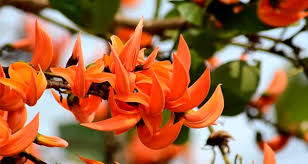
he leaves are pinnate with 8-16 cm petiole (the stalk attaching the leaf blade to the stem) having three leaflets. Each leaf is about 10-20 cms long. The leaves when tender are soft, thick, and velvety. They appear in pale bronze green colour. Old leaves are firm and tough as leather, smooth above and hairy below. The leaves have a leathery texture. The leaves which wither during autumn are filled with bright orange coloured flowers that appear like a flame covering the entire tree. Thus the tree gets the name Flame of the forest. The flowers also resemble an orange colour net spread over the entire tree, which is referred to as Kimsuka net.
Each flower consists of five petals comprising one standard, two small wings and a curved beak shaped keel. The curved beak shaped keel gives its name as Parrot Tree. The flowers are indicative of the onset of spring season and the colour of love. Jayadeva in Gita Govindam has compared the flowers to the red nails of the Lord of Cupid, Kamadeva which tear at the hearts of the lovers.



Connect with us





 For Buyer
  For Seller
  Help
Help 

 Sachin, Surat, Gujarat
 Send Enquiry