
Company Information
 Member Since 13 Years
 Nature of Business Supplier
Ask for more detail from the seller
Contact Supplier
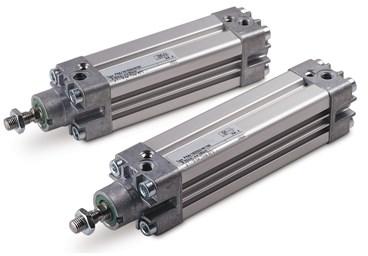
. ACTUATORS A Pneumatic actuator mainly consists of a piston, a cylinder, and valves or ports. The piston is covered by a diaphragm, or seal, which keeps the air in the upper portion of the cylinder, allowing air pressure to force the diaphragm downward, moving the piston underneath, which in turn moves the valve stem, which is linked to the internal parts of the actuator. Pneumatic actuators may only have one spot for a signal input, top or bottom, depending on action required. Valves require little pressure to operate and usually double or triple the input force. The larger the size of the piston, the larger the output pressure can be. Having a larger piston can also be good if air supply is low, allowing the same forces with less input. These pressures are large enough to crush objects in the pipe. On 100 kPa input, you could lift a small car (upwards of 1,000 lbs) easily, and this is only a basic, small pneumatic valve. However, the resulting forces required of the stem would be too great and cause the valve stem to fail. This pressure is transferred to the valve stem, which is hooked up to either the valve plug (see plug valve), butterfly valve etc. Larger forces are required in high pressure or high flow pipelines to allow the valve to overcome these forces, and allow it to move the valves moving parts to control the material flowing inside. Valves input pressure is the "control signal." This can come from a variety of measuring devices, and each different pressure is a different set point for a valve. A typical standard signal is 20–100 kPa. For example, a valve could be controlling the pressure in a vessel which has a constant out-flow, and a varied in-flow (varied by the actuator and valve). A pressure transmitter will monitor the pressure in the vessel and transmit a signal from 20–100 kPa. 20 kPa means there is no pressure, 100 kPa means there is full range pressure (can be varied by the transmiters calibration points). As the pressure rises in the vessel, the output of the transmitter rises, this increase in pressure is sent to the valve, which causes the valve to stroke downard, and start closing the valve, decreasing flow into the vessel, reducing the pressure in the vessel as excess pressure is evacuated through the out flow. This is called a direct acting process.



Connect with us





 For Buyer
  For Seller
  Help
Help 
 dubai
dubai  Send Enquiry