
Company Information
 Member Since 12 Years
 Nature of Business Manufacturer
Ask for more detail from the seller
Contact Supplier
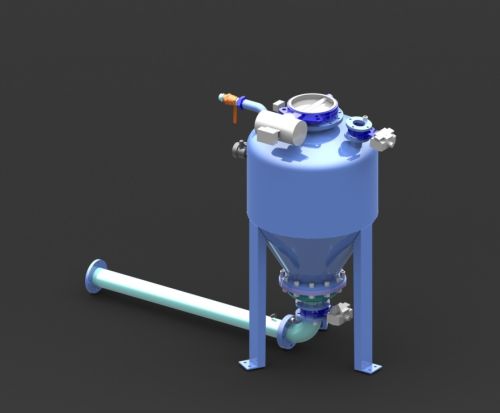
We are offering pneumatic conveying systems equipments.
pneumatic conveying is achieved by creating a pressure differential along a pipeline and using the air that moves toward the area of lower pressure to move bulk material. This process can be performed with a vacuum inducer or by injecting compressed air into one end of a pipeline or along the pipeline.
dilute-phase dense-phase pneumatic conveying
the two main categories of pneumatic conveying technologies are low-pressure (dilute-phase) and high-pressure (dense-phase) systems. Utilizing air pressure under 15 psig, the first category uses either positive or negative pressure to push or pull material through the convey line at relatively high velocities (see figure 1). It is a low-pressure, high-velocity system because it has a high air-to-material ratio.
The second category utilizes air pressures above 15 psig. This system uses positive pressure to push materials through the convey line at relatively low velocities (see figure 2). It is a high-pressure, low-velocity system because it has a low air-to-material ratio.
why dense phase?
dense-phase pneumatic conveying uses a small amount of air to move a large amount of bulk material in closely associated slugs through a convey line, much like extruding. Unlike dilute-phase conveying systems, which typically use larger amounts of air to move relatively small amounts of material at high velocities in suspension, dense-phase systems offer the advantage of efficiently pushing a much denser concentration of bulk solids at relatively low velocities through a convey line.
pneumatic conveying systems for bulk materials
many material-handling plants transfer large quantities of materials, often over long distances. As a result, the conveying system’s power consumption is of prime importance. In pneumatic conveying, power consumption is a function of the system design, transfer rate, and convey length. Therefore, a conveying system that transfers 100 tn/hr of a bulk material over a distance of 200 m uses about the same amount of power as a system of the same design that conveys 200 tn/hr of the same material over a distance of 100 m. Consequently, it is evident that the length of a pneumatic conveying system has the same impact on power consumption as does rate.
traditionally, bulk materials have been conveyed by inefficient pneumatic conveying systems. However, modern material-handling plants require more-efficient conveying systems to reduce power costs. In addition to reducing electricity costs, lowering power consumption offers many other benefits. First, conveying systems that use less power require less maintenance. Compare a formula 1 racecar to an economy car. Which car requires more maintenance? which car gets more life from the tires? which car gets more life from the engine? pneumatic conveying systems are no different. If two pneumatic conveying systems must convey the same material over the same distance and one system uses less power than the other, the system that consumes less power will experience less wear, require a smaller dust filter, and reduce pollution.
conclusion
since modern material-handling facilities have become more concerned with energy efficiency and conveying-system reliability, they require more-advanced conveying systems to reduce their operating costs. Therefore, a supplier of pneumatic conveying systems must provide a high-tech solution to move material reliably using a minimal amount of compressed air. Although slightly more expensive in the short run, such a system pays for the advanced technology in just a few years by reducing operating costs in the long run.



Connect with us





 For Buyer
  For Seller
  Help
Help 
 Turkey
  Send Enquiry