
Company Information
 Member Since 16 Years
 Nature of Business Manufacturer Year of Establishment 1997
Ask for more detail from the seller
Contact Supplier
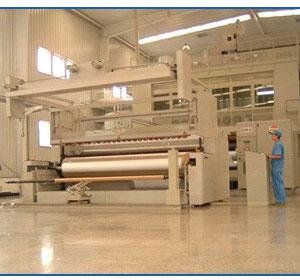
We are offering 1800mm pp spunbonded nonwoven fabric production line/machinery.
width: 900mm, 1600mm, 1800mm, 2400mm, 3200mm in standard, or customer-designed
die head: s, ss, sss, ssss
weigt: 9-200gms
pattern: spot, cross, double cross
applied widely at industry package, hotel, medical, argriculture.
also provide pp nonwoven fabric rolls
nonwoven fabrics are broadly defined as sheet or web structures bonded together by entangling fibre or filaments (and by perforating films) mechanically, thermally or chemically. They are flat, porous sheets that are made directly from separate fibres or from molten plastic or plastic film. They are not made by weaving or knitting and do not require converting the fibres to yarn. Typically, a certain percentage of recycled fabrics and oil-based materials are used in nonwoven fabrics. The percentage of recycled fabrics vary based upon the strength of material needed for the specific use. Conversely, some nonwoven fabrics can be recycled after use, given the proper treatment and facilities. For this reason, some consider nonwovens a more ecological fabric for certain applications, especially in fields and industries where disposable or single use products are important, such as hospitals, schools, nursing homes and luxury accommodations.
nonwoven fabrics are engineered fabrics that may be a limited life, single-use fabric or a very durable fabric. Nonwoven fabrics provide specific functions such as absorbency, liquid repellence, resilience, stretch, softness, strength, flame retardancy, washability, cushioning, filtering, use as a bacterial barrier and sterility. These properties are often combined to create fabrics suited for specific jobs, while achieving a good balance between product use-life and cost. They can mimic the appearance, texture and strength of a woven fabric and can be as bulky as the thickest paddings. In combination with other materials they provide a spectrum of products with diverse properties, and are used alone or as components of apparel, home furnishings, health care, engineering, industrial and consumer goods.
non-woven materials are used in numerous applications, including:
[edit]hygiene
baby diapers or nappies
feminine hygiene
adult incontinence products
wet wipes
bandages and wound dressings
disposable bath and face towels
disposable slippers and footwear
[edit]medical
isolation gowns
surgical gowns
surgical drapes and covers
surgical scrub suits
caps
medical packaging: porosity allows gas sterilization
[edit]filters
gasoline, oil and air - including hepa filtration
water, coffee, tea bags
pharmaceutical industry
mineral processing
liquid cartridge and bag filters
vacuum bags
allergen membranes or laminates with non woven layers
[edit]geotextiles
soil stabilizers and roadway underlayment
foundation stabilizers
erosion control
canals construction
drainage systems
geomembrane protection
frost protection
agriculture mulch
pond and canal water barriers
sand infiltration barrier for drainage tile
landfill liners[1]
[edit]other
carpet backing, primary and secondary
composites
marine sail laminates
tablecover laminates
chopped strand mat
backing/stabilizer for machine embroidery
packaging where porosity is needed
insulation (fiberglass batting)
pillows, cushions, and upholstery padding
batting in quilts or comforters
consumer and medical face masks
mailing envelopes
tarps, tenting and transportation (lumber, steel) wrapping
disposable clothing (foot coverings, coveralls)
weather resistant house wrap



Connect with us





 For Buyer
  For Seller
  Help
Help 
 Jiangsu
 Send Enquiry