
Company Information
 Member Since 9 Years
 Nature of Business Retailer
 GST No. 07ABCFM4332J1ZC
Ask for more detail from the seller
Contact Supplier
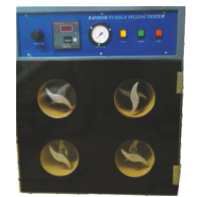
Random Tumble Pilling Tester, to determine the pilling and fizzing characteristics of textile fabrics. Random Tumble Pilling Tester uses stainless steel impellers that rotate within individually lit aluminum chambers constantly tumbling test fabrics against cork liners for a pre-determined time controlled by a timer and audible alarm.
Compressed air is also injected into the chamber to assist in the tumbling action. With 2 or 4 pilling test chambers. Laboratory standard compressed air supply is required.
Optional order
Scope
For directions covering the measurement of resistance to pilling by the Appearance Retention Tester, refer to Method D 1375 in the 1973 Annual Book of ASTM Standards, Part 24. For direction covering the measurement of resistance to pilling by the Inflated Diaphragm Tester and the Reciprocating Table Tester, Refer to Method D 1375 in the 1966 Annual Book of ASTM Standards, Part 24.
Definations
For definitions of other textile terms used in this method, refer to Terminology D123.
Summary Of Test Method
Pilling and other changes in surface appearance, such as fuzzing, that occur in normal wear are simulated on a laboratory testing machine. Fabrics are caused to form typical pills by a random rubbing motion produced by tumbling specimens in a cylindrical test chamber lined with a mildly abrasive material. In order to form pills that resemble those produced in actual wear in appearance and structure, small amounts of short length cotton fiber (gray in color) are added to each test chamber with the specimens. The degree of fabric pilling is evaluated by comparison of the tested specimens with visual standards that may be actual fabrics or photographs of fabrics or photographs of fabrics, showing a range of pilingresistance. The observed resistance to pilling is reported on an arbitrary scale ranging from No.5 (no pilling) to No.1 (verysevere pilling).
Uses And Significance
Apparatus, Reagents, And Materials
Sampling



Connect with us





 For Buyer
  For Seller
  Help
Help 

 Geeta Colony, Delhi


 Send Enquiry