
Company Information
 Member Since 13 Years
 Nature of Business Supplier
Ask for more detail from the seller
Contact Supplier
Soda ash light is the common name for the technical grade anhydrous sodium carbonate (Na2CO3). In the eighteenth century soda ash light was produced by LeBlanc process based on roasting salt cake with carbon and limestone. The synthetic process for the manufacture of soda ash lightby ammonia soda process was developed by Ernest Solvay in 1861. Natural deposits of soda containing sodium carbonate (known as Trona1) mostly occur in America, East Africa, Mexico and China.
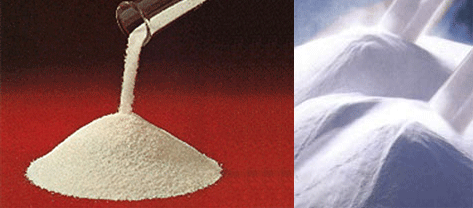
About 30% of world soda ash light production (90% of this is in U.S. alone) is from natural deposits and the rest 70% from synthetic process. Soda ash lightis a white, finely crystalline, hygroscopic powder. When freshly packed, contains at least 98.5% Na2CO3. It absorbs moisture and carbon dioxide from the atmosphere during storage and transit.
Soda ash lightis available in four standard forms as light, medium, dense and granular according to the bulk density to suit various industrial requirements. Soda ash lightis moderately soluble in water and the solution is strongly alkaline. Although it is low in toxicity, ingestion can be harmful. Product dust may produce irritation of eyes, nose, throat and lungs.
The raw materials and utility consumption by different processroutes have been tabulated. The most accepted technology for producing synthetic soda ash lightis ammonia-soda or Solvay process mainly because investment and maintenance cost is low compared to other processes



Connect with us





 For Buyer
  For Seller
  Help
Help 
 jakarta, indonesia
  Send Enquiry