

Company Information
 Member Since 7 Years
 Nature of Business Manufacturer
 GST No. 24AAMCA4757D1ZQ
Ask for more detail from the seller
Contact Supplier
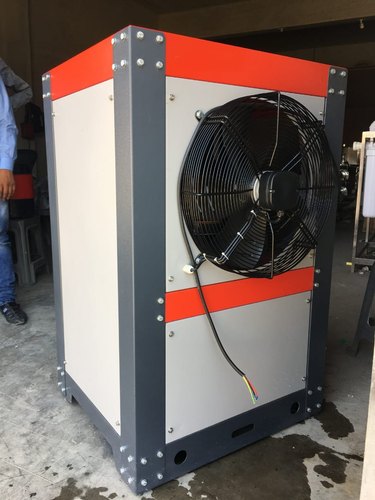
| Lower initial & running cost | Smaller capacity means cheaper equipment, less material cost, less installation expense. The electricity consumption is also lower compared to large chillers. |
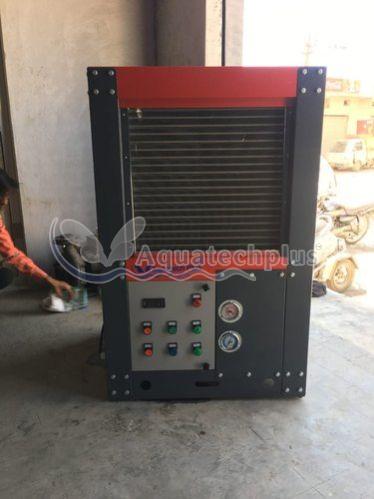
| Compact size / Less space needed | Easier to install, fits in smaller rooms or tight spaces. Easier to manage layout and piping. |
| Suitable for smaller loads & partial load operation | If your cooling requirements are modest (e.g. lab, small production line, small HVAC), then a 2 TR chiller can match the load well without large oversizing. |
| Quicker payback | Because investment and running costs are lower, the return on investment (ROI) tends to be faster for small‐scale uses. |
| Flexibility & modularity | It can be used to cool specific equipment (lasers, moulds, small process water loops) without needing a large centralized chiller plant. If loads increase, you can add more rather than replacing a big one. |
| Lower maintenance complexity | Fewer components, simpler system, easier access, less complicated piping/installation vs big chillers. Also easier to service. |
| Improved energy efficiency under part‐load | When used properly (i.e. not significantly oversized), a smaller chiller may run closer to its optimum efficiency more often. Less “wasted” capacity. |
| Faster response / control | Small chillers often respond more quickly to temperature changes, because less thermal mass to cool down. This helps for processes needing precise temperature stability. |
| Lower infrastructure needs | Less demand on supporting systems (power supply, foundation, piping, cooling water or ambient air etc.), especially if it’s air‐cooled. |
To be fair and help you decide, there are also some downsides or constraints to keep in mind:
If load growth happens (you need much more cooling later), a 2 TR unit may become undersized.
Efficiency isn’t always proportional: large chillers sometimes have better efficiency per TR at high loads.
Quality matters: a cheap 2 TR chiller might have poorer components, less durable, more frequent breakdowns.
Ambient temperature and environment affect performance; in hot climates, air‑cooled 2 TR units may struggle or cost more to run.
Maintenance access, pumping losses, and heat rejection capability still matter; even a small unit needs careful design to work well.
If you want, I can compare a couple of 2 TR chiller models for your region (Haryana / Ambāla), show prices and which ones give the best value. Do you want me to do that?



Connect with us





 For Buyer
  For Seller
  Help
Help 

 Kuvadva Road, Rajkot, Gujarat


 Send Enquiry