
Company Information
 Member Since 4 Years
 Nature of Business Manufacturer Year of Establishment 1995
Ask for more detail from the seller
Contact Supplier
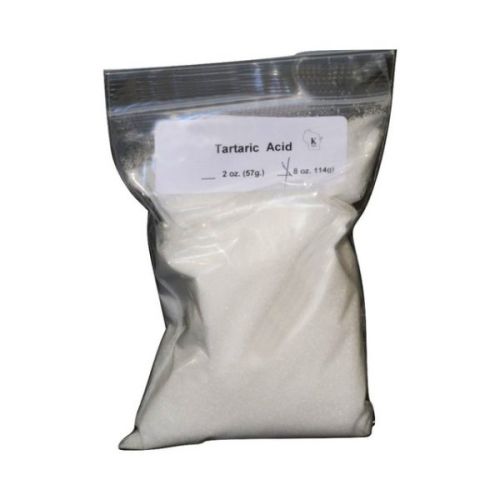
Making: Tartaric acid is the primary acid in grapes. It is more tart than the other two acids: malic and citric. It is the acid of choice for acid adjustments.
Usage: 1 teaspoon per gallon of increases the acid by 0.15%.
Cheese Making: Tartaric acid is a natural vegetable acid also derived from the seeds of the Caribbean tamarind tree. It is a coagulant used for making Mascarpone, an Italian soft cheese that is made from cream and has a rich velvety texture with a sweet delicate flavor.
Tartaric acid — formally known as dihydroxybutanedioic acid is a naturally occurring organic acid that’s found in a number of fruits and plants including bananas, grapes, citrus, and tamarinds. Its basic chemical formula is C4H6O6, and its structural formula is HO2CCH(OH)CH(OH)CO2H.
The preferred IUPAC name for tartaric acid is 2,3-dihydroxybutanedioic acid, and its CAS Number is 526-83-0. Other names for tartaric acid include racemic acid, threaric acid, paratartaric acid, and uvic acid.
The salt of tartaric acid — potassium bitartrate or cream of tartar — is a natural byproduct that’s formed during the winemaking process. When blended with sodium bicarbonate, it is used as a leavening agent — in the form of baking powder — in food preparation. Tartaric acid has the E number E334 and is used as an antioxidant in the food industry. Due to its palatable sour taste, it is also used as a flavoring agent.
The first known production of tartaric acid was from the residues of winemaking around 800 A.D. In 1769, a more modern production process based on fermentation was developed by Carl Wilhelm Scheele. For more information or access to high-quality tartaric acid from a trusted specialty and chemical distributor, contact Brenntag North America.



Connect with us





 For Buyer
  For Seller
  Help
Help 

 Watson Lane


 Send Enquiry