
Company Information
 Member Since 23 Years
 Nature of Business Retailer Year of Establishment 2002
Ask for more detail from the seller
Contact Supplier
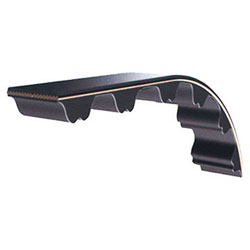
A timing belt is a type of cogged belt, usually made of reinforced rubber. Timing belts are used for power transmission or to interchange rotary motion and linear motion. In such cases, either high loads or maintaining a specific drive ratio are very important. A common non-automotive application of rubber timing belt is in linear positioning systems. Thus, the basic purpose of timing belt is to transfer driving force by connecting wheel transmission, chain transmission and belt transmission. Rubber belts are quieter in their operation, are less expensive and are mechanically more efficient. We have timing & polyflex V-belts in different nomenclature like: T5, T10, T20, AT5, AT10, AT20, H, L, XL, XH, XXH, MXL, 3M, 5M, 8M, 14M, etc.
Advantages
¤ Anti-wearing out
¤ Small elongation rate
¤ Strong
¤ Cost effective
¤ Anti-oil
¤ Anti-heat
¤ Anti-ageing
¤ Anti-ozone
¤ Simple transmission mechanism
¤ Light weight
¤ No Lubrication
¤ Less noise while running
¤ Easy for maintenance
Types of rubber timing belts
¤ Rubber synchronous driving belt: This is a special kind of rubber driving belt to transmit the mechanical driving force.
¤ Circular arc tooth belt: Used in sewing machinery, food processing equipment and small household electrical appliances. Composed of closed round rubber, teeth and attached belt or pulley.
¤ T-Type Belt etc.
Applications: Automobile Industry, Chemical fiber, Needlework equipment, Spinning equipment, marking machines, Printing machines, Office equipment, Communication equipment, Foodstuff machines, Chemical machines, Light industrial machines and Various precision machine tools and instruments.



Connect with us





 For Buyer
  For Seller
  Help
Help 
 Ajmeri Gate, Delhi
  Send Enquiry