
Company Information
 Member Since 10 Years
 Nature of Business Manufacturer Year of Establishment 2006
Ask for more detail from the seller
Contact Supplier
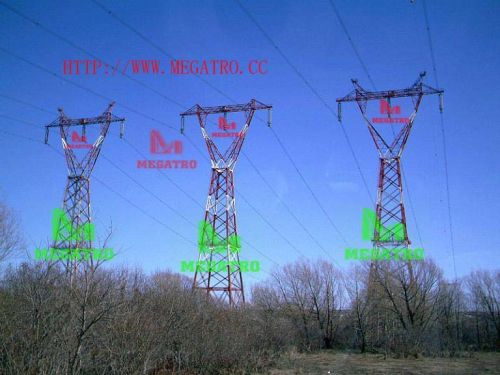
Two types of single-circuit 735 kV delta pylons near Saint-Jean-sur-Richelieu paralleled by a dual-circuit 315 kV line. The center 735 kV line uses a larger version delta pylon while the one to the right uses smaller one.
Hydro-Québec TransÉnergie uses several different types of electricity pylons to support their 735 kV power lines.[10] All of them are single-circuit, meaning that each pylon carries one power line with three bundles of four electrical subconductors separated by spacers,[8] with each bundle transmitting one phase of current.
The earliest type of tower used was a massive self-supporting delta pylon, or waist pylon,[41] which consumed 21 tonnes of steel per kilometre of line.[10] This type of pylon was used for the first 735 kV power line from the Manic-Outardes power stations to the load centre of Montreal.[35] There are two significant variations of the delta pylon; one has longer side crossbars such that all three bundles of conductors are suspended on V-shaped insulators.[42] The other has shorter side crossbars, such that the two outside bundles are hung on a vertical insulator string and only the middle bundle is hung with a V-shaped insulator.[43]
Over the years, Hydro-Québec researchers engineered a new type of pylon, the V-guyed tower, which reduced materials consumption to 11.8 tonnes of steel per kilometre of power line.[10] This type of tower also includes a variation with longer side crossbars, where all conductors are hung with a V-shaped insulator[44] and one with shorter side crossbar, where only the middle bundle hangs from the insulator and the side bundles are strung on vertical insulator strings.[45][46]



Connect with us





 For Buyer
  For Seller
  Help
Help 

 Qingdao
 Send Enquiry